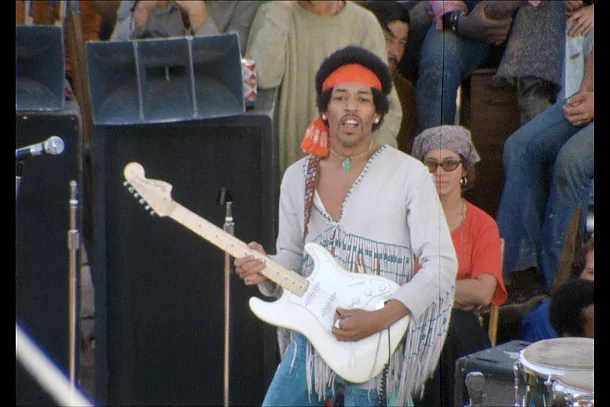
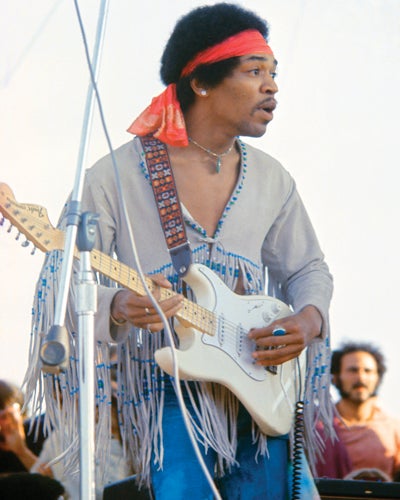
On Monday morning, August 18, 1969, Hendrix closed Woodstock at sunrise with a 17-song set. The guitar was a right-handed 1968 Olympic White Stratocaster — serial widely cited as 240981 — flipped and modified for left-handed stringing. It's commonly nicknamed "Izabella," after a song in that set, and today it's in MoPOP's permanent collection in Seattle.
Why This Guitar Matters
- Played by the most famous guitarist to headline the most famous festival in history, Hendrix's "Star-Spangled Banner" on Izabella became one of rock's defining moments
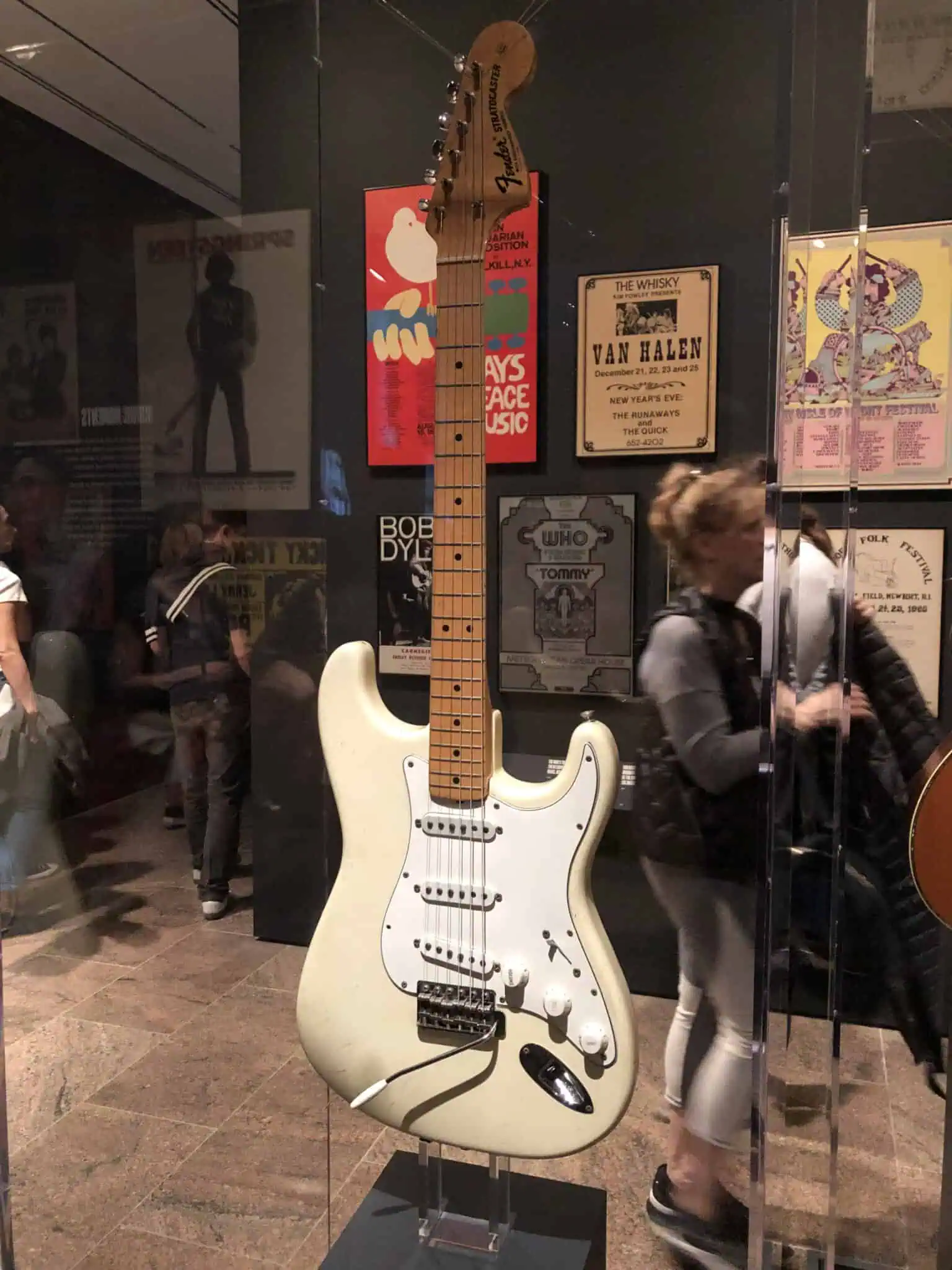
- The guitar is among the most technically documented: the Met's object record lists parts-level specs down to knob color, trem type, and explicit modification notes
- It survived intact — wear, cigarette burns, rusty strings, and all — and is viewable to the public at the MoPOP museum, where many of Hendrix's other guitars were lost, destroyed, or ended up in private collections
- Played upside down, strung in reverse, with nut and strap buttons modified to accommodate left-handed playing
- Sold at Sotheby's in 1990 for $324,000 — at the time one of the highest prices ever paid for a musical instrument at auction
The Instrument
Specs
| Feature | Detail | Source |
|---|---|---|
| Make / Model | Fender Stratocaster | — |
| Year / Parts era | 1968 | Metropolitan Museum of Art |
| Body | Alder, Olympic White finish | Metropolitan Museum of Art |
| Neck | Two-piece maple cap, no skunk stripe, heel truss rod | Metropolitan Museum of Art |
| Fretboard | Maple with black dot inlays | Metropolitan Museum of Art |
| Headstock | Large (post-CBS era), standard orientation but appears reversed due to playing it left-handed | Metropolitan Museum of Art |
| Pickguard | Three-ply white/black plastic | Metropolitan Museum of Art |
| Pickups | Stock Fender single-coil pickups | Metropolitan Museum of Art |
| Switching | Three-way selector switch | Metropolitan Museum of Art |
| Knobs | White plastic | Metropolitan Museum of Art |
| Bridge | Chrome synchronized tremolo | Metropolitan Museum of Art |
| Tuners | Nickel (stock) | Metropolitan Museum of Art |
| Left-hand mods | Nut reversed, strap buttons relocated | Metropolitan Museum of Art |
| Serial | 240981 | Fender; Christie's |
| Current location | MoPOP (Museum of Pop Culture), Seattle | MoPOP — Hendrix: Wild Blue Angel |
Izabella is mostly a stock 1968 Stratocaster, but a few details are worth noting. Olympic White was a custom color at the time, not a standard finish option. The nut was reversed and the strap buttons relocated for left-handed playing. And the neck is a maple cap construction, which Fender only used for a brief window in the late 1960s.
The maple cap is worth explaining. In the 1950s, Fender made true one-piece maple necks — neck and fingerboard from a single piece of wood. By the early 1960s, the standard production neck had switched to a separate rosewood fingerboard glued onto a maple blank. Maple fretboards subtly returned to the catalog as a custom option in the mid/late 60s, but Fender built them the same way the production line was already set up: a separate maple cap glued onto the neck blank rather than a true one-piece maple neck. The result has a subtle glue line that you'd miss if you didn't know to look.
Izabella's Tone and Rig Rundown
Hendrix played this guitar through a Marshall stack, typically a 100-watt Super Lead through 4×12 cabinets. His standard signal chain was a Dallas Arbiter Fuzz Face and a Vox wah, sometimes also including an octavia (octave fuzz) or a uni-vibe. The Strat itself is standard-issue 1968, which means alder body, two-piece maple neck (some argue maple caps had a distinct tone but this is controversial), and stock '68 single-coil pickups with no documented modifications to the electronics.
- Attributable to the guitar: 25.5" scale, standard single-coil output, alder body warmth, the specific resonance of a two-piece maple neck with heel truss adjustment. Being nearly stock, Izabella would have had a fairly classic late 60s Strat tone.
- Attributable to the orientation: : The bridge pickup's angle was inverted when Hendrix played it with the guitar strung left-handed and played upside down. This changes the EQ, making the bass strings brighter and tighter, and the treble strings softer and warmer than in the traditional right-handed playing orientation.
- Rig-dependent: Marshall stack pushing into saturation, Fuzz Face for lead distortion, Vox wah for filter sweeps
- Player-dependent: Hendrix's strumming attack, vibrato technique, and the upside-down orientation (strings flipped so wound strings were at the bottom — this changes how the pickups respond to the magnetic field and affects perceived brightness)
If you could only copy three things from this setup:
- Right-handed Strat strung upside-down — the wound string at the top, plain string at the bottom orientation changes pickup response in a subtle but real way
- A germanium Fuzz Face unit (early Dallas Arbiter or modern equivalent) — the Woodstock lead tone lives in that fuzz
- A Vox wah swept slowly and deliberately, more as a filter than a wah
Provenance: Where It's Been
How the artist got it
Fender's account states the guitar was purchased new at Manny's Music on 48th Street in New York City, most likely in the fall of 1968. The official Hendrix editorial uses the same Manny's claim and frames the purchase as sometime around fall 1968, placing the guitar in Hendrix's hands roughly a year before Woodstock. The Met's own record simply dates the instrument to 1968 without specifying the purchase story.
Ownership timeline
| Period | Owner | How acquired | Notable changes |
|---|---|---|---|
| Fall 1968 | Jimi Hendrix | Purchased new, Manny's Music, NYC | Nut reversed, strap buttons relocated for left-hand stringing |
| Shortly before Sept 18, 1970 | Mitch Mitchell | Gift from Hendrix | None documented - Mitchell left it untouched before the service by Marten |
| April 25, 1990 | Gabriele Ansaloni | Purchased at Sotheby's rock memorabilia auction, $324,000 | Pre-sale service by Neville Marten (restring, truss rod, setup) |
| 1993 | Paul Allen | Private sale, rumored to be approx. $2m | None documented |
| 2000 | MoPOP (Museum of Pop Culture, Seattle) | On loan or acquired from the Allen estaste (Paul Allen founded MoPOP), displayed indefinitely but occasionally loaned out | None |
| Temporarily, in 2019 | On loan to The Metropolitan Museum of Art | Loan from MoPOP, displayed in "Play It Loud" exhibition | None |
Timeline: How It Changed
| Era | What changed | Why | Evidence |
|---|---|---|---|
| 1968 (before Woodstock) | Nut reversed, strap buttons relocated to opposite horn | To convert a right-handed guitar for Hendrix's left-handed playing style | Met object record; Hendrix editorial |
| By 1990 | Nut worn from use; frets tarnished; strings rusted; cigarette burns on headstock; finish staining on body | Years of heavy use and storage | Neville Marten, MusicRadar (2008) |
| April 1990 | Pre-auction service: strings replaced, truss rod adjusted, full setup | Preparation for Sotheby's sale | Neville Marten, MusicRadar (2008) |
When Neville Marten serviced the guitar before the 1990 Sotheby's sale, he found it exactly as you'd expect from a guitar that had been heavily used and then stored for 20 years: the reversed nut needed attention, frets were tarnished, strings were corroded, and the headstock had cigarette burns. The strap was still in the case. None of that was fixed cosmetically — only functional work was done. The cigarette burns, the body staining, the general road wear are all still there.
Visual Record
Essential Listening
- "The Star-Spangled Banner" (Woodstock, Aug 18, 1969) — The defining performance on this guitar. Hendrix coaxes bombs, sirens, and screams out of a Stratocaster with no effects beyond fuzz and vibrato arm. It's a six-minute argument for what electric guitar can do.
- "Voodoo Child (Slight Return)" (Woodstock, Aug 18, 1969) — The wah-and-fuzz interplay here is Izabella at full volume, fully wrung out. The studio version exists, but the Woodstock performance is longer, looser, and rawer.
- "Izabella" (First Rays of the New Rising Sun, studio recording 1969–70) — The song the guitar was named for. A studio track recorded in roughly the same era as the Woodstock performance.
- "Hear My Train A Comin'" (Woodstock, Aug 18, 1969) — A slow blues that gives you an extended look at Hendrix's picking-hand attack and vibrato in a relatively clean context.
- "Purple Haze" (Woodstock, Aug 18, 1969) — The set closer. By this point the crowd had been awake all night; Hendrix was playing to maybe 50,000 of the original 400,000. The energy is different — looser, almost private — and it shows in the playing.
- "Spanish Castle Magic" (Woodstock, Aug 18, 1969) — One of the more extended performances of the Woodstock set, and a good study in how Hendrix moved between rhythm and lead within a single song with Gypsy Sun & Rainbows.
- "Red House" (Woodstock, Aug 18, 1969) — Blues at sunrise. Slower and more deliberate than any of the rock tracks; the guitar's single-coil clarity is more audible here than anywhere else in the set.
Market Context
The comparable basket
"1968 Fender Stratocaster, Olympic White, alder body, two-piece maple neck, standard-issue pickups, player grade or better"
The Woodstock Strat is a production instrument with no unusual factory specs. What makes it Izabella is documented use, not exotic parts. Any honest "comparable" is a stock 1968 Strat in Olympic White — the market cares about originality, condition, finish color, body date, and neck date, and fretboard material, in roughly that order.
Relevant AxeDB model pages:
Hendrix Signature Stratocaster (MIM)
American Performer Stratocaster (if you just want the big headstock)
What actually drives price in this segment
- Finish color — Olympic White ages dramatically (yellows, checks, flakes) and is harder to find in clean condition than sunburst; original finish in any condition adds significant premium over refin; custom colors are more rare and drive a premium over the default sunburst finish
- Neck date and body date — CBS-era (post-1965) Strats have varying quality control; 1968 is squarely post-CBS, and neck/body date alignment within the same year matters to collectors; Fender did not make many Strats in '68, making these relatively rare and significantly more valuable than a '70 Strat with similar quality and specs
- Maple cap neck — a detail that's more construction curiosity than tonal holy grail, but somewhat uncommon and drives collectability
- Pickup originality — original gray-bottom pickups from this era are the baseline; later replacements drop value meaningfully
Famous-guitar premium vs instrument premium
The guitar itself sold for $324,000 in 1990. At current market rates for provenance items of this caliber — and given 35 years of appreciation — the number would be well over $1m. That's a provenance valuation, not an instrument valuation. A player-grade 1968 Olympic White Strat can be found for $8,000–$18,000 depending on originality and condition. Same guitar, different story.
Get Your Own
Off the shelf
Fender's Jimi Hendrix Stratocaster (currently around $900 new) gets the fundamentals right for the price: alder body, maple neck, "Reversed Headstock" configuration to mimic the upside-down Strat look, and a reverse-slanted neck pickup. It's an honest tribute instrument at an accessible price point. For something closer to the actual experience, the Fender Custom Shop makes various Hendrix tribute and Woodstock-spec builds — prices vary but typically land in the $3,500–$6,000 range for Custom Shop production pieces.
Vintage sweet spot
The straightforward answer is a post-CBS, large-headstock 1960s Stratocaster in Olympic White — but that's also the expensive answer. A 1968 Strat in this finish with reasonably original parts will run $9,000–$20,000 depending on the specifics. The fact that Hendrix played one of these alone makes it more expensive to find an honest vintage homage. If Olympic White pushes the budget, a matching-era Strat in sunburst (the default factory finish) or black (Hendrix's other commonly-played finish in this era) will give you the same neck profile and pickup voicing for meaningfully less. For the "Hendrix feel" rather than the exact guitar: look for a 1966–1969 Strat with a thick C-to-D neck profile and original pickups.
Watch out for refins — Strats from this era were refinished in enormous numbers, and Olympic White in particular is used in refinishes where people wanted the Hendrix look. Ask for UV light photos and look for miscolorerd paint around the pickup routes and in the neck pocket. Period-correct pickguard screws matter too; they're often swapped.
Build your own
Parts list:
- Body: Alder, Olympic White finish — period nitro or nitro-over-poly reissue lacquer; avoid thick poly for this build
- Neck: One-piece or two-piece maple, no skunk stripe, heel truss rod; period C profile
- Pickups: Fender Custom Shop '68 Reverse Wound Middle or equivalent; or Texas Specials for more output, though that's slightly off-era
- Bridge: Vintage 6-saddle synchronized tremolo, chrome
- Hardware: Nickel Kluson-style tuners; white plastic knobs
- Setup targets: String at factory height or slightly above; check nut slot depth (reversed nut if building a true left-hand-style configuration); 10–46 roundwound, standard pitch
Myths and Disputes
- Myth: Izabella was the last guitar Hendrix ever played in concert. → Reality: Fender asserts this, but the Met says "used until about 1970" and the Hendrix estate editorial frames it as played from October 1968 through September 1970 without claiming exclusivity over his final shows. Treat this as attributed, not confirmed.
- Disputed: Sale price — some sources cite $324,000 USD, others cite £198,000 GBP. → Best read: The April 1990 Sotheby's sale is documented in contemporaneous press (Deseret News, April 26, 1990) at $324,000 paid by Richard Pugliese. The £198,000 figure likely reflects a slightly different accounting (hammer price vs buyer's premium, or a currency conversion from the auction context). Both figures are real; neither is a fabrication.
- Myth: "Izabella" was played on "Purple Haze" at Woodstock because Hendrix always used this guitar for that song. → Reality: Hendrix used multiple guitars across different shows. The documented fact is that Izabella was the guitar for the entire Woodstock set. Guitar-by-song attribution at other performances would require show-specific documentation.
FAQ
What year is Izabella, and does it have a serial number? The Met's object record dates the guitar to 1968. The serial number 240981 is cited by Fender and cross-referenced in a Christie's auction catalog via an inventory document; the Met record confirms detailed construction but does not publish the serial in accessible metadata fields. High confidence: it's a 1968 instrument with serial 240981.
Why is it called Izabella? Hendrix wrote a song called "Izabella" — recorded in 1969 and released posthumously on First Rays of the New Rising Sun — and performed it at Woodstock with this guitar. The name stuck to the guitar.
What pickups were in it? Standard 1968 Fender Stratocaster single-coil pickups. The Met record confirms three single-coil pickups, but pickup-specific specs (maker's marks, DC resistance, pole piece dates) are not published in accessible museum documentation. No modifications to the electronics are documented.
How did Hendrix play a right-handed guitar left-handed? He flipped a right-handed Strat over and strung it for left-hand playing — nut reversed and strap buttons relocated. This meant the controls, pickguard, and tremolo arm were all on the "wrong" side from a conventional standpoint. The upside-down orientation also means the wound strings are at the bottom when he's playing, which some argue affects the pickup's response slightly differently than a proper left-hand guitar.
What strings did Hendrix use? Various gauges are documented across his career, but he was commonly associated with light-to-medium sets — often .010–.038 on some accounts. The Woodstock guitar was found with rusted strings in 1990, 20 years after the performance, so no definitive gauge call can be made from examination alone. The Neville Marten account mentions restringing the guitar before the auction.
Where is the guitar now? In MoPOP's permanent collection in Seattle. It was on loan to the Metropolitan Museum of Art in New York for the "Play It Loud" exhibition in 2019, but MoPOP holds the underlying collection.
How much would it sell for today? The provenance value is speculative, but $324,000 in 1990 adjusted for inflation and 35 years of growth in the vintage instrument market would put a floor auction estimate in the millions. The instrument itself — a player-grade 1968 Olympic White Strat — trades for $9,000–$20,000 on the open market depending on originality. The rest is Woodstock.
What amp did Hendrix use at Woodstock? Marshall Super Lead 100-watt heads through 4×12 cabinets. His rig also included a Dallas Arbiter Fuzz Face and a Vox wah. The guitar and amp were both turned up — the clean headroom of a Fender was not part of this setup.