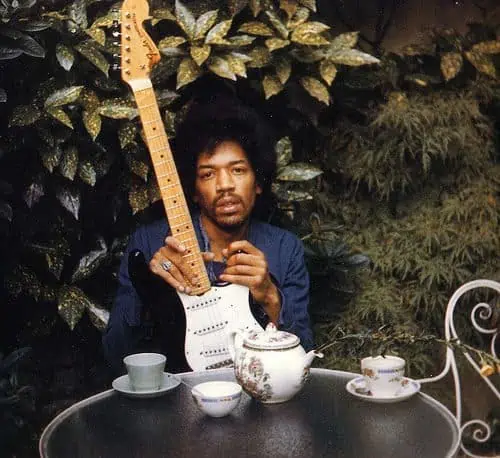
On September 17, 1970, Monika Dannemann photographed Jimi Hendrix at their London flat holding a black Stratocaster. Those photographs — taken one day before his death — are among the most quietly devastating images of Hendrix because he appears unhurried. No stage, no crowd. Just a man and a guitar he knew well. That instrument is what has come to be called "Black Beauty."
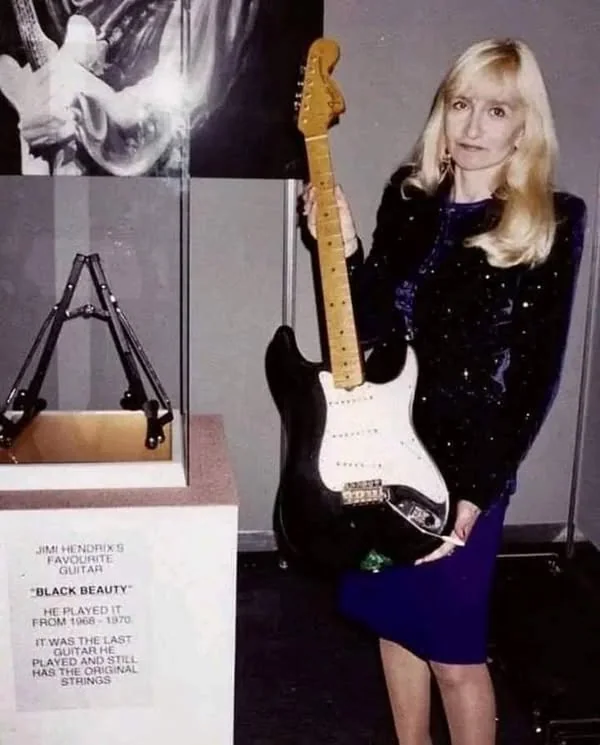
The problem is that almost everything else is about this guitar thinner than you'd expect. No published serial number, no public inspection, no museum record. What keeps it in the conversation is the custody story — held privately by the Dannemann family since his death — and a single strong claim from guitarist Uli Jon Roth: that it's the only Hendrix guitar preserved exactly as he left it.
This article is an evidence ledger: what the photographs confirm, what witnesses claim, and what would need to surface to turn lore into documentation.
Why This Guitar Matters
The photographs are the irreducible fact. They place Hendrix with a specific black Stratocaster one day before he died — not at a show, not in a tour photo, but in a private setting, which gives them a different weight than performance imagery. It was a regular in his stage rotation, including for the famous New Years shows at the Fillmore East which later became the Band of Gypsys album. It's also a widespread, albeit unsourced piece of internet lore that it was Hendrix's favorite. I don't think that ever came out of his mouth in an interview or other first hand source so we'll probably never know.
Beyond the photographs:
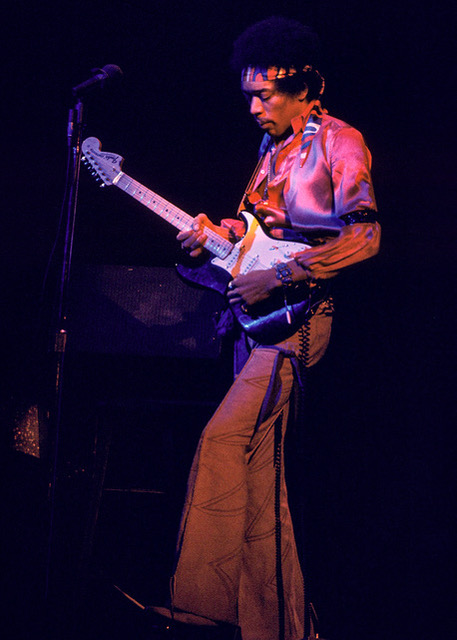
- The black Strat appears in his Fillmore East and Isle of Wight shows (January 1 and August 30, 1970), two of his most famous live shows
- The "unchanged" claim — that it still has the strings, setup, and configuration from when Hendrix last played it — is remarkable if true; no other Hendrix guitar carries that provenance
The Instrument
Specs
Black Beauty has never shown up in a museum exhibit or auction, so there's no independent, verified documentation of its specs or condition. The specs below reflect what can be inferred from photographs and what Uli Jon Roth has stated in interviews — treat them as testimony and photographic inference, not verified object data.
| Feature | Detail | Source |
|---|---|---|
| Make / Model | Fender Stratocaster | Self evident |
| Year | 1968 | Guitar World (Uli Jon Roth interview) |
| Finish | Black | Photos |
| Serial number | Unknown | — |
| Neck / fingerboard wood | Maple fingerboard, two-piece (maple cap) | Dannemann photographs, Sept 17, 1970; GroundGuitar blog |
| Pickup type, specs | Not documented, likely stock | — |
| Bridge type | Not documented in accessible sources | — |
| Modifications | None claimed; described as "unchanged" | Guitar World (Uli Jon Roth interview) |
| Condition claim | "Only Hendrix guitar still in exactly the same condition as he left it" | Guitar World (Uli Jon Roth interview) |
| Current location | With Dannemann family, per Roth (private) | Guitar World (Uli Jon Roth interview) |
Black Beauty's Tone and Rig Rundown
The Band of Gypsys Fillmore East shows — where Roth claims Black Beauty was used — are the best documented context for this guitar's likely sound. Hendrix's rig at those shows: 100-watt Marshall Super Lead through 4×12 cabinets, Dallas Arbiter Fuzz Face (germanium), and a Vox wah. He was also running a Univox Uni-Vibe on several numbers, and occasionally an Octavia (octave fuzz). The Band of Gypsys period sounds fundamentally different from the Experience era — slower tempos, more deliberate bends, heavier low-end emphasis, more space.
The guitar itself, assuming stock 1968 specs, would have been similar in construction to the Woodstock Strat: alder body, maple neck, standard late-'60s single-coil pickups.
- Attributable to the guitar: Late-'60s Strat single-coil character — clear highs, defined low end, the slight quack of a maple-board instrument. If stock, similar in construction to Izabella.
- Rig-dependent: The Marshall/Fuzz Face pairing is the core of the Band of Gypsys sound — thick, compressed, singing sustain on lead lines. The Uni-Vibe adds the churning, underwater wobble audible on "Machine Gun."
- Player-dependent: Hendrix's Band of Gypsys playing is more restrained than Woodstock — wider vibrato, longer held notes, more space between ideas. The guitar is responding to a different approach.
If you could only copy three things from this setup:
- A germanium Fuzz Face — the Band of Gypsys lead tone is built on that compression and sag
- A Uni-Vibe (or close equivalent) — "Machine Gun" doesn't sound like "Machine Gun" without it
- Play slower than you think you should — Hendrix's late-era phrasing is the hardest thing to replicate
Provenance: Where It's Been
How the artist got it
The guitar's acquisition by Hendrix is not documented in accessible sources. It appears in use and photography during his final year — at the Isle of Wight (August 1970) and in the Dannemann photographs (September 17, 1970).
Ownership timeline
| Period | Owner | How acquired | Notable changes |
|---|---|---|---|
| By mid-1969 | Jimi Hendrix | Not documented | None documented |
| Sept 18, 1970 | Monika Dannemann | Remained at the flat after Hendrix's death; exact legal transfer not documented | None claimed |
| 1996–present | Dannemann family | Dannemann died April 5, 1996; guitar remained with family per Roth | None claimed — "unchanged" per Roth |
The post-Dannemann chain deserves a direct note: no estate dispute, auction record, or legal proceeding involving the guitar has surfaced in accessible sources. That might mean the transfer was clean and uncontested. It might mean it simply hasn't been documented publicly. For a collector or curator making a provenance judgment, that silence is a question mark worth naming. The Woodstock Strat has a chain of title that satisfies museum standards; this one does not, at least not publicly.
Timeline: How It Changed
| Era | What changed | Why | Evidence |
|---|---|---|---|
| None claimed | Guitar described as "unchanged" throughout its post-Hendrix history | — | Guitar World (Uli Jon Roth interview) |
The absence of documented modifications is the story. If accurate, this is the only Hendrix guitar where you could theoretically still read the last strings he chose, the setup he preferred at the end. That's an extraordinary claim for any instrument — extraordinary enough that the absence of a published inspection report is hard to explain away as simple privacy. The guitar is apparently accessible to Roth; the documentation would strengthen the claim substantially. Its absence doesn't disprove anything, but it leaves the provenance resting entirely on testimony.
Visual Record

Essential Listening
These recordings represent contexts where a black Stratocaster is either confirmed or credibly claimed to have been in Hendrix's hands.
- "Machine Gun" (Band of Gypsys, Fillmore East, Jan 1, 1970) — Per Roth, Black Beauty was the guitar here. Attribution aside, this is the definitive late-Hendrix recording: 12 minutes of blues improvisation, the Uni-Vibe churning underneath, Hendrix's phrasing slowed down and stretched out in a way that sounds completely different from Woodstock. Notes held twice as long, bends wider, more space.
- "Who Knows" (Band of Gypsys, Fillmore East, Jan 1, 1970) — The show opener. The Band of Gypsys configuration sounds fundamentally different from the Experience — less pyrotechnics, more groove.
- "Power of Soul" (Band of Gypsys, Fillmore East, Jan 1, 1970) — Slower and funkier than anything from the Experience catalog; the guitar sits back in the arrangement in a way Hendrix rarely did earlier.
- Isle of Wight set (Aug 30–31, 1970) — Photo evidence documents a black Strat at this performance. Whether it's Black Beauty or another instrument isn't confirmed. The complete concert is on film.
- "Dolly Dagger" (Rainbow Bridge, recorded Aug 1970) — Late-era studio track from the same window as the Dannemann photographs. Rig reference if not specific-guitar reference.
Market Context
The comparable basket
1968 Fender Stratocaster, black finish, alder body, maple neck, large headstock, original pickups — factory black preferred, player grade
A genuine factory-black 1968 Strat is rare, and the reason black Strats carry unusual scrutiny is Hendrix. Black is a common refinish target in the late 60s/early 70s Strat market precisely because of the association. That makes finish verification the first and most consequential question for any comparable instrument, if you're looking for a near-equivalent vintage piece.
Finish originality matters more here than in almost any other segment of the vintage market. A confirmed Custom Color black from 1968 commands 50–100% price premium over a standard sunburst. A refinish in black drops significantly below sunburst, both because the original finish is gone and because the instrument is now an object of suspicion. The determination is binary — factory or refinish — and it shapes everything downstream.
Any Strat from approximately '67 through '69 should be a fair comp. '66 and earlier gets too far into the CBS "transition" era vs. Black Beauty's true early-CBS vibe. '70 and onward, you'll start seeing bullet truss rods, skunk stripe / non-maple-cap necks, and three-bolt necks, which Hendrix's strats didn't have.
Relevant AxeDB model pages:
Vintage Stratocaster (pre-2000)
Jimi Hendrix Signature Stratocaster
Custom Shop Stratocaster (Hendrix and Landeau artist models, any '68-era reproduction)
American Performer Stratocaster (a modern large-headstock model)
What actually drives price in this segment
- Factory black vs. refinish — the first and most important question; see above
- Pickup originality — original gray-bottom single-coils from this era are the baseline; replacements move the needle down meaningfully even if period-correct
- Neck and body date — 1968 is squarely post-CBS; Fender production that year was inconsistent. A confirmed 1968 neck/body date match matters more than in higher-volume years.
- Headstock condition — late-'60s Strat headstocks crack and get repaired; repaired cracks reduce value even on otherwise clean instruments
Famous-guitar premium vs instrument premium
Black Beauty has never come to auction and shows no signs of doing so. If it did, the Dannemann photographs and the "unchanged since 1970" provenance would drive a price far into the millions — comparable Hendrix-associated Strats have sold in the high six to seven figures, and this one has an unusually specific custody narrative. A player-grade 1968 Strat in any finish, with original or close-to-original parts: $8,000–$18,000. A '68 custom shop: $3500 - 5000.
Get Your Own
Off the shelf
Fender's Jimi Hendrix Stratocaster (around $900 new) is the straightforward answer. It's configured for upside-down left-handed playing with a reverse-slanted neck pickup. Black finish is available. For the Band of Gypsys sound specifically, the guitar matters less than the signal chain — you want a cranked Marshall or equivalent, a germanium Fuzz Face, and a Uni-Vibe.
Some would look past this one, though, due to being made in Mexico, the poly finish, and due to the reverse headstock being cosmetric vs. Jimi's strats harving standard headstock orientation and merely being played upside down. The cosmetically-flipped headstock isn't for everyone.
Vintage sweet spot
A player-grade late-1960s Strat in black, with as much original hardware as you can find. Budget $10,000–$18,000 for a genuine 1968 with original or period-correct parts. If black finish is out of reach, any 1967–1969 Strat gives you the neck profile, scale length, and pickup character of the era.
The main thing to verify before buying a black late-'60s Strat: UV light on the body routes and neck pocket. Mismatched paint color under UV — whiter than the body surface — is the standard tell for a refinish. Also check the pickguard screw holes; refin jobs often leave slight discoloration or filler around them. A seller who won't provide UV photos for a black Strat in this price range is worth walking away from.
Build your own
Parts list:
- Body: Alder, black finish — period nitro lacquer; avoid thick poly
- Neck: One-piece maple, medium C-to-D profile, maple board; large headstock, optionally reversed
- Pickups: Fender Custom Shop '69 single-coils or equivalent — the Band of Gypsys recordings suggest a clean, wide-frequency single-coil with good low-end extension
- Bridge: Vintage 6-saddle synchronized tremolo, chrome
- Hardware: Nickel tuners, white plastic knobs
- Setup targets: .010–.046 or .010–.038; trem floating; medium-low action
Myths and Disputes
- Disputed: Which performances involved Black Beauty → Best read: A black Strat is confirmed at Isle of Wight (photographic) and claimed for Band of Gypsys "Machine Gun" (Roth testimony, single-witness, no corroborating performance photograph identified). The Dannemann flat photographs are the most confirmed association. Treat the three contexts separately.
- Myth: Black Beauty has a verified serial number → Reality: No serial number is published in accessible primary sources. Serial attributions in secondary gear journalism should be treated as unverified until confirmed by neck plate photography from an independent source.
- Claimed: "The only Hendrix guitar in exactly the same condition as he left it" → What verification requires: Original strings (identifiable by ball end stamps and corrosion patterns), original solder joints, period-correct parts throughout, and a serial number tracing to 1968 production. None of that documentation has been published. The claim may be accurate; without a public inspection report, it remains testimony.
FAQ
Did Hendrix actually play it on "Machine Gun"? Per Roth's account, yes. Per independent documentation, the attribution is unconfirmed. The Band of Gypsys Fillmore shows are extensively recorded, but guitar-to-track attribution requires visual documentation — and no published performance photograph from those shows has been identified that confirms which instrument Hendrix used. Roth had direct access to Dannemann and handled the guitar, which makes his testimony meaningful. But it is single-witness testimony, and that's the honest answer.
What is Black Beauty, exactly? A black 1968 Fender Stratocaster used by Hendrix in the final year of his life, now held privately by the Dannemann family. The name comes from the finish and from Uli Jon Roth's association with the guitar through his connection to Monika Dannemann.
Where is it now? With the Dannemann family, per Roth. It has not been publicly displayed, auctioned, or loaned to a museum in any documented case.
Is it really unchanged since Hendrix played it? That's the claim. To verify it, you'd need an independent inspection: original strings identifiable by corrosion and ball end stamps, original solder joints, period-correct parts throughout, and a serial number confirmed to 1968 production. None of that documentation has been published. The claim may be entirely accurate — but the absence of a published inspection, given how much it would strengthen the provenance, is itself something worth noting.
What's the most documented Hendrix guitar? The Woodstock Strat (serial 240981, permanent collection at MoPOP in Seattle). The Met's archived object record covers specs down to knob color and trem type, with multiple independent sources for provenance and modification history.
What's the closest guitar I can actually buy? A late-1960s Strat in black — factory color preferred, refinishes are common. The Fender Jimi Hendrix Stratocaster (around $900) is the production answer. See the vintage Stratocaster page for used market data on period instruments.