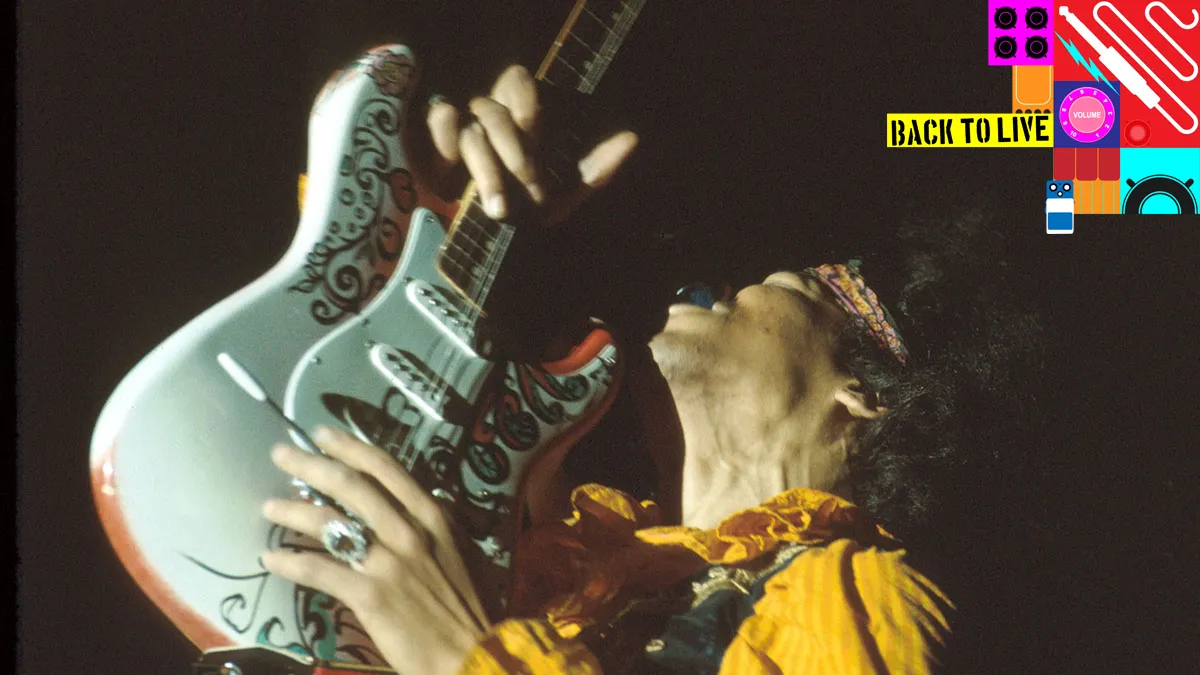
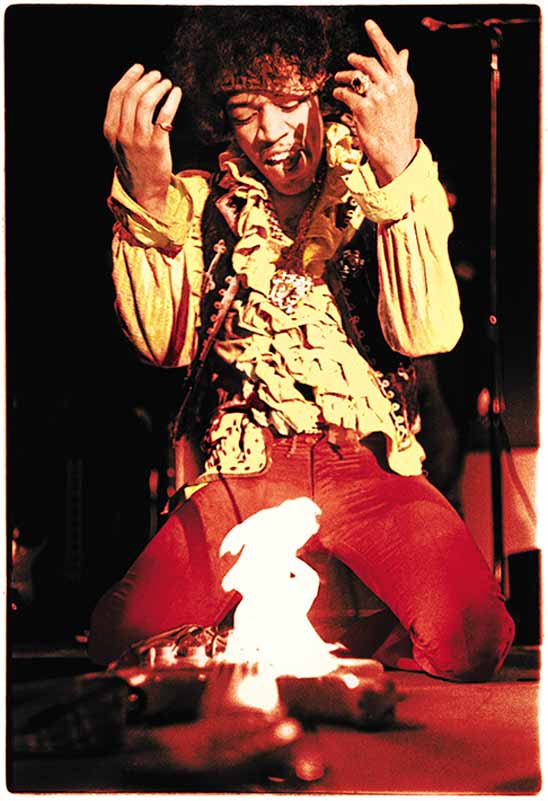
Most guitars are famous for what was played on them. The Monterey Strat is famous for what was done to it. On June 18, 1967, Jimi Hendrix closed his Monterey Pop Festival set by kneeling on stage, applying lighter fluid to his Stratocaster, kissing it, lighting a match, and then smashing the burning guitar against the stage.
The whole sequence was photographed by Ed Caraeff, who was 17 and had talked his way backstage. That matters more than it sounds. Hendrix had burned a guitar at a London show three months earlier — March 31, 1967 — but that moment is a footnote. Monterey became the canonical guitar-burning almost entirely because Caraeff was in the right spot with a camera, and D.A. Pennebaker was there with a film crew. The images became some of the most reproduced photographs in rock history. This is a story about what was documented, not just what happened.
The surviving fragment is held by MoPOP in Seattle and was displayed at the Metropolitan Museum of Art during the 2019 "Play It Loud" exhibition. The Met's material description is worth pausing on: wood, metal, nail polish. The nail polish Hendrix applied the night before — flowers and ornate imagery — is listed as a constituent material of a museum artifact alongside wood and metal. Most guitars end up in collections because of serial numbers and pickup specs. This one is partly defined by its nail polish.
Why This Guitar Matters
The event and the artifact are two different things, and they matter for different reasons.
The event — Monterey, June 18, 1967 — was Hendrix's American mainstream breakthrough. He had been building a reputation in the UK for nearly a year; this performance ended the gap in one set. The destruction is what defined the moment visually, but the set itself — "Killing Floor" through "Wild Thing" — is the musical document. The burning is inseparable from the performance because of what it represented: a deliberate, theatrical, irreversible gesture at a critical moment in his career.
The artifact — the fragment at MoPOP — matters for a different reason. The nail polish and spray paint Hendrix applied the night before survived the fire and impact. They are physically present on the object the Met describes. You are looking at the decoration on the guitar as Hendrix left it, not a reconstruction or a photograph. For a guitar that exists otherwise only in film and photographs, that's something.
The practical points, in order of what they prove:
- The fragment is the only widely documented surviving piece; its dimensions, materials, and condition are confirmed in the Met's archived object record
- The photographs and film are why Monterey, rather than London in March, is the reference — documentation made it canonical
- Monterey was Hendrix's American breakthrough; the burning is inseparable from that moment in the historical narrative
- Unlike most guitars in this series, the Monterey Strat matters as an artifact of a documented event, not as a working instrument with a recording history
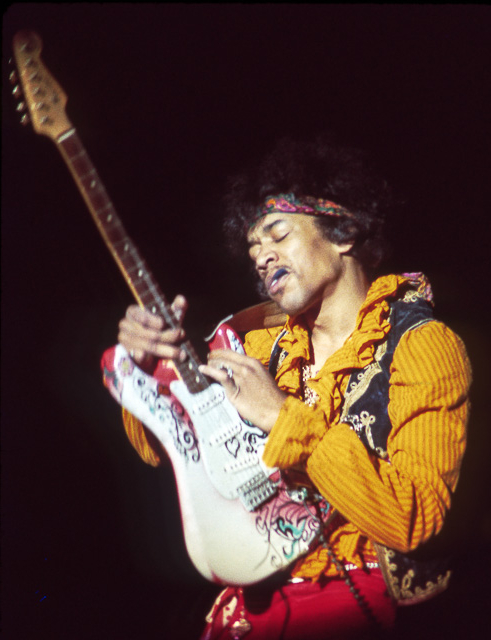
- It looks cool. Hendrix's hand-painted design is a one-of-one, completely unique finish that feels inseparable from 1967: flower power, the Summer of Love, and the counterculture
The Instrument
Specs
The guitar was destroyed on June 18, 1967. The specs below cover the surviving fragment — confirmed from the Met's object record — and what can be inferred about the intact instrument before destruction. Almost nothing about the pre-destruction guitar is documented with spec-level precision.
| Feature | Detail | Confidence | Source |
|---|---|---|---|
| Surviving Artifact | "Fragment of Monterey Pop Stratocaster" | Confirmed | Metropolitan Museum of Art |
| Year | 1964-65 (GroundGuitar argues its small headstock and spaghetti logo would have been phased out by mid '64, while Wheeler's Stratocaster Chronicles claims it was a '65) | Moderate | GroundGuitar, Stratocaster Chronicles |
| What survived | Lower treble bout including output jack, wiring, and part of control cavity | Confirmed | Metropolitan Museum of Art |
| Fragment dimensions | 11 5/8" × 8" × 2 1/8" | Confirmed | Metropolitan Museum of Art |
| Fragment weight | 1.3 lb (0.6 kg) | Confirmed | Metropolitan Museum of Art |
| Fragment materials | Wood, metal, nail polish | Confirmed | Metropolitan Museum of Art |
| Decoration | Spray-painted and painted with nail polish designs | Confirmed | Metropolitan Museum of Art |
| Base finish color | Fiesta Red | Uncertain | Hendrix estate, Monterey narrative |
| Serial | Not preserved; intact guitar destroyed | Unknown | — |
| Pickup type, pot values, wiring | Only partial wiring referenced in fragment record; intact guitar's electronics undocumented | Unknown | Metropolitan Museum of Art |
| Current location | MoPOP (Museum of Pop Culture), Seattle; on loan to The Met for "Play It Loud" (2019) | Confirmed | Metropolitan Museum of Art |
The decoration being part of the Met's official material description is not a biographical footnote — it's the reason the fragment is what it is. The nail polish and spray paint are listed as constituent materials alongside wood and metal. Hendrix applied the paint the night before the performance, reportedly with Eric Burdon of the Animals present. That paint is what survived. The rest of the intact guitar's specs are unrecoverable: no neck, no headstock, no pickups, no serial number. What you can know about this guitar is bounded by that fragment, limited videos and photos of the Monterey set, and conflicting secondhand accounts.
Monterey's Tone and Rig Rundown
This guitar has no known studio recording legacy. It existed for only one performance in its iconic painted form and was destroyed by the show's end. Hendrix was photographed playing a fiesta red strat earlier that year, which may have been the same instrument, but it's not completely clear. As a tone reference, the sound of that set lives in the rig and the player. The surviving fragment doesn't preserve enough to make spec-level claims about this particular instrument; what the Monterey recording actually documents is Hendrix plus his 1967 rig, which any comparable mid-'60s Strat would have delivered similarly.
Hendrix's Monterey rig: Marshall stack (the Experience was using Marshall Super Leads by this point), Dallas Arbiter Fuzz Face (germanium), and a Vox wah. Earlier in the set he was running relatively clean rhythm passages; by "Wild Thing" the fuzz was wide open.
- Attributable to the guitar: Standard mid-'60s Strat single-coil character — clear highs, moderate output, responsive to pick attack. The Monterey recording doesn't reveal anything that distinguishes this instrument from any comparable 1964 Strat.
- Rig-dependent: Marshall saturation and the Fuzz Face are doing the heavy lifting on lead passages. The wah appears in rhythm sections and transitions throughout the set.
- Player-dependent: 1967 Hendrix is faster and more overtly showman-like than the later Band of Gypsys era — wider pitch range, more aggressive picking, the whammy bar used as punctuation. He also played his guitar upside down, which changes the character of the angled bridge pickup and will be hard to reasonably mimic without similarly buying a wrong-handed instrument.
If you could only copy three things from the Monterey sound:
- A germanium Fuzz Face — germanium transistors compress and clip differently than silicon; the attack hits and then the sustain smooths and blooms rather than staying hard-edged. That bloom is the tone. A silicon fuzz in the same circuit sounds faster and brighter; it's a different texture entirely.
- A Marshall pushed past clean — the amp is generating its own saturation above the Fuzz Face's contribution. The lead passages are two stages of saturation in series — fuzz into an already-overdriven amp input — which produces something warmer and more compressed than either alone.
- A wah used rhythmically, not just for solos — at Monterey, the wah appears in rhythm passages, rocked in time with chord changes. That's a different technique than the sustained wah used for lead lines, and it's part of what makes the set sound like it does.
Provenance: Where It's Been
How the artist got it
The guitar's pre-Monterey provenance is not well documented. It was in Hendrix's possession by June 1967 at the Monterey festival. He was also seen playing a fiesta red strat earlier that year, which may have been the same guitar pre-paintjob. The official estate narrative describes him applying spray paint and nail polish to it the night before the performance — flowers and ornate imagery — with Eric Burdon of the Animals aware of or present for the process. Beyond that, the guitar's purchase history and prior use are unspecified.
Ownership timeline
| Period | Owner | How acquired | Notable changes |
|---|---|---|---|
| By June 1967 | Jimi Hendrix | Not documented | Painted with flowers and ornate designs in spray paint and nail polish the night before the show |
| June 18, 1967 | Destroyed at Monterey Pop Festival | — | Guitar ignited with lighter fluid and smashed; fragment separated from wreckage |
| Post-1967 to MoPOP acquisition | Unknown — chain of custody not documented in publicly accessible sources | — | How the fragment passed from the Monterey stage to MoPOP's collection is not publicly documented |
| Present | MoPOP (Museum of Pop Culture), Seattle | Acquisition not documented in accessible sources | Institutional custody |
| 2019 | On loan to The Metropolitan Museum of Art | Loan from MoPOP | Displayed in "Play It Loud: Instruments of Rock and Roll" |
Timeline: How It Changed
| Era | What changed | Why | Evidence |
|---|---|---|---|
| Night before Monterey (June 17, 1967) | Guitar painted with flowers and ornate imagery in spray paint and nail polish | Hendrix's creative preparation for the planned stage piece | Hendrix estate, Monterey narrative |
| June 18, 1967 | Guitar ignited with lighter fluid, then smashed against the stage during "Wild Thing" | Planned stage performance — the idea attributed to journalist Keith Altham, adopted by manager Chas Chandler | Met object record; Hendrix estate |
The decoration isn't just context — it's physically present on the fragment. The nail polish and spray paint survived the fire and impact, and the Met's description lists them as part of the artifact's material composition. What the fragment shows you is the guitar Hendrix made it into the night before, not the stock instrument he started with.
Visual Record

Essential Listening
The Monterey guitar has no studio recording legacy — it existed for one performance and was destroyed in it. The complete set was released as Jimi Plays Monterey and is the only recording document for this instrument.
-
"Killing Floor" (Monterey Pop, June 18, 1967) — The set opener, a Howlin' Wolf cover. Pay attention to the rhythm parts in the opening thirty seconds: the Fuzz Face's germanium compression is what makes the chunky low-string hits feel loose and slightly bloomy rather than tight and snappy. A silicon fuzz in the same circuit would sound harder and brighter. The guitar here is painted and intact; the fire is an hour away. This is the rig at its most straightforward.
-
"Foxy Lady" (Monterey Pop, June 18, 1967) — The feedback intro is the best isolated example on the record of the Marshall and Fuzz Face interacting before the arrangement gets busy. Listen to how Hendrix's pick attack controls the fuzz output during the main riff — playing harder opens the circuit, lighter playing lets it tighten. That dynamic response is characteristic of germanium circuits and it's harder to hear once the full band is in.
-
"Hey Joe" (Monterey Pop, June 18, 1967) — Mid-set, slower tempo. The verse chord stabs are where the guitar is most audible without the fuzz fully engaged — the Strat's single-coil clarity is plainly there. The bridge is where the rig opens up. The transition between those two textures is one of the cleaner illustrations of what this setup could do across its range.
-
"Purple Haze" (Monterey Pop, June 18, 1967) — Played second-to-last, one song before "Wild Thing." The descending opening riff on the low E string is the moment where the Marshall is generating its own saturation — even before the Fuzz Face adds its layer, the amp is past clean. Listen for how different the character is from the Fuzz Face passages: the amp breakup is smoother and more even, the fuzz is chewier and more compressed. One song separates this from the fire.
-
"Wild Thing" (Monterey Pop, June 18, 1967) — The performance begins as a standard cover and ends with Hendrix on his knees coaxing feedback from the burning guitar before smashing it against the stage. The feedback section in the final minutes isn't a studio sound — it's the guitar and amp in an uncontrolled loop, the pickup and the burning wood responding to stage volume. What you're hearing at the end is not music as composition. It's physics and burning magnets.
Market Context
The comparable basket
"1964 Fender Stratocaster, any original finish, player grade, original pickups — specs otherwise unspecified"
The Monterey guitar's full specs are unrecoverable. No unusual pre-destruction spec is documented. It was working equipment in 1967 — the kind of instrument Hendrix used as a stage tool, not a specially selected or modified piece. Any 1963–1964 Strat in player condition puts you in the same parts era. The specific guitar is the wrong thing to chase here, because there's nothing left to authenticate against.
Relevant AxeDB model pages:
Vintage Stratocaster (pre-2000)
Custom Shop Stratocaster - there was a limited run of Monterey reproductions done in '97
American Vintage II '65 Stratocaster
The buyer lesson from Monterey: don't chase Monterey correctness. There's no spec to verify against — the guitar is gone, and the fragment tells you nothing about the neck, pickups, or finish color. Shop '63-64 Stratocasters for era feel; prioritize originality, pickups, and structural health. Don't pay a premium for a red finish on the assumption that it matches what Hendrix used — the base color under the paint is undocumented, and red-finish Strats from this era attract higher rates of refinishing and forgery precisely because of the Hendrix association.
What actually drives price in this segment
- Finish originality — Mid-1960s Strats were refinished at very high rates; the thin original nitro lacquer chips and checks, and players often had them redone. Original nitro in any color commands a meaningful premium over a refinished body. UV verification is the starting point for any serious purchase, not a box to check at the end.
- Neck and body date match — Leo Fender famously recommended that players get a whole new neck once the frets wore out, so many old Strats don't have a matching neck and body date; a guitar with a confirmed neck and body date from the same year is preferred by collectors
- Pickup originality — original gray-bottom single-coils from this era are the standard; replacements reduce collector value even if period-correct
The above all helps with valuation for a similar-era Strat. The Monterey Stratocaster was famously beaten and refinished, though, so if you really want your own, you can buy an old refin, spray paint it, and draw all over it like Jimi did.
Famous-guitar premium vs instrument premium
The fragment itself is not a market item — it's in institutional custody and has cultural heritage status. The performance guitars Hendrix used at Monterey (multiple Strats were at the show) would be directionally high six to seven figures at auction based on comparable Hendrix-provenance instruments; that is not a documented valuation. A player-grade 1964 Strat with original parts has sold in the $9,000–$20,000 range on Reverb, though the sample of documented 1964 instruments is small enough that those numbers are directional rather than precise benchmarks.
Get Your Own
Off the shelf
Fender's Jimi Hendrix Stratocaster (around $900 new) is the entry-level answer. For Monterey specifically — where the guitar's appearance is inseparable from its significance — the visual matters as much as the specs. Any Strat with a coat of paint and your own iconography gets closer to the spirit of the event than a spec-correct vintage piece, because the Monterey guitar's specs are undocumented anyway.
Fender has historically done limited runs of Monterey reproductions, which fetch a hefty premium on the resale market. There was a production line of Mexican-made Monterey reproductions in 2017 which, at the time of writing, fetch over $2,000 on Reverb.
There was also a limited run of Custom Shop Monterey Stratocasters in 1997. Today those get listed for over $30,000. They only made a few, so it's unclear what the actual market clearing price on those is these days.
Vintage sweet spot
A 1963–1964 Stratocaster in any standard finish, player condition, with original or period-correct pickups. Budget $9,000–$20,000 for a solid player-grade example. You're buying the era and the feel, not spec-level authenticity — the Monterey guitar's pre-destruction specs are unrecoverable.
Watch for refins: mid-'60s Strats were refinished in large numbers, and any "original" color claim deserves UV light verification. Check the paint around the neck pocket and pickup routes. A refin almost always shows lighter or inconsistent color under UV in those areas. Headstock cracks are common; ask for photos of the back of the headstock before traveling to inspect. A repaired crack is still a real vintage Strat — price it accordingly, but don't let it be a dealbreaker.
Build your own
Any Strat-style guitar with vintage-voiced single-coil pickups, a germanium fuzz, and a wah gets you closer to the Monterey sound than chasing 1964-specific details that can't be verified against an intact guitar. The rig is the sound: Marshall stack or equivalent, Dallas Arbiter Fuzz Face (germanium, not silicon), Vox wah.
Parts baseline if you're building: alder body, maple neck with rosewood or maple board, period-voiced single-coils, 6-saddle vintage tremolo. For the visual: Monterey is the argument that the decoration is part of the instrument. If you want to replicate that aesthetic specifically, the approach is paint over a finished body — aerosol, nail polish, whatever Hendrix had available — then clearcoat over it. The original had no protection and lasted one performance. Build for longevity if you're going to play it.
Myths and Disputes
- Myth: Hendrix burned the guitar during "Fire" → Reality: The official Hendrix estate narrative places the burning as the climax of "Wild Thing," the final song. "Fire" appears in some photo captions and later reproductions. Follow the estate's account and Pennebaker's filmed record.
- Myth: Monterey was the first time Hendrix burned a guitar on stage → Reality: The concept was planned before Monterey; a London instance on March 31, 1967 is documented earlier. Monterey became canonical because Caraeff and Pennebaker were there. The London show is earlier but underdocumented.
- Myth: The fragment is the whole guitar → Reality: The Met's record is explicit: lower treble bout, output jack, wiring, and part of the control cavity. No neck, no headstock, no pickups. The rest was destroyed in the fire and impact.
- Myth: The burning was spontaneous → Reality: The idea is attributed to journalist Keith Altham, who suggested it backstage as a way to top Pete Townshend smashing his guitar. Manager Chas Chandler adopted it. Hendrix planned it and painted the guitar the night before.
FAQ
Was it Fiesta Red or Candy Apple Red? Not confirmed. The official estate narrative describes it as a "red Strat," which encompasses several factory finishes Fender offered in 1967: Fiesta Red, Candy Apple Red, and others. Fiesta Red gets repeated most commonly, which looks right when viewing Monterey footage and the surviving fragment.
Did Hendrix actually plan the burning, or was it spontaneous? Planned. The idea is attributed to journalist Keith Altham, who proposed it as a way to top Pete Townshend smashing his guitar. Manager Chas Chandler adopted it. Hendrix painted the guitar the night before and brought lighter fluid to the show. The theatrical spontaneity of the performance was the point; the logistics were worked out in advance.
Was Monterey the first guitar Hendrix burned? No. A London instance on March 31, 1967 is documented earlier. Monterey became the reference because Ed Caraeff and D.A. Pennebaker were there. The London show is a footnote because it wasn't photographed or filmed with the same visibility.
What survived, and where is it now? The MoPOP fragment — lower treble bout with output jack and wiring — is the only piece in documented institutional custody. It is held by MoPOP in Seattle and was on loan to the Metropolitan Museum of Art for "Play It Loud" in 2019. Whether any other pieces exist in private hands is not publicly documented; the fire and impact were thorough. The chain of custody from the Monterey stage to MoPOP's collection is also not publicly documented.
What are the primary sources for what we know about this guitar? The Metropolitan Museum of Art's archived object record (object number 2019.202) is the most precise documented source for the fragment's physical description, dimensions, and materials. D.A. Pennebaker's film and Ed Caraeff's photographs are the primary visual record of the performance. The official Hendrix estate narrative at jimihendrix.com covers the preparation and staging. Beyond those, claims about the guitar's pre-destruction specs — finish color, serial, electronics — are inference, not documentation.
Did Monterey make Hendrix in America? It's the simplest version of the story, and it's mostly accurate. Hendrix had been in the UK since September 1966 and had built a substantial reputation there. The US had little exposure to him before Monterey. The set — not just the burning — is what established him. The burning is what made it a photograph.
Was this Hendrix's best guitar? It was a stage prop for a planned destruction piece. Hendrix's working guitars — the Woodstock Strat, Black Beauty, and others — are separate instruments that he played across multiple recordings and performances. The Monterey guitar's significance is entirely about the event, not about any musical property of the instrument.
What's the closest guitar I can actually buy? Any standard mid-1960s Fender Stratocaster. The Fender Jimi Hendrix Stratocaster (around $900) is the obvious production answer, though that's modeled after a fairly different '68 Strat. See the vintage Stratocaster page for used market data on period instruments.