Modern Guitar Price Estimator
ExperimentalTrained on ~274k verified 2000+ Fender and Gibson sales using a machine learning model. Covers current-production and recent-era Stratocasters, Telecasters, Les Pauls, SGs, and more, across every major factory tier.
The guitar
Don't see it? Pick “Other” — the estimate falls back to a generic baseline for that family.
Player Plus was produced 2021–2026.
The Player Plus series was only built in Mexico, so country isn't adjustable here.
Condition & extras
The sale
Estimated sale price
Middle 50% of sales: $550 – $750
Half of real sales land between $550 and $750. 1 in 10 sells below $500 · 1 in 10 above $900.
Highest verified sale of this model in our data: $11,900 (2003).
Based on 346 closely comparable sales.
This market is up ~21% since 2018.2018 → 2026
Estimates come from a machine learning model trained on ~274,188 verified 2000+ Fender and Gibson sales (2018–2026). The curve shows the estimated spread of real sale prices for your configuration: the shaded band is the middle 50%, and about 1 sale in 10 lands beyond each marked tail. Listings with an unrecognized product tier or at the extreme ends of the price range (well under $500 or well over $5,000) are less reliable. For informational purposes only; not a substitute for expert appraisal.
Valuing a vintage (pre-1980) or Custom Shop guitar instead? Try the estimator router
How this estimator works
We train a gradient-boosted model (XGBoost, quantile regression) on 274,188 verified sales collected from Reverb, dealers, and auction houses between 2018 and 2026. The model predicts the 25th, 50th, and 75th percentile of sale price from dozens of signals extracted from each listing.
On held-out sales the median estimate lands within 22.6% of the true price on average, and the typical range is calibrated — roughly half of real sales fall inside it, by construction. Estimates for rare combinations lean on the model rather than direct comparables; the comp count shown under each estimate tells you which regime you're in.
Unlike the vintage and Custom Shop estimators, this is one combined model across both brands — the grid is brand × product family × factory tier × condition, so brand and tier do the work that separate sub-models do elsewhere. Coverage on the tier classifier (how often a listing maps to a specific named tier rather than a generic “Other” bucket) lands around 65% for Fender and 70% for Gibson — short of an ambitious 80% target, because both catalogs have a long tail of limited runs, artist signature models, and regional variants that don't cleanly fit a fixed tier list. Listings that do map to a real tier are noticeably more accurate than the “Other” bucket.
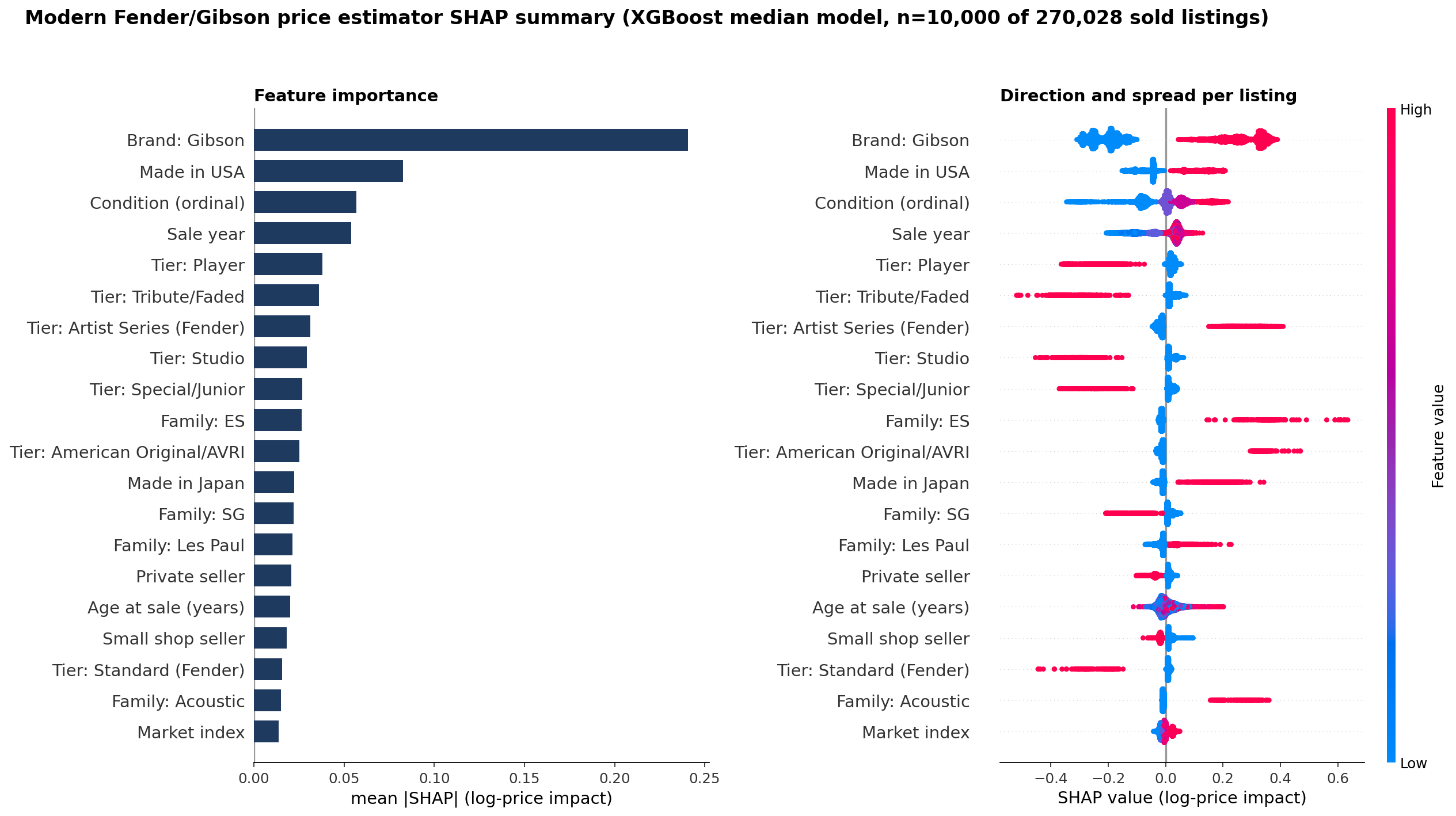
Below: SHAP values for the model — how much each feature moves the price prediction, per listing. Brand dominates (Gibson trading above Fender on average), followed by country of manufacture, condition, and sale year; individual tiers like American Original/AVRI and Artist Series show clear positive premiums, while budget tiers like Player, Tribute/Faded, and Studio show the expected discount.
Sale prices are verified transaction data, not asking prices. Grid predictions are evaluated at a reference configuration; secondary adjustments are applied client-side. Nothing you type here is stored.
Estimate
$700
$550 – $750
Common questions
Does finish or color affect a modern guitar's resale value?
Usually very little. On a mass-produced Fender or Gibson, one standard color sells for about the same as the next. A used buyer mostly wants a clean guitar that plays well. Gibson's figured tops are one exception. A Les Paul with a nice flame or quilt maple top brings more than a plain-top version of the same model, which is why Gibson grades those tops and prices them up from the factory. A rare limited color can add a little, but for most modern guitars the finish barely changes what it sells for.
Does a newer used guitar sell for more than an older one?
A little, and only for the first few years. A nearly-new example sells for slightly more than one that is a few years old, and after that the build year barely moves the price. Modern Fenders stay roughly flat as they age. Older Gibsons are the exception: as they get close to twenty years old they start creeping back up toward vintage prices. Condition and which series you have swing the price far more than a two- or three-year gap in build date.
How much more is an American-made Fender worth than a Mexican-made one?
Country of manufacture is one of the biggest value factors for modern Fenders: American-series instruments typically sell for roughly a third more than equivalent Mexican-made models in our data, with Japanese-made Fenders in between and often the sleeper value. For Gibson this question doesn't arise — every Gibson-branded guitar in our dataset is US-built.
Do modifications hurt a modern guitar's resale value?
On modern production guitars, mods are roughly value-neutral in our data — a quality pickup swap neither adds nor subtracts much, unlike the vintage market where originality carries a real premium. You won't recoup the cost of the parts, though, so mod for yourself, not for resale.
Related: All guitar value estimators · Guitar market indexes