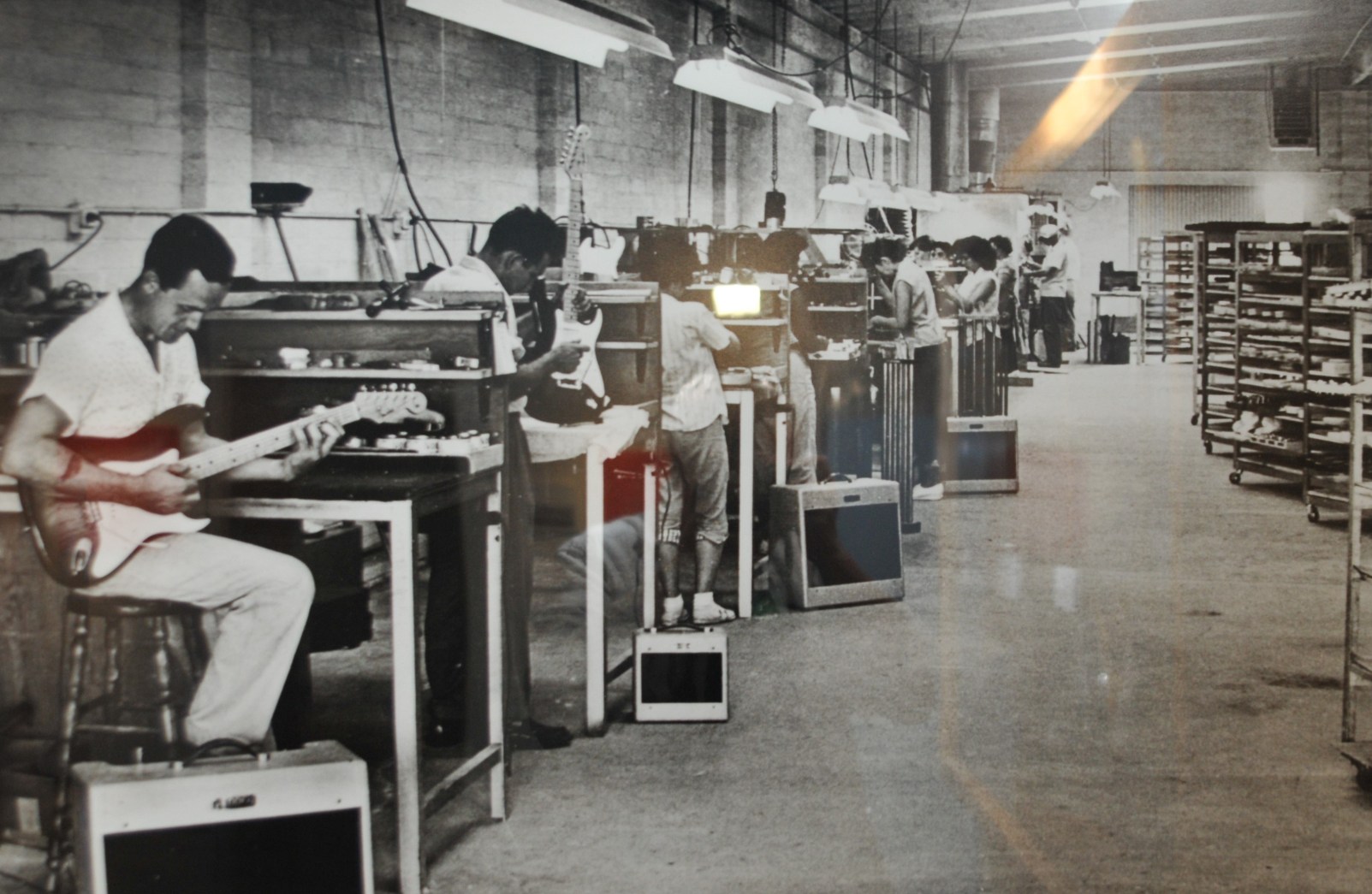
Collectors talk about "the CBS cliff" as if it were one thing. Fender sold to CBS on January 5, 1965, and in the popular version of the story that date splits the company's history cleanly in two: the good years before, the compromised years after. The bill of particulars is familiar: CBS scaled up production, moved from nitrocellulose lacquer to polyester finishes, replaced the four-bolt neck joint with a three-bolt design (plus Micro-Tilt adjustment and bullet truss rod) in 1971, and generally prioritized volume over the hand-built consistency of the Leo Fender era. Collectors treat these changes as the reasons CBS guitars are worth less — but the changes did not all arrive at once, and they did not hit every model the same way.
CBS-era Fenders do sell for less. But they do not fall off as one universal break in 1965 across every model. On the flagship collector guitars, what looks like a single cliff from a distance is actually a staircase — the first step lands in the immediate CBS years, but the deeper drops come later, as late-'60s changes accumulate and the heavy-CBS 1971-75 era arrives. On offsets the pattern is weaker; on student models it is real but milder than the flagship story.
This piece draws on a structured dataset of 12,181 sold Fender guitars from 1951 through 1980 — sourced from Reverb, vintage dealer records, and auction lots — and asks a more specific question than the internet usually does:
When people say "CBS killed Fender value," which models actually got hit, when did the market start to turn against these guitars, and how much of the story belongs to the 1965 sale versus the changes that happened later?
A note on comparisons: the transition figures below use a tight 1962-64 predecessor window rather than all pre-CBS. Early-'50s Blackguards are so valuable that lumping them together with the immediate pre-CBS period inflates the baseline and overstates the 1965 break in value. The goal is to measure what changed at the transition, not what separates a 1952 Blackguard from a 1974 Telecaster. (For more on how Blackguards anchor the Telecaster market, see our vintage Telecaster deep dive.)
The Big Picture: this is a staircase
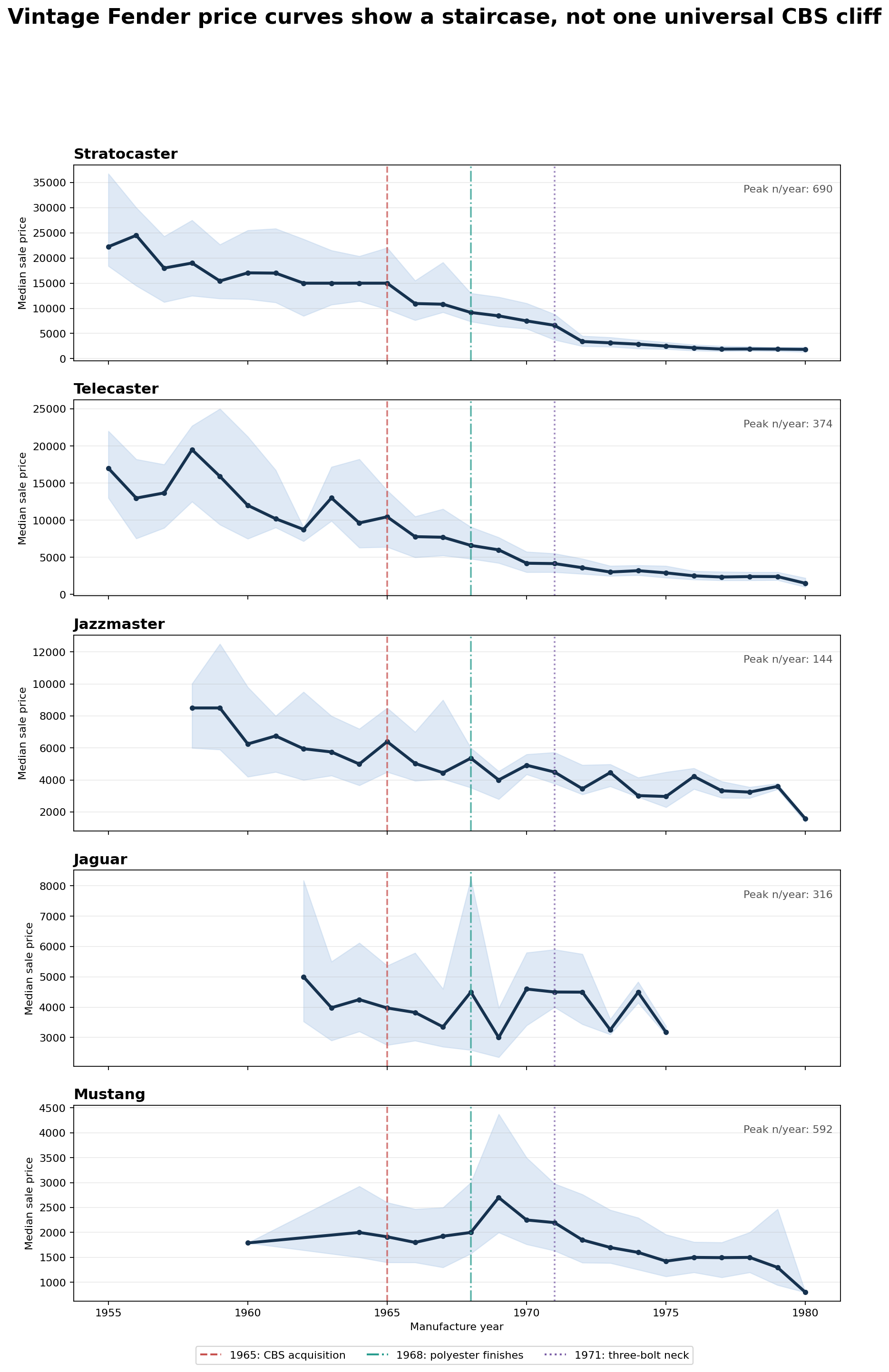
The first plot makes the point. Collapse all vintage Fenders into one bucket and you either lose or dilute the story.
- Stratocaster and Telecaster show the cleanest repricing after 1965, with declines continuing through the '70s. The Strat, in particular, reacts harshly to the introduction of the three-bolt neck in '71.
- Jazzmaster shows a weaker but still-visible and steady decline.
- Jaguar appears flat, but that is a custom-color artifact — sunburst-only comparisons show a real ~30% decline through 1968-69. After that, production was declining toward the 1975 discontinuation and samples are too thin to track reliably.
- Mustang shows a late-'60s spike — but this turns out to be driven entirely by the competition-color variants introduced around 1968-69, not Mustangs broadly. Standard Mustangs show no such spike.
"CBS cliff" is useful shorthand, but only if you understand it as a model-specific staircase — each step driven by feature changes that landed at different times on different models — rather than one universal event.
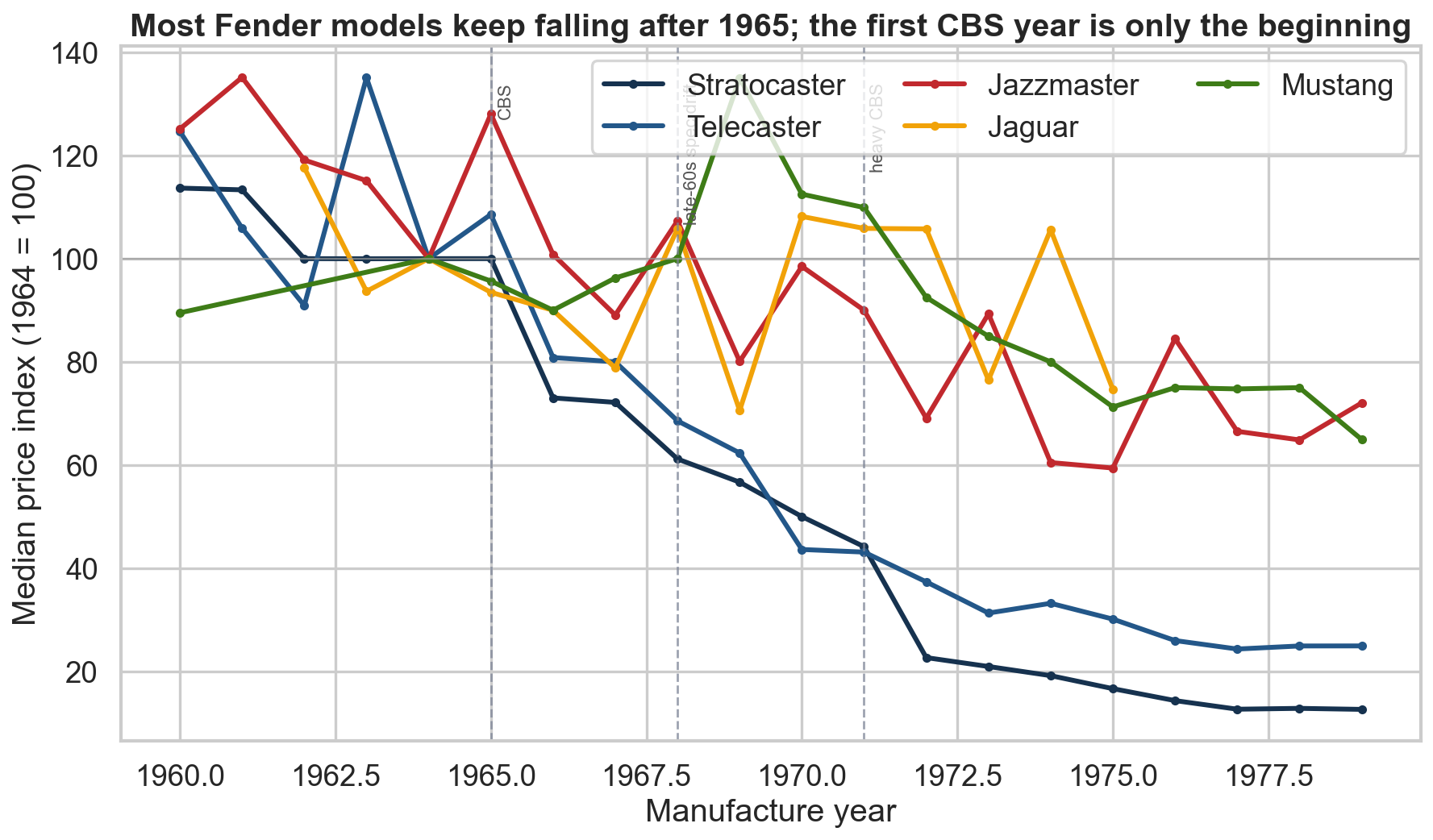
Indexed to 1964, the flagship lines are clearer. Stratocaster and Telecaster both fall after the sale, then fall again into the later CBS years. The market is not simply saying "pre-1965 good, post-1965 bad." It is discriminating between early CBS and late CBS, and treating the two very differently.
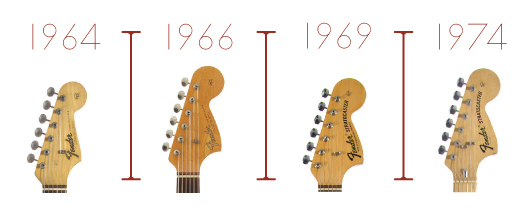
Which models actually get hit?
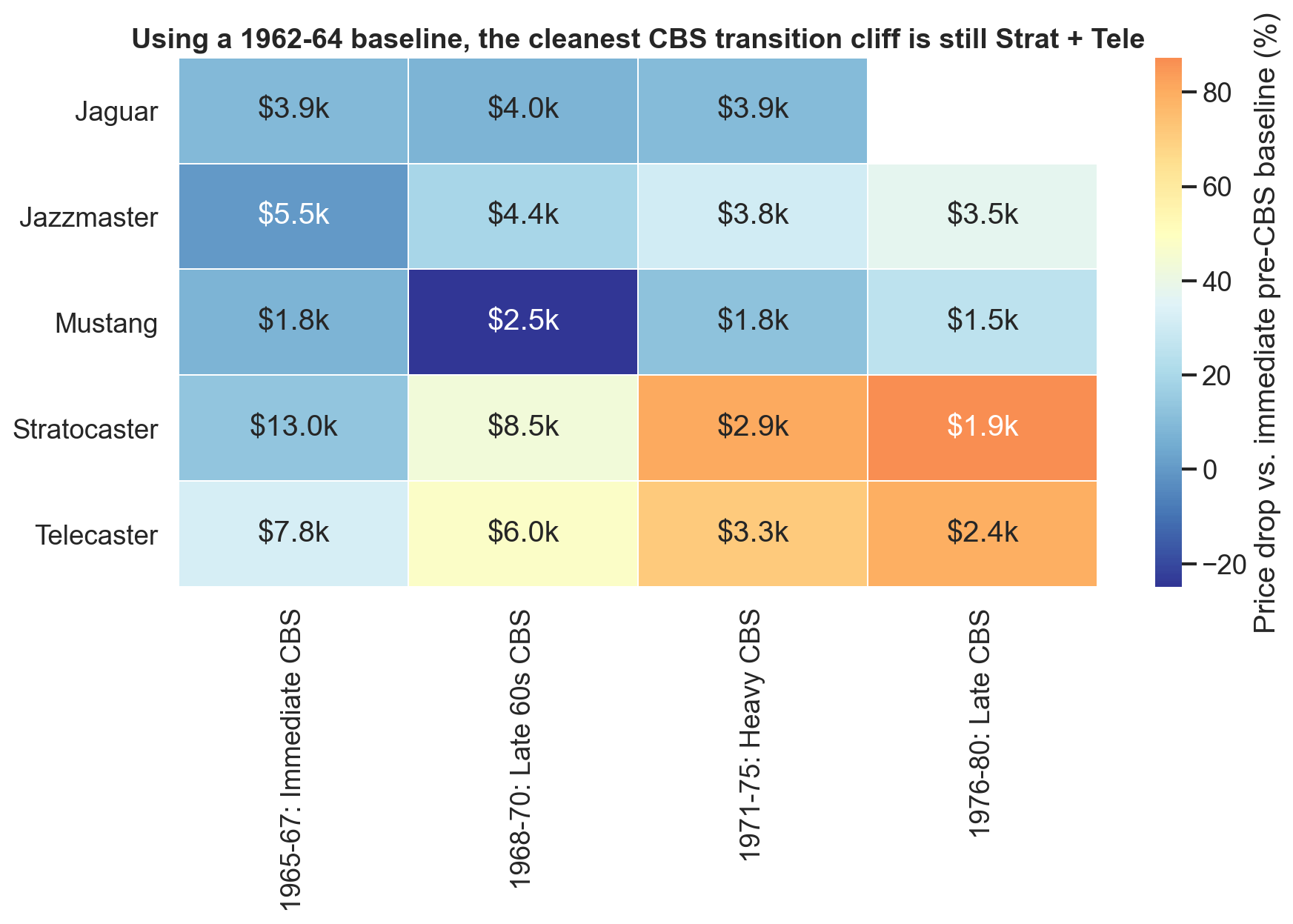
Against the 1962-64 baseline, the first CBS step down looks roughly like this:
- Telecaster: about -32%
- Stratocaster: about -13%
- Jaguar: about -10%
- Jazzmaster: effectively flat
- Mustang: about -8% (standard Mustangs; competition-color Mustangs introduced around 1968-69 behave differently — see below)
These are not permanent constants; they are the first stage of the staircase. What stands out is the hierarchy: Telecaster gets hit hard immediately, Stratocaster falls but less violently at first, and the offsets barely register a 1965 break at all. By the 1968-70 bucket, Strat and Tele are clearly lower again. By 1971-75, they have been repriced into a different market altogether.
The Jazzmaster's near-flat immediate reading deserves a closer look, because the year-by-year data reveals something the summary hides. In 1964, the Jazzmaster was already soft — a $4,995 median, well below the $5,750-$6,750 range of 1961-63. Then 1965 came in at $6,395, higher than 1964. The CBS acquisition simply did not register as the dominant pricing signal for this guitar. By 1965 the Jazzmaster was already on its own trajectory: originally positioned for jazz players in 1958, adopted by the surf scene in the early '60s, and by the mid-'60s both of those markets had moved on — surf killed by the British Invasion, jazz players long since committed to archtops and hollowbodies. The Jazzmaster does eventually drop to about -37% below pre-CBS in the heavy-CBS era, but it arrives as a gradual drift rather than a cliff.
The discount survives simple controls
One obvious objection: later guitars may just look cheaper because more of them are low-grade, refinished, or sold through weaker venues. We test this claim by controlling for refinishes and guitar condition.
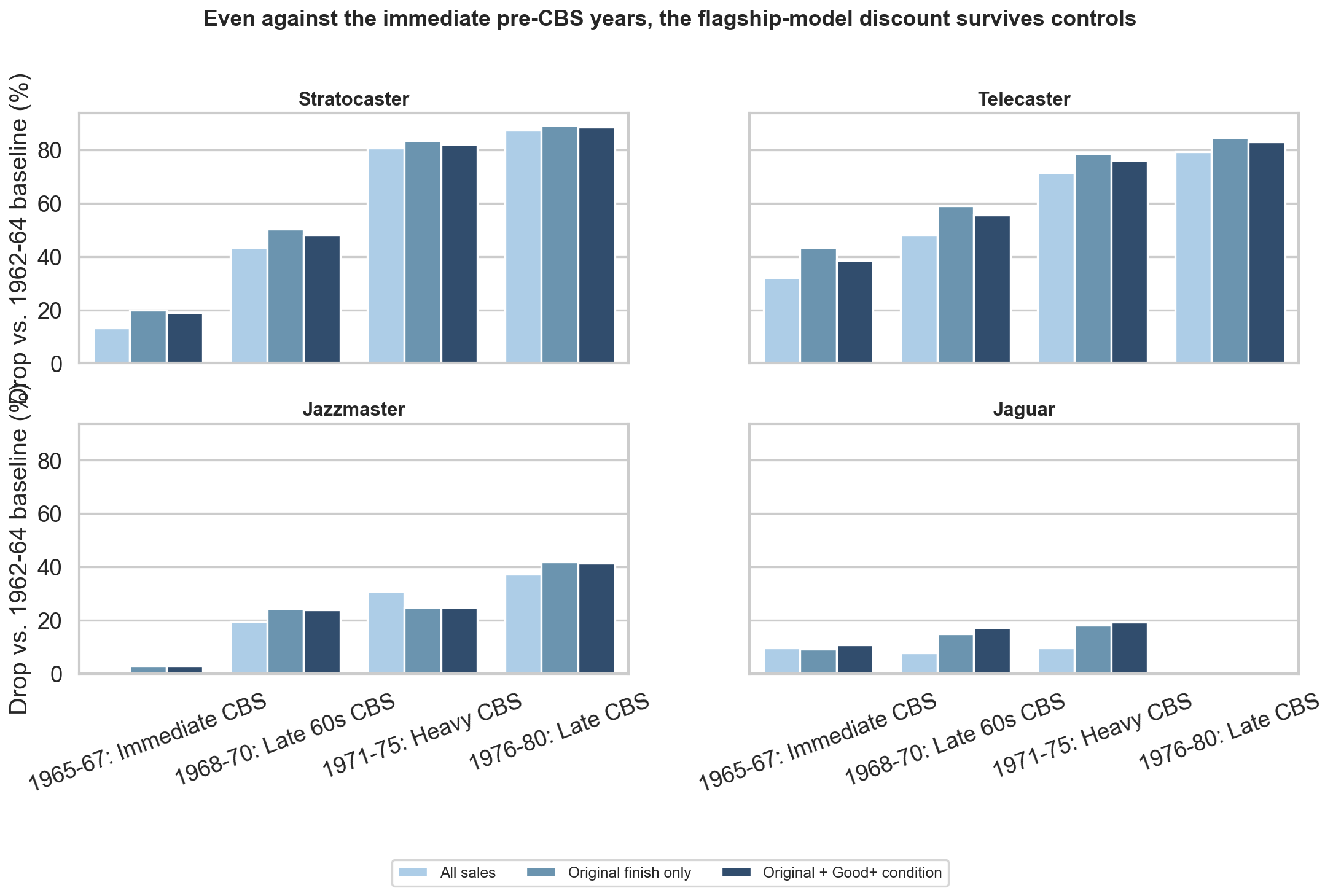
Restricting to original-finish examples only, then original-finish combined with Good+ condition, the pattern holds quite strongly. On Stratocaster and Telecaster the discount gets cleaner, not weaker. This supports the claim that the "CBS Staircase" or "Cliff" is not merely a condition artifact, but a true value effect.
A subtle twist hiding in this control analysis: pre-CBS Stratocasters and Telecasters actually carry more refinishes in this sample than their CBS-era counterparts — roughly 44-46% of pre-CBS Strats and Teles in our data have been refinished, versus 11-13% in the heavy-CBS era.
This makes sense: pre-CBS guitars are older and were actively played through decades when refinishing was routine maintenance, not a collectibility red flag. Refinished examples pull the median price down, so having more of them in the pre-CBS bucket actually depresses the pre-CBS number. This makes the condition-controlled gap between eras larger than the originally-shown raw gap, not smaller. If anything, the simple median understates the CBS discount.
For more on the history of refinishes, custom colors, and their impact on value, we explore this in depth in another research post.
Supply, durability, and the alternative explanation
Before treating the CBS discount as purely a quality story, there is a simpler alternative to confront: CBS made more guitars, and more supply means lower prices.
The sample counts in this dataset show the pattern unevenly. Pre-CBS Telecasters account for 336 listings; heavy-CBS Telecasters for 1,229 — a 3.7x increase. For Stratocaster, the ratio is only 1.1x. CBS ramped Telecaster production dramatically; Strat production did not balloon in the same way. Some portion of the Telecaster's steeper, earlier price collapse is likely supply compression — not just a quality or reputation effect.
CBS also moved Fender away from nitrocellulose lacquer toward polyester finishes, gradually through the late '60s and more broadly by the early '70s. Poly is more durable. Heavy-CBS guitars in natural or sunburst poly have survived in better average physical condition than many pre-CBS guitars whose fragile nitro finish has spent decades checking, yellowing, and wearing through. If supply is part of the price story, so is the irony that the "cheaper" CBS guitars may have held together better as instruments — while the finish that collectors prize most is the one that ages worst.
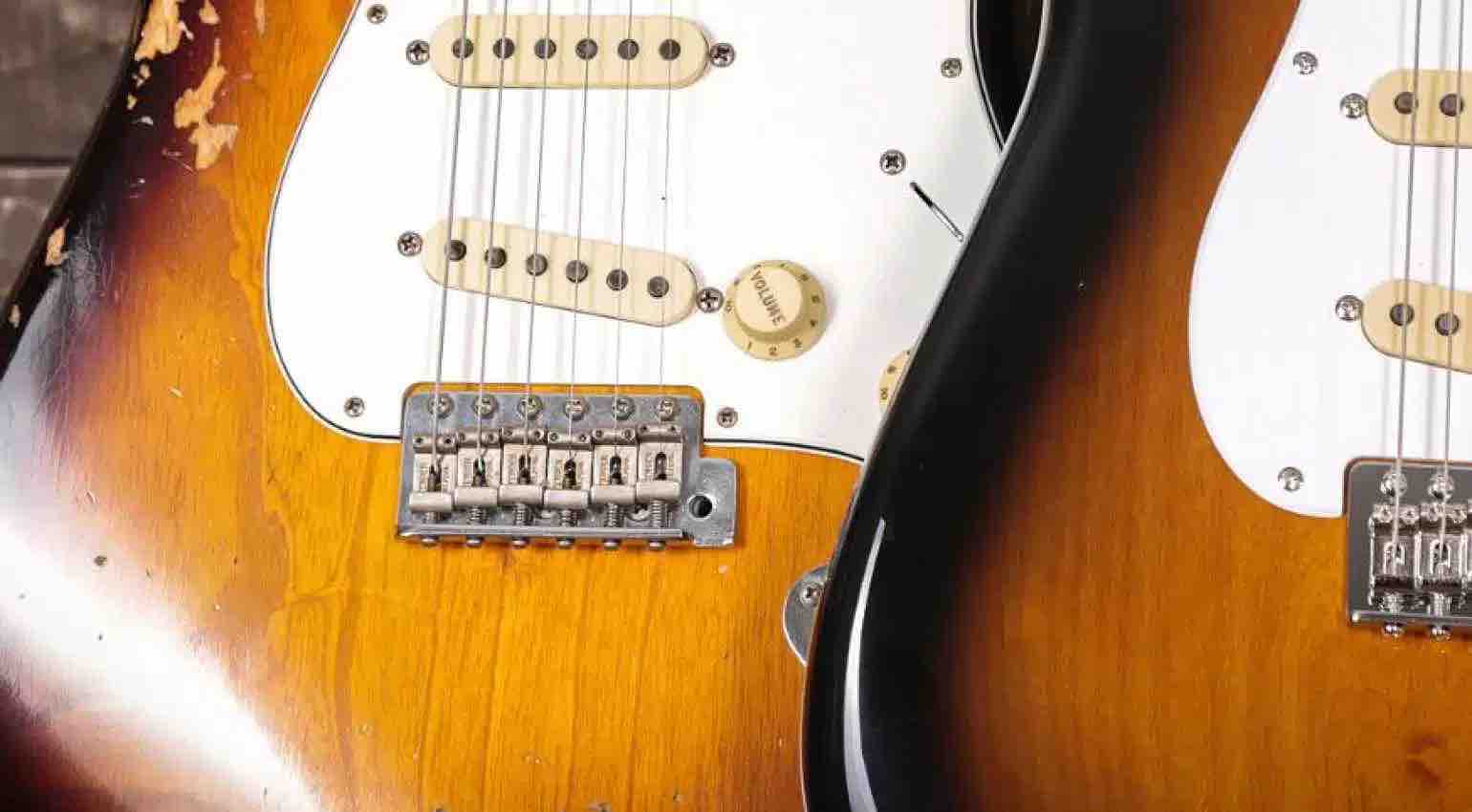
None of this erases the CBS discount. The controlled comparisons hold within condition grades, and all three market channels agree on direction. But calling it purely a quality penalty overstates the case. The Telecaster's steeper, earlier collapse has a supply story embedded in it; the Stratocaster's does not. Any honest account of the CBS discount has to weigh scarcity and production decisions alongside the quality narrative.
The channels agree
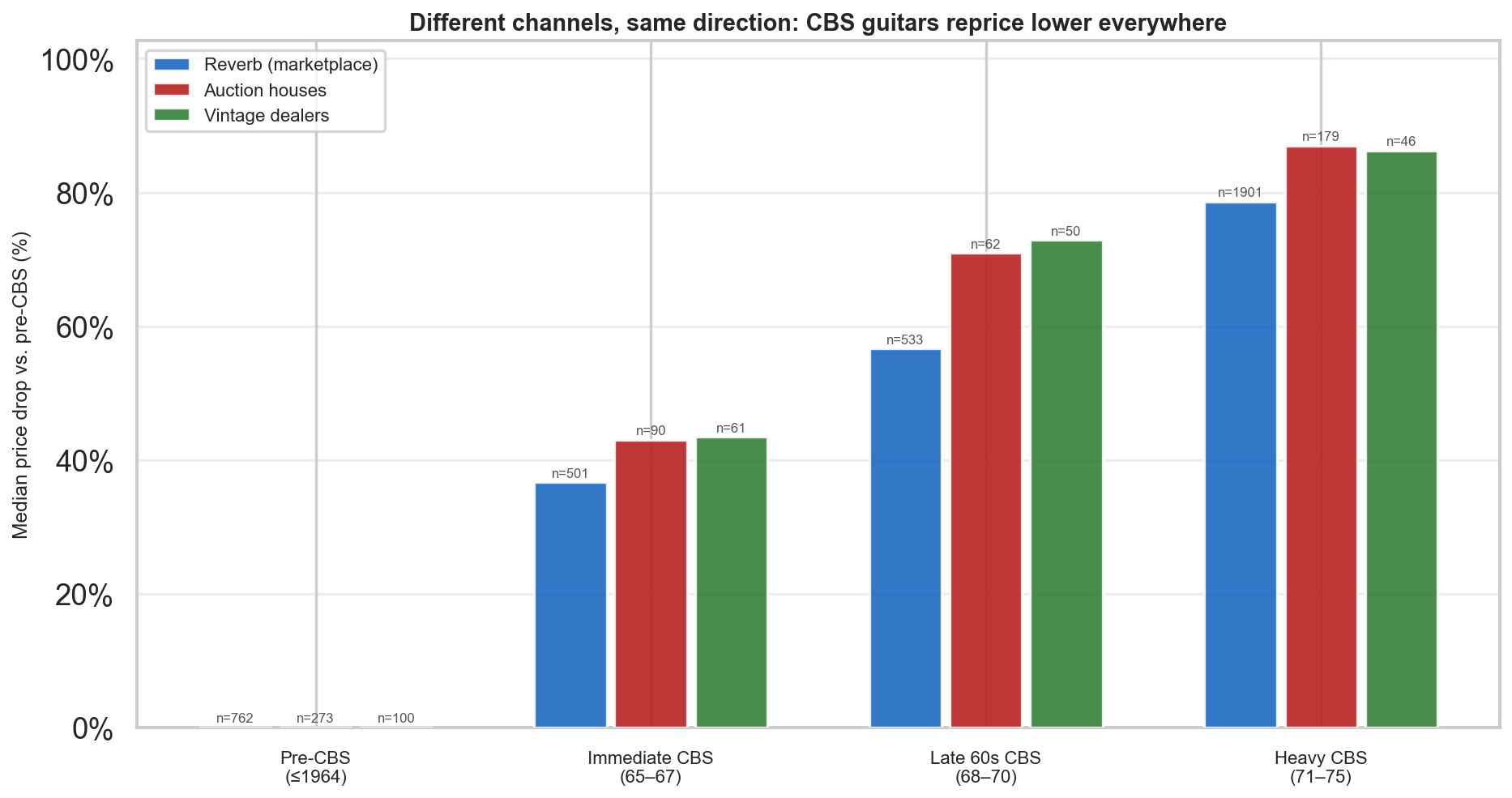
Absolute price levels differ across channels. Auction houses and dealers skew higher than Reverb marketplace sales, as you would expect. But the shape agrees: immediate CBS years are lower than pre-CBS in every channel, late-'60s CBS is lower still, and heavy-CBS years are dramatically lower. If this were a Reverb-specific artifact, driven by the platform's lesser-known sellers and the uncertainty of buying online, auction houses and vintage dealers would show a different pattern. They do not.
Why 1971 matters so much on Stratocaster
The Stratocaster's biggest repricing does not land in 1965. It lands when the later CBS hardware changes — three-bolt neck, Micro-Tilt adjustment, and bullet truss rod, all introduced in late 1971 — become legible in listing language.
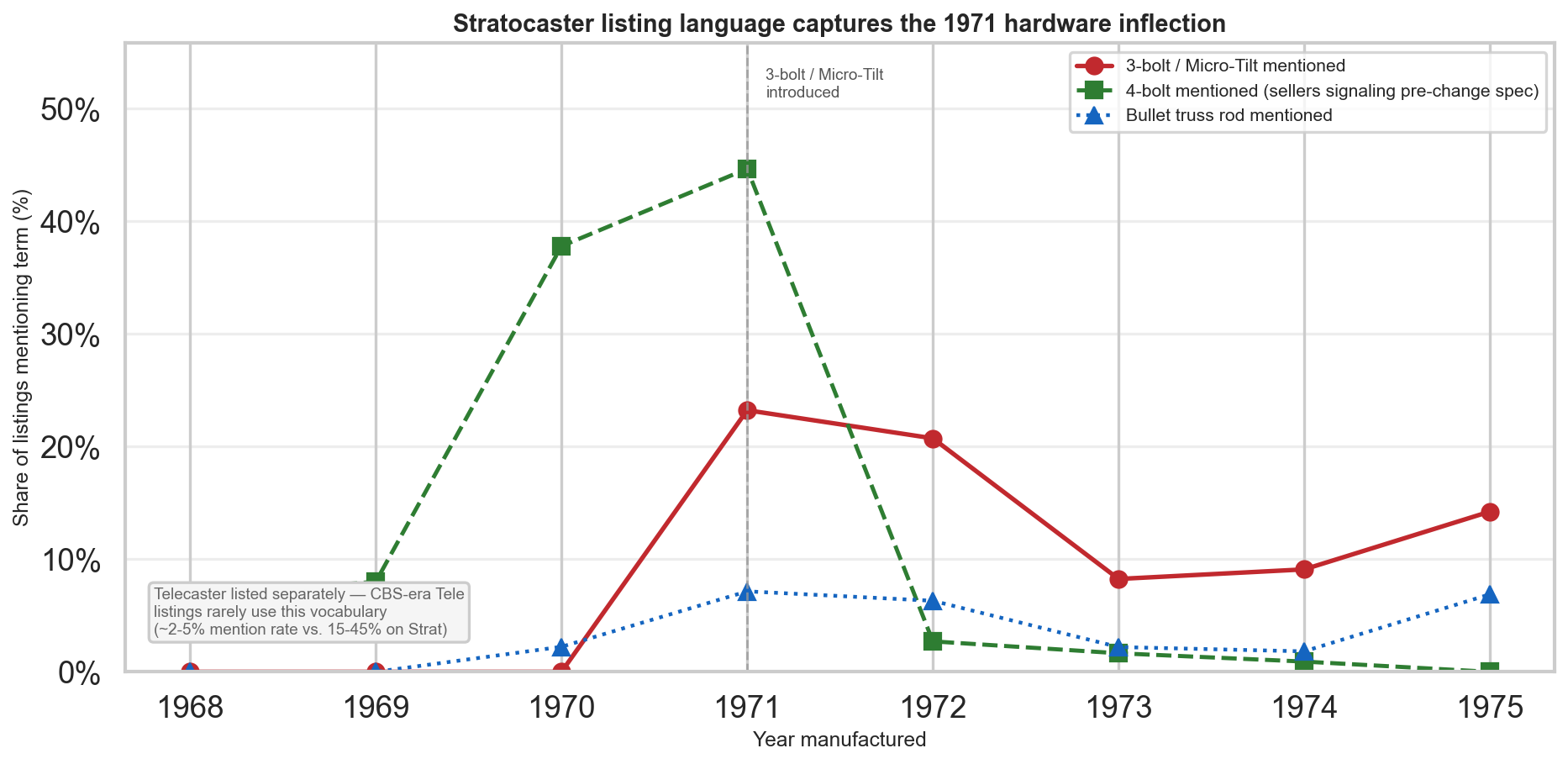
This chart is Stratocaster-only. Telecasters also received a three-bolt neck in 1971, but sellers of CBS-era Teles almost never call it out in listings — mention rates run below 5% versus 15-45% on Strat. That absence is telling: the Telecaster's CBS pricing penalty landed up front at the 1965 transition rather than at a specific 1971 hardware inflection, so the spec vocabulary never developed in the same way.
On Stratocaster, the story is in the crossover. In 1970, a large share of listings mention 4-bolt explicitly — sellers signaling to buyers that this guitar still has the pre-change construction. By 1971-72, three-bolt mentions spike and four-bolt mentions drop away. The price curves fall in exactly that window. A 1970 Strat with a four-bolt neck and a 1972 Strat with a three-bolt neck are only two years apart. In the market, they occupy different tiers, with the three-bolt being a "final straw" of sorts to some buyers who dislike the heavy-CBS package of the three-bolt neck, bullet truss rod, and poly finish that are all represented from this point forward.
The Jaguar: a gradual decline, not a flat line
The Jaguar's price curve has looked unusually flat so far throughout this study. It deserves closer scrutiny, because the flat appearance is partly a data artifact. When controlling for custom colors and refinishes, the CBS Staircase becomes more pronounced.
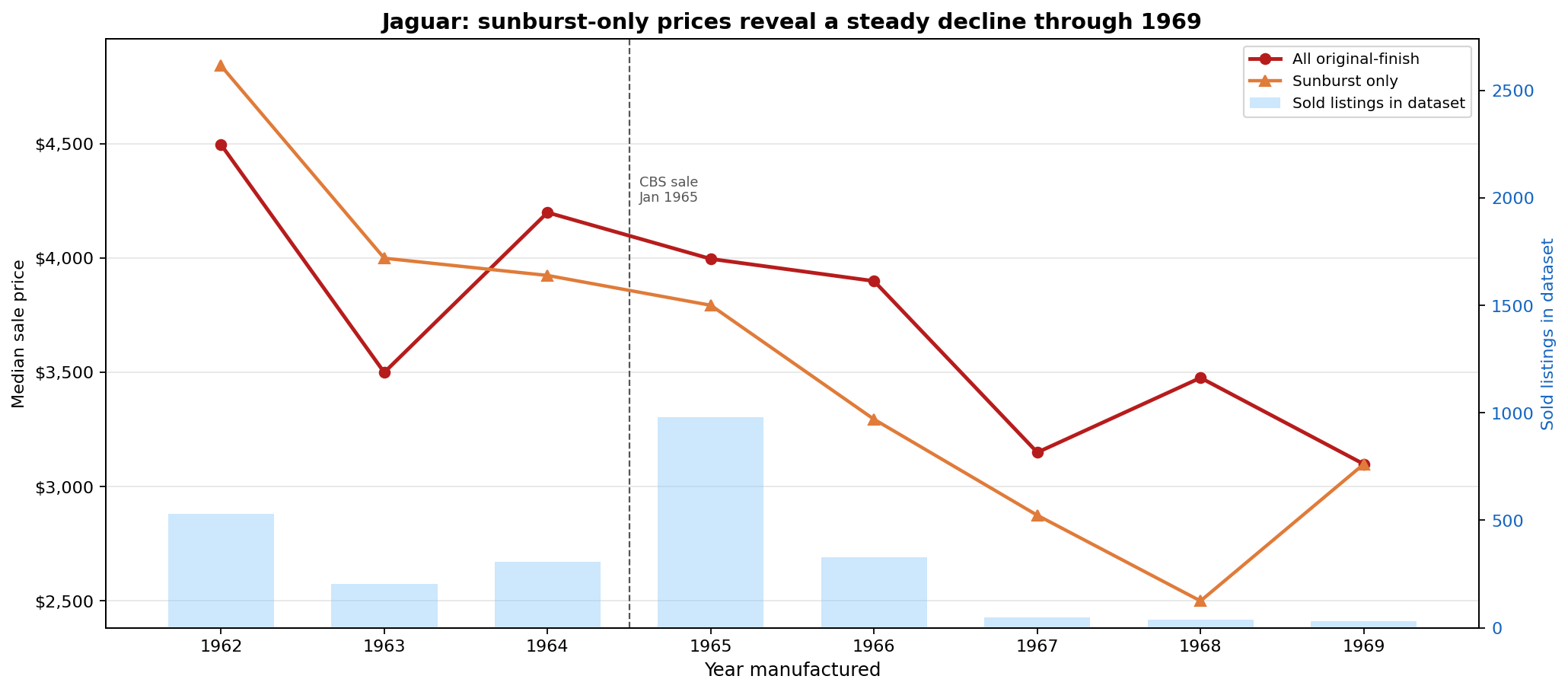
Fender introduced the Jaguar in 1962 as the most expensive guitar in its catalog. Post-acquisition, CBS did not continue Fender's investment in its offset lines. Production declined sharply through the late 1960s and the Jaguar was discontinued in 1975.
The overall original-finish line looks roughly flat after 1965, but that line is misleading when looking at the composition of the post-1967 sample. After 1967, total listings in the dataset drop to 20-40 per year. The guitars that do reach market in those thin years are disproportionately custom-color and rare-variant examples (matching-headstock custom colors, maple-cap neck variants) that command significant premiums over standard sunburst production. Stripping to sunburst-only comparisons reveals a real decline: a standard sunburst 1968 Jaguar trades around $2,500, down roughly 35% from the $3,800-$4,000 range of 1963-65.
Both price lines stop at 1969, where the data gets too thin to be reliable. That is not a dataset construction problem; it reflects the instrument's commercial trajectory. As guitar historian Martin Kelly noted in Guitar World: "Jaguar sales had plummeted by the late 60s, and you really don't see many 70s ones around." CBS wound down production rather than scaling it up, and the Jaguar was discontinued in 1975. The early-'70s data does show prices appearing to rebound slightly — but with only 6-15 examples per year and a sample skewed toward well-preserved guitars, that uptick is inconclusive noise rather than a genuine market signal.
That also explains why the Jaguar's decline looks shallower than the Strat's or Tele's. Stratocaster and Telecaster production stayed high enough throughout the CBS era to generate a deep, representative market. The Jaguar never got that. The market of surviving '70s Jaguars is thin and difficult to make conclusions about.
The Jaguar is not a counterexample to the CBS story. It is an example of what happens when CBS abandons a model rather than scaling it up: the decline is visible, but with light production and eventual cancellation, the story gets cut short.
The Competition Mustang: when CBS-era features become desirable
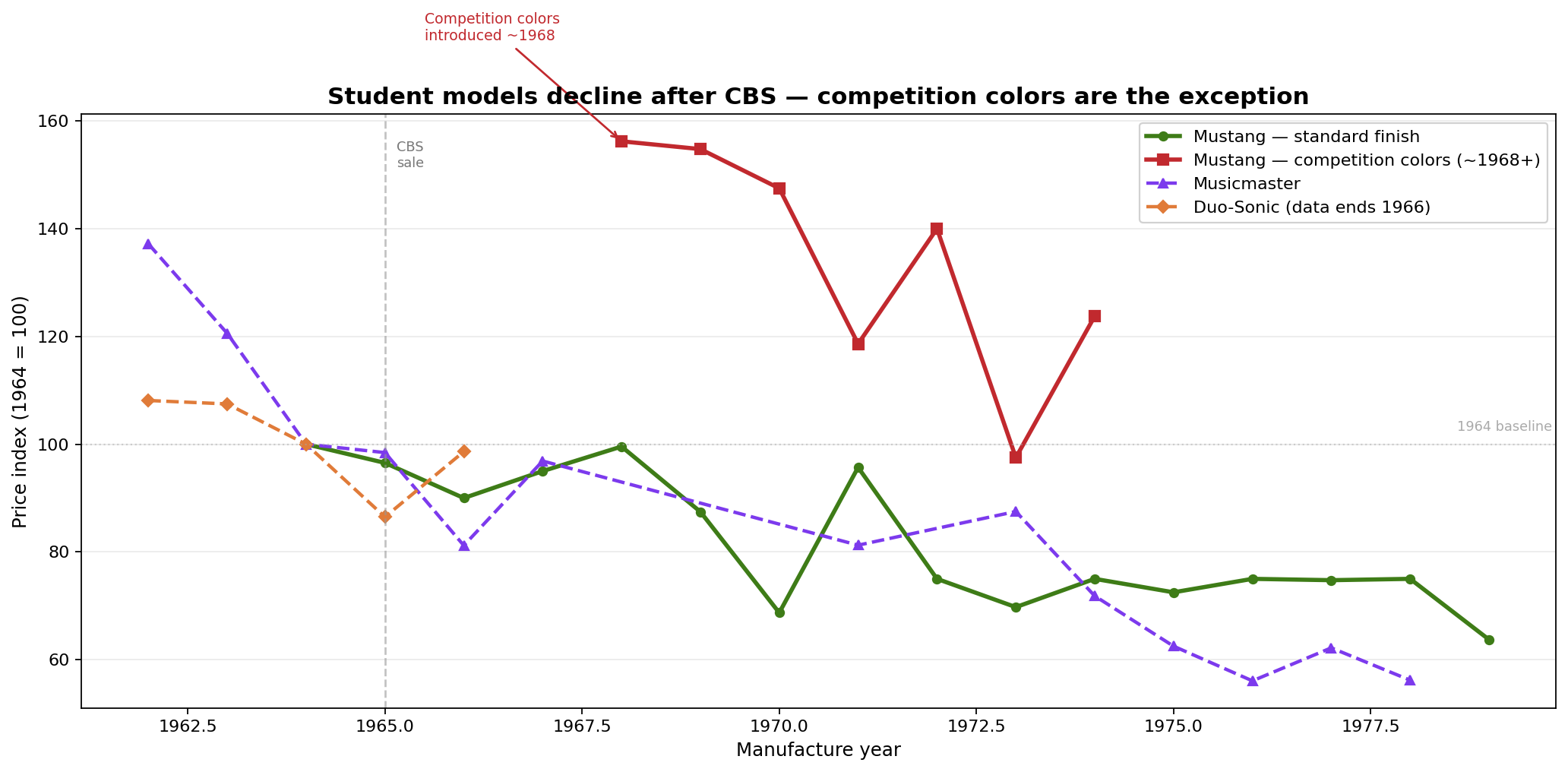
The Fender student models — Mustang, Musicmaster, and Duo-Sonic — do show CBS-era declines. Standard Mustangs trade around $1,800-$2,000 through 1968, then step down through the mid-'70s. Musicmaster follows a similar path. Duo-Sonic data thins quickly after 1966 (the model was discontinued in 1969), but the trajectory is the same — median prices fall roughly 25% from the 1962-64 baseline by 1966. None of them are exceptions to the CBS discount story.
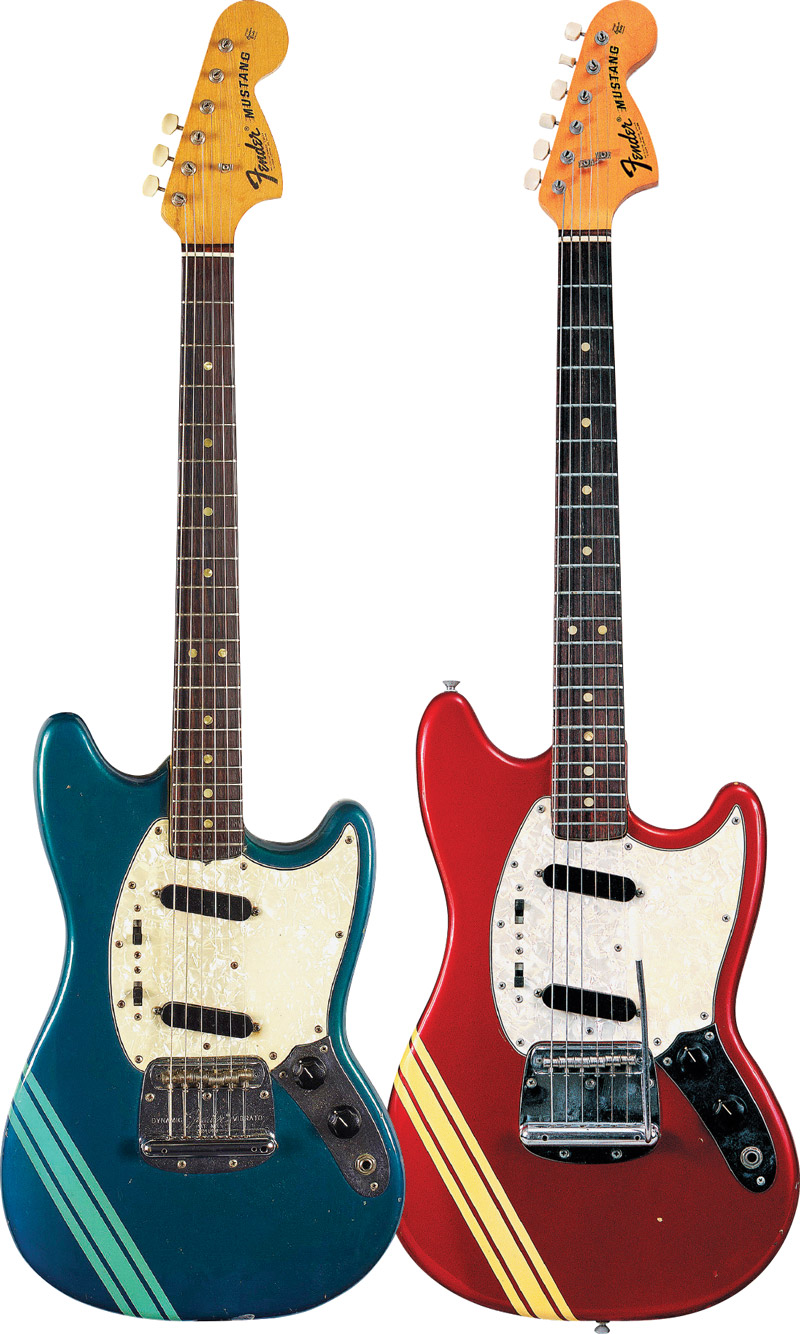
What looks like an exception in the combined Mustang data is entirely a composition effect from the Competition color Mustangs introduced around 1968-69. These are visually unlike anything else in the Fender catalog — solid competition colors (Red, Orange, Burgundy) with racing stripes and matching headstocks, growing out of the same motorsport-influenced aesthetic that was everywhere in American consumer culture that year. They command persistent medians of $2,500-$3,000+, roughly 60-70% above a same-year standard Mustang.
The reason this inverts the usual CBS logic is that the Mustang never had much of a pre-CBS mythology to begin with. The model launched in 1964 — one year before the sale — so there is no substantial "last Leo-era" production to idealize. The CBS stigma is organized around what was lost at the transition on Strats and Teles. On the Mustang, the collector story is organized around what CBS introduced — the competition colors. Different mechanism entirely.
If you are buying a vintage Mustang because you believe in a general "student models escape the CBS discount" thesis, the data does not support it. Standard Mustangs decline. What holds up are the competition colors specifically — and those are worth understanding as their own collector market rather than as a CBS-era exception.
What this means for buyers
- Collector-grade flagship Fender: the market treats the CBS transition as meaningful and the 1971-75 heavy-CBS period as a separate, even steeper discount tier.
- Vintage Fender as a player: the immediate CBS years can be more attractive than the reputation suggests, given that the transition in quality and specs happened gradually over ~7 years and many early CBS models are nearly indistinguishable from the earlier era.
- Offsets: the CBS binary is not the central pricing story. Jaguar and Jazzmaster follow production-cycle logic more than ownership-change logic.
- Student models: the "Mustang exception" is specifically a competition-color story. Standard Mustangs show a mild CBS decline, not strength. Competition Mustangs (~1968-73) are a distinct product with their own collector appeal and trade at a persistent 60-70% premium over standard examples from the same years.
For someone who wants pre-CBS-adjacent tone and craftsmanship without pre-CBS prices, the cleanest safe harbor in our data is the 1965-66 Stratocaster.
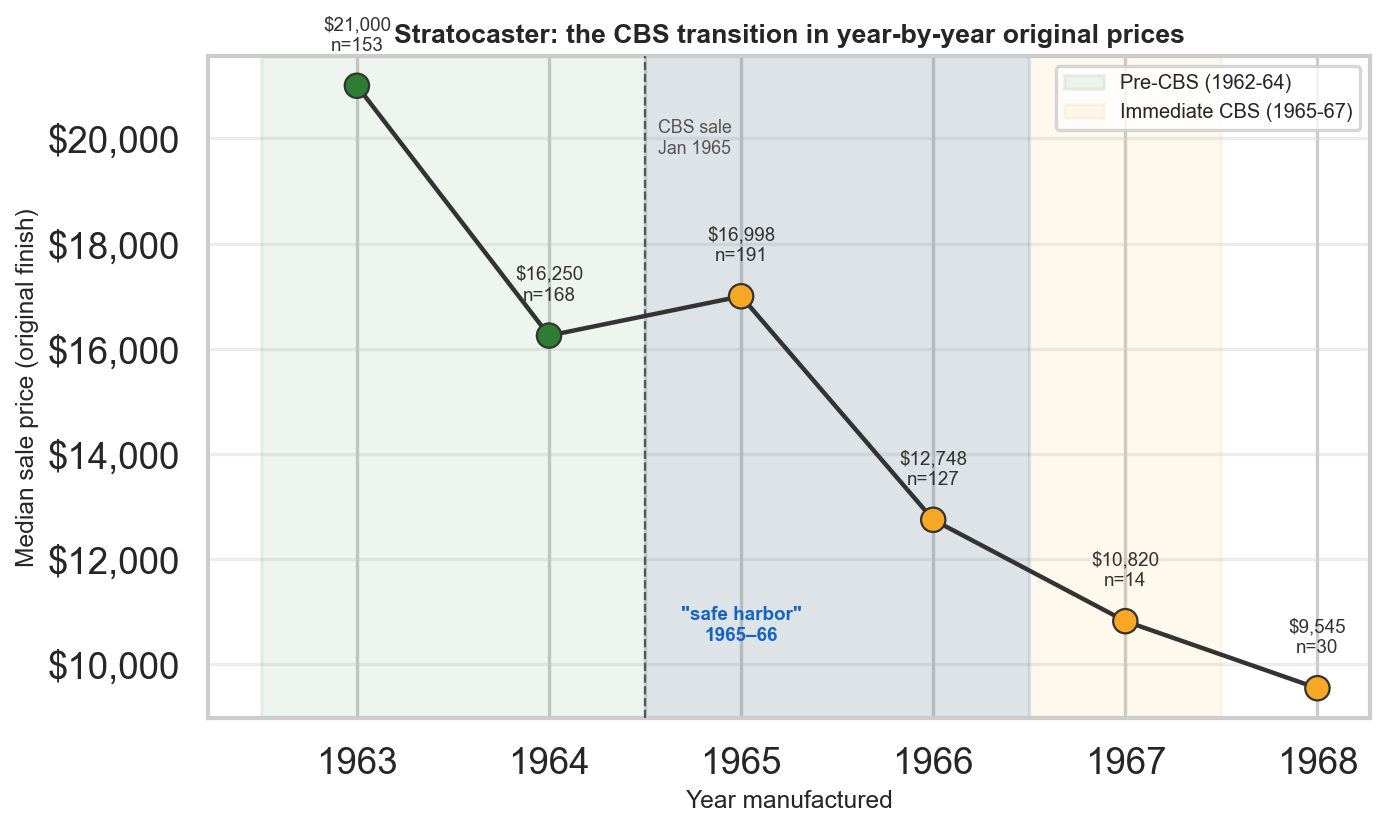
A 1965 Strat in original finish sells for a median around $17,000 in this sample — a meaningful discount from 1963-64, but not a collapse. A 1966 falls to ~$12,700, a steeper drop but still before the late-CBS hardware changes have arrived. Both years share essentially the same specifications: four-bolt neck, nitro finish, clay dots, the same pickup and wiring configuration as their 1964 predecessors. The market is pricing these toward the CBS name, not a change in the instrument. By 1967-68 the trajectory steepens, and by 1971 you are in a different tier. If early-CBS Strats have a case as a relative-value entry into Fender's golden pre-CBS era, 1965-66 is the window. On Telecaster, the same logic applies to 1965-67.
Conclusion
The sales data confirms the spirit of the collector story: CBS-era Fenders are usually worth less than the guitars that came just before them.
It also shows that "the CBS cliff" is not one event. There is a flagship-model staircase, driven by quality changes and production scale-up, where the deepest drops land not at the 1965 sale but years later when the heavy-CBS hardware and alleged quality decay arrives. There is an offset story, where production-cycle economics and the collapse of the surf market shaped pricing more than the change of ownership. There is a Jaguar story that is partly a data artifact — the model's decline is real, but low production after 1967 means the surviving sample skews toward clean, custom-color guitars that flatter the median. And there is a Mustang story that turns out to be specifically a competition-color story: standard Mustangs decline normally, while the competition variants introduced around 1968-69 developed their own collector logic that has nothing to do with whether CBS was good or bad at making guitars.
The market does not punish the word "CBS." It prices specific instruments, in specific eras, against specific benchmarks. That is a more useful framework than the folklore — and probably a better starting point for anyone deciding what a vintage Fender is actually worth.