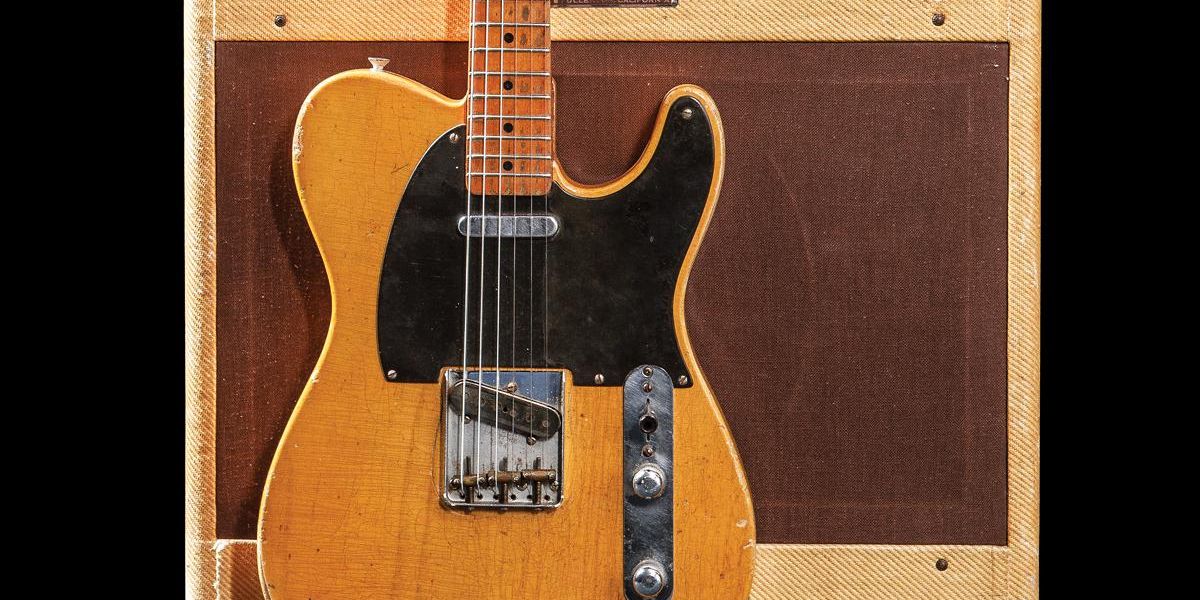
We tracked 3,509 verified sale prices from four independent sources across 30 years of vintage Telecaster production — Reverb marketplace, two major auction houses, and a specialist vintage dealer. This post analyzes the vintage Telecaster market in depth, showing the drivers of value and other market trends.
The Big Picture
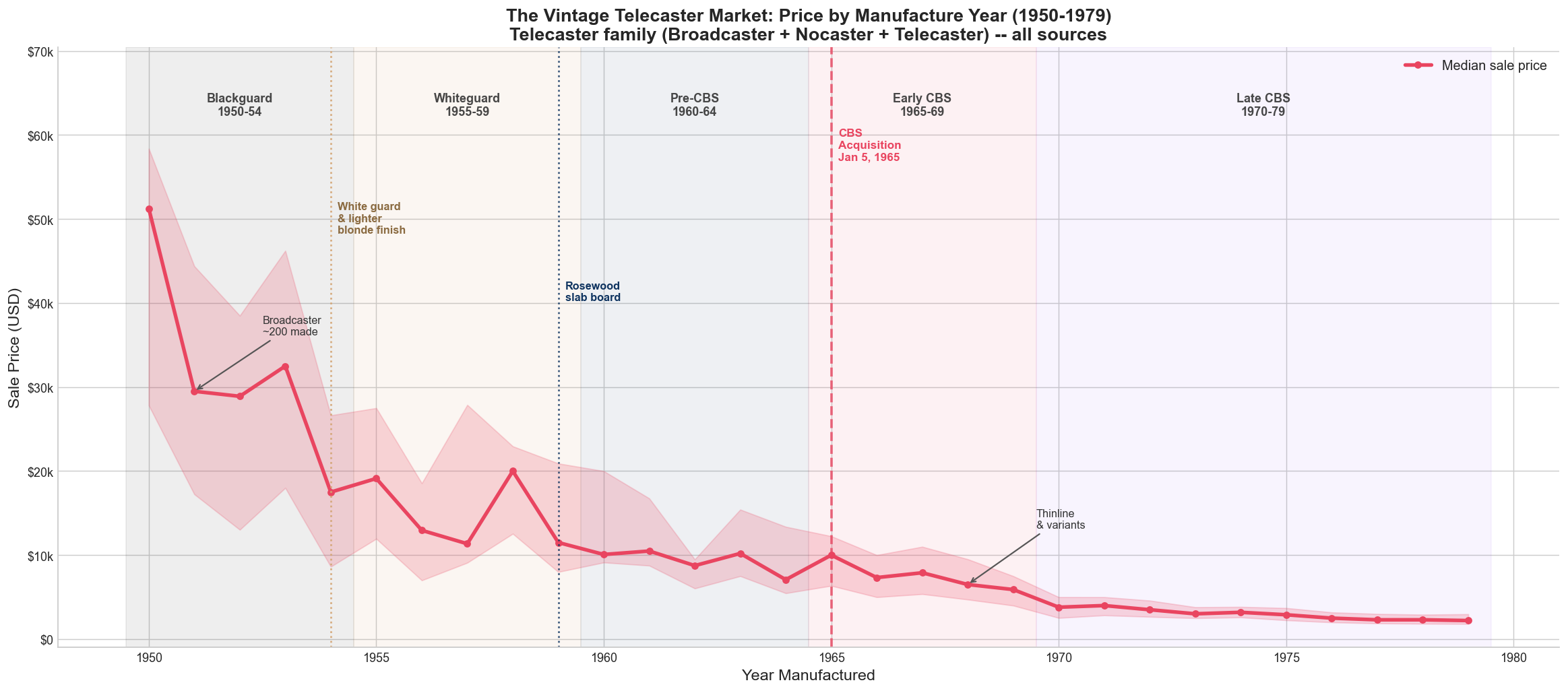
The shape of this curve contains almost everything that matters about this market. Three inflection points are visible in the data:
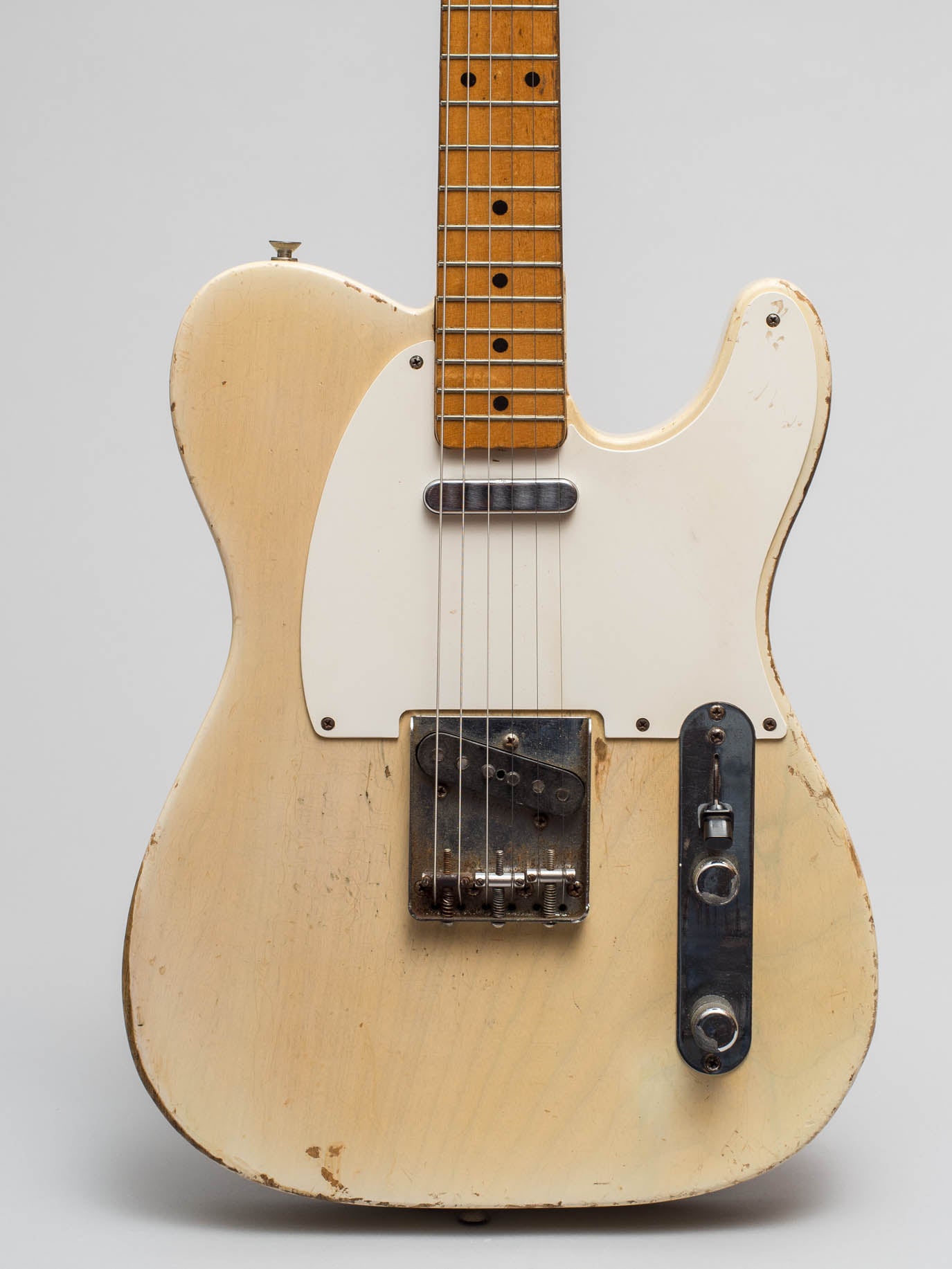
- 1954: Fender transitions from black to white pickguard material mid-year. Prices step down sharply.
- 1959: Rosewood slab fretboard replaces the all-maple neck. Another modest step down for buyers who prefer the earlier spec.
- 1965: CBS acquisition. Considered the end of Fender's golden age, post-CBS instruments on average sell at a significant discount.
After 1965, prices don't recover — they continue declining through the entire decade as CBS-era spec changes accumulate. By the mid-1970s, a Telecaster costs roughly one-tenth what a Blackguard commands.
The Broadcaster, the Nocaster, and the Telecaster
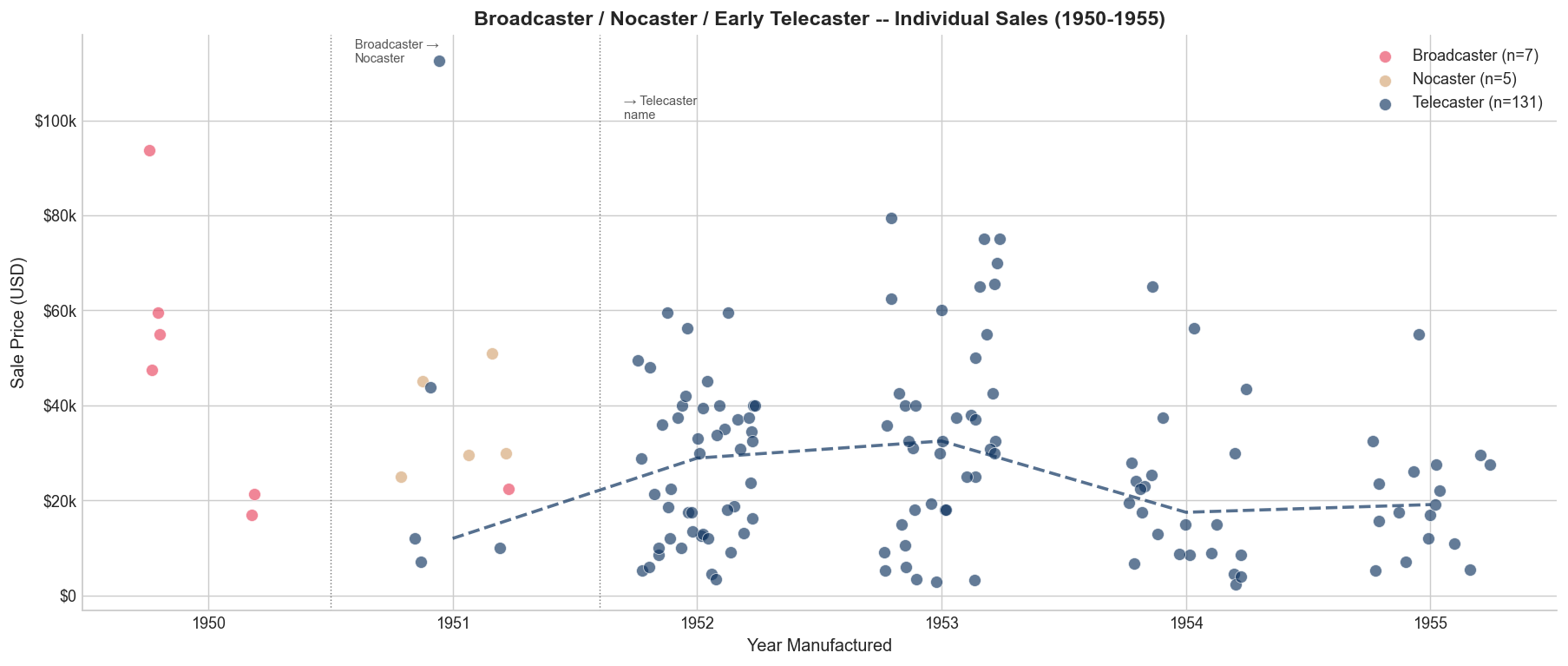
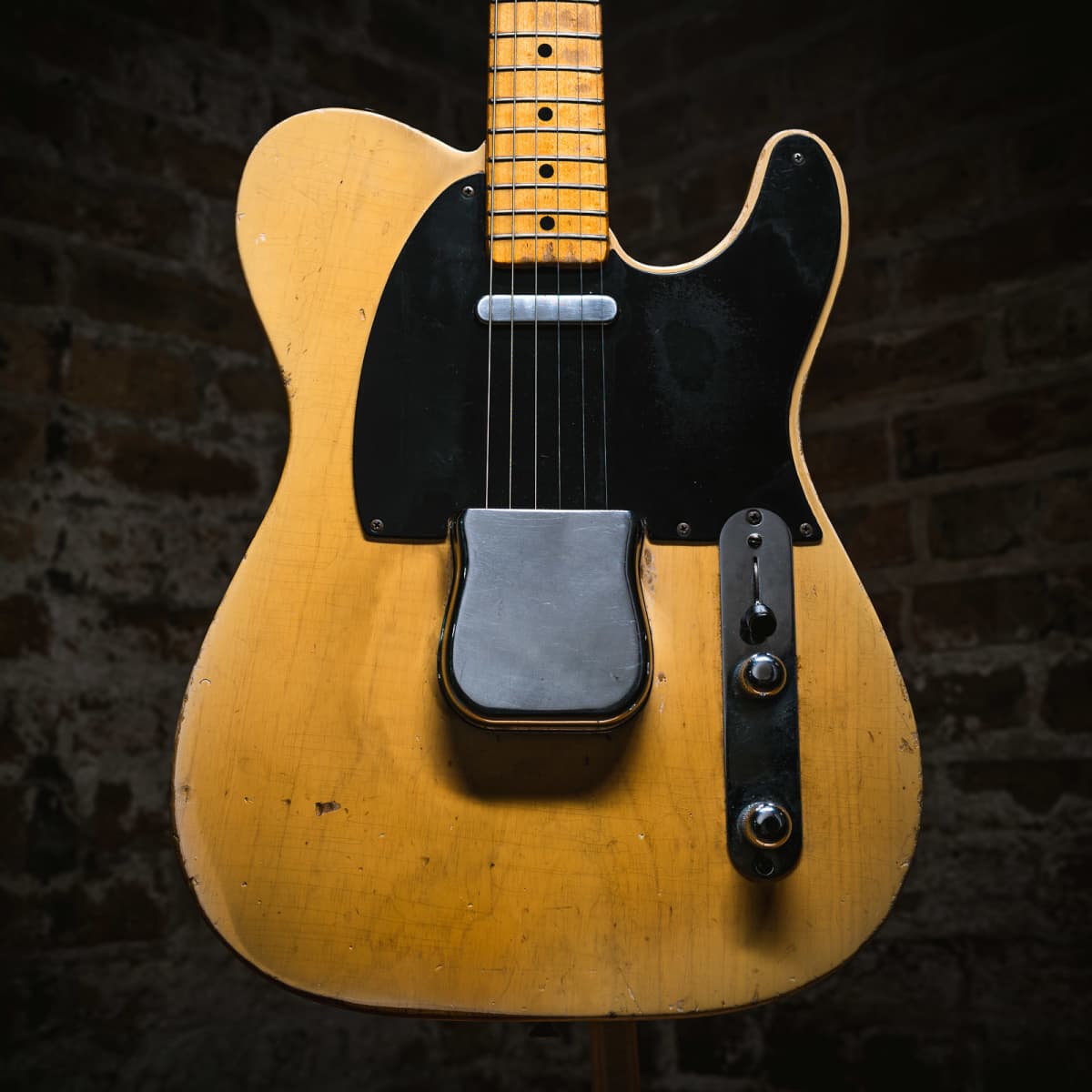
The Telecaster was born with an identity crisis. Fender introduced the model as the Broadcaster in late 1950, shipped roughly 200 before Gretsch complained about a trademark conflict, then spent most of 1951 cutting the name off the headstock decals and shipping the same guitar with no model name — the Nocasters — before landing on Telecaster in the fall.
The data for Broadcaster and Nocaster is thin, but directionally clear:
| Variant | n | Median | Range |
|---|---|---|---|
| Broadcaster (1950) | 6 | $51,250 | $16,870–$93,750 |
| Nocaster (1951) | 5 | $30,000 | $25,000–$51,000 |
| Telecaster (1951–52) | 25 | $35,996 | $12,000–$112,500 |
The Broadcaster commands roughly double a Nocaster for reasons that are part rarity (~200 made), part documentation (verified Broadcasters are clearly the earliest production examples), and part market mythology. The $93,750 top end shows individual examples can reach well beyond the median.
Our data on these very-early blackguards is affected by small sample sizes. A pristine Broadcaster or Nocaster could go for much more than our data here suggests. We simply don't have many such examples in our data. Three of our five Nocaster data points, for example, were either refinished or moderately modified. Even incorporating dealer and auction sales, it's hard to find extensive data on confirmed Broadcaster and Nocaster sales.
One note worth flagging: prior Telecaster market analyses that plotted only "Telecaster" prices show a gap in 1950–1951, because Fender wasn't making Telecasters yet. Both the age-value curve in this report and the Blackguard vs. Whiteguard comparison include Broadcasters and Nocasters in the 1950–1951 data, because they are the same instrument.
The Pickguard Color Premium
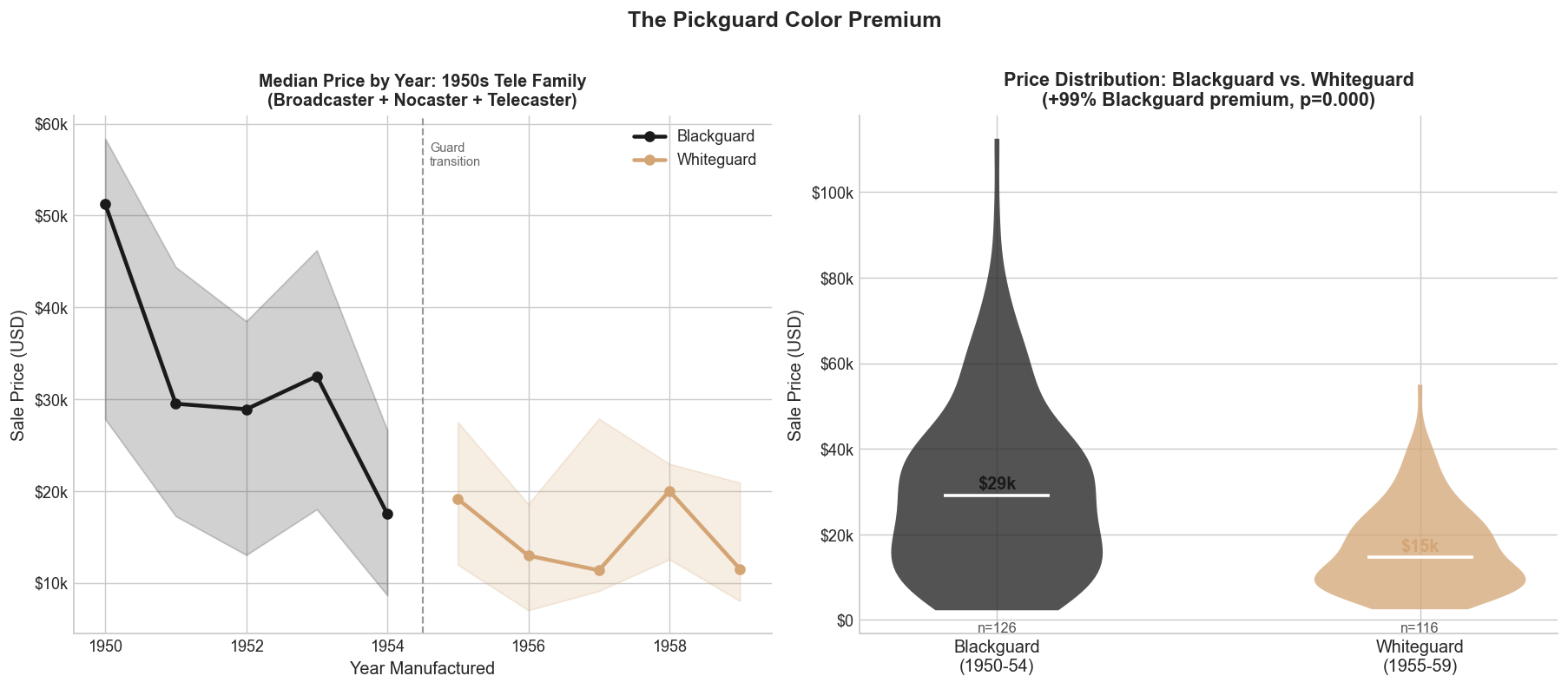
The Blackguard era (1950–1954) gets its name from the black phenolic pickguard. Fender switched to white plastic mid-1954. Collectors have treated this transition as definitive for decades. The data confirms this judgment, with blackguards fetching a consistent premium to whiteguards.
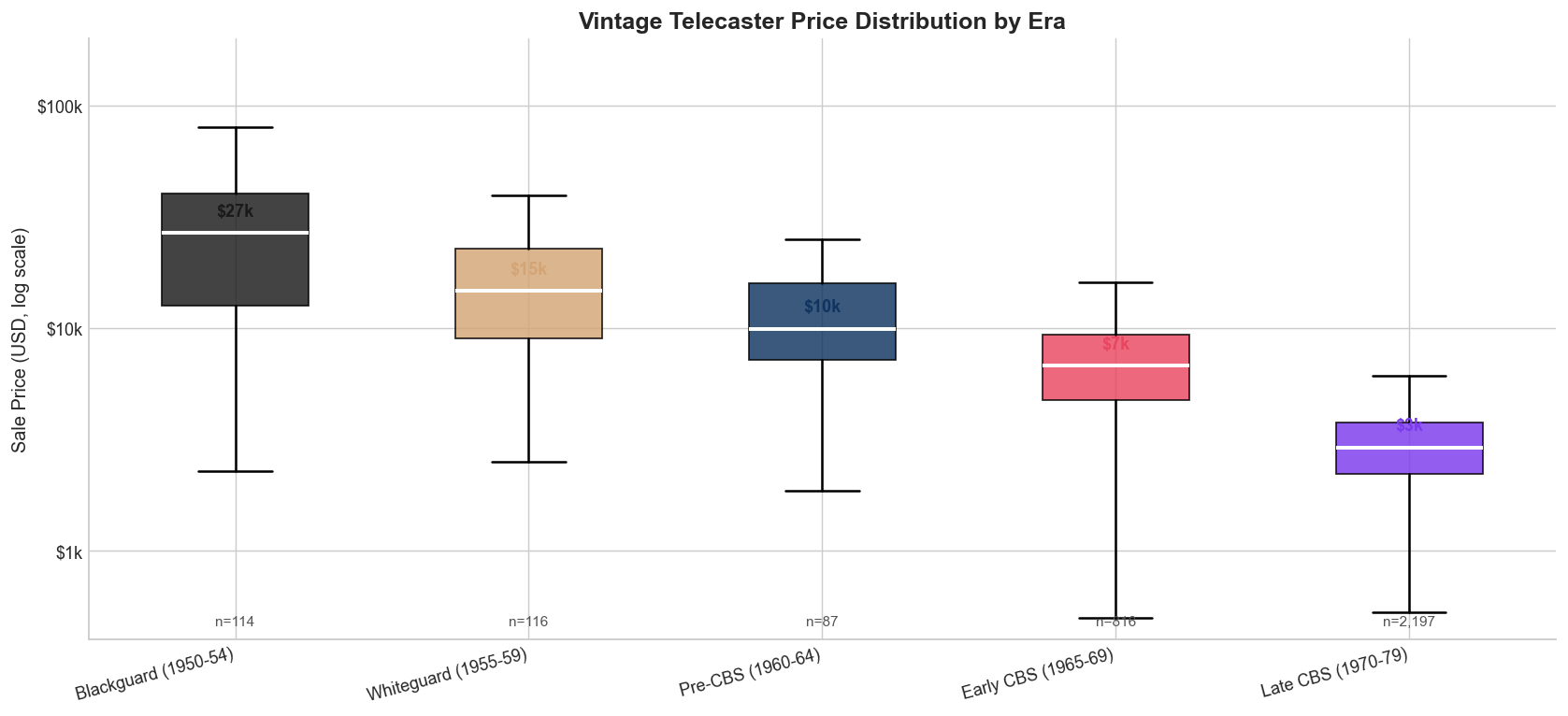
Blackguard median: $29,200. Whiteguard median: $14,645.
Year-by-year, the transition is visible as a clear step down at 1954–1955. The 1954 transition year is particularly interesting: Fender changed the guard mid-production, meaning some 1954 guitars have black guards and some have white. The year label alone can't distinguish them, which is why physical inspection and documentation matter especially for '54 examples.
1952 and 1953 are the strongest individual years, both commanding medians above $28,000. Both are solidly mid-Blackguard production with the canonical spec: maple neck, ash body, butterscotch blonde, two-pickup configuration. Condition and originality do more to move price within these years than year-to-year differences.
The Whiteguard era ($14,645 median) remains serious collector territory. The 1955–1959 span includes some desirable spec variations — refinements to the bridge, gradual body weight changes — but none of them overcome the pickguard premium in collector psychology. A Whiteguard is not a Blackguard, and the market prices that accordingly.
The CBS Cliff
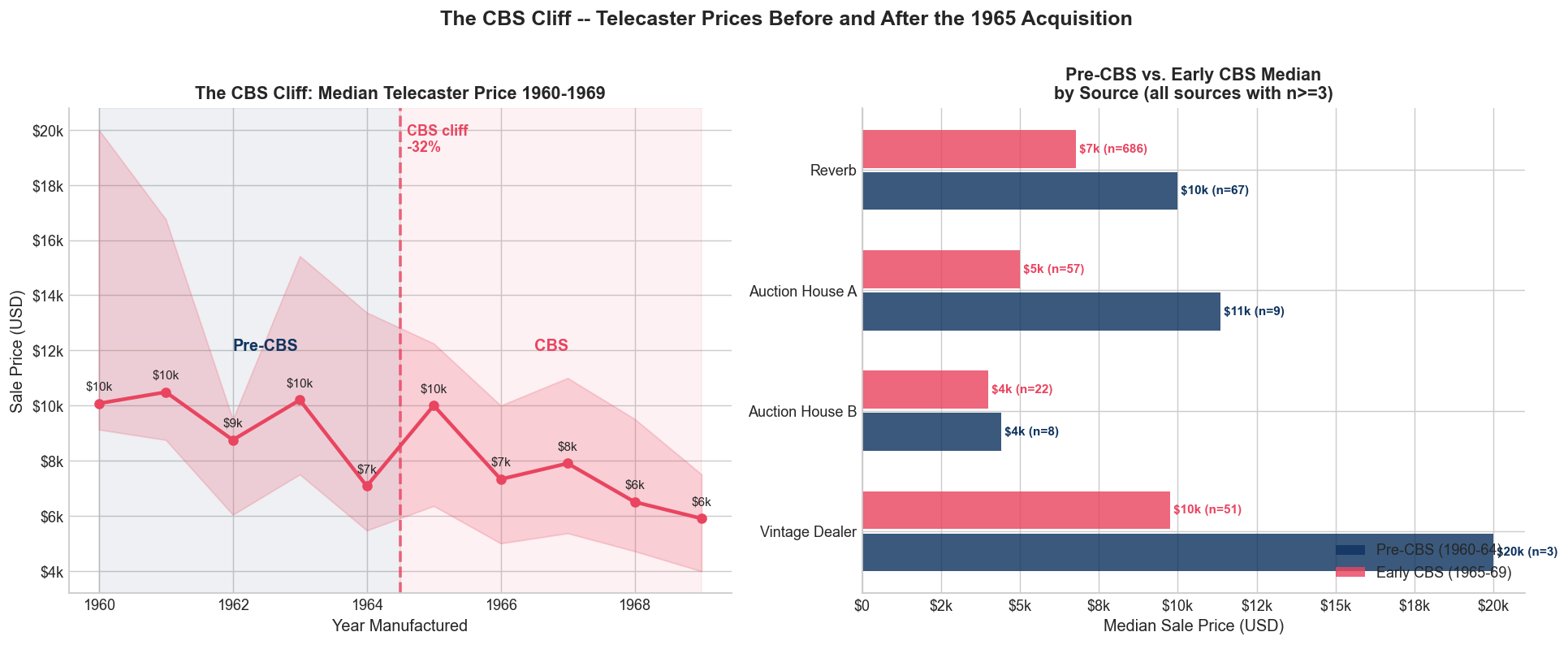
The CBS "cliff" is more of a slope. The acquisition in January 1965 triggers an immediate sentiment discount, but the physical changes collectors actually object to — the large headstock (1965–66), thicker polyester finishes (1968+), three-bolt neck and Micro-Tilt system (1971) — arrive in stages over several years. The year-by-year data reflects this: early CBS examples from 1965–1966 that predate most spec changes still trade at premiums within the era.
The cross-source chart here is meaningful. Both auction houses, the dealer, and Reverb all show the same cliff independently. This is strong evidence the discount reflects genuine market consensus — it's not driven by any particular buyer pool. For a broader look at how the CBS transition plays out across all Fender models — and why it's better understood as a model-specific staircase than a single one-time cliff — see our CBS transition analysis.
Condition Is the Variable That Matters Most
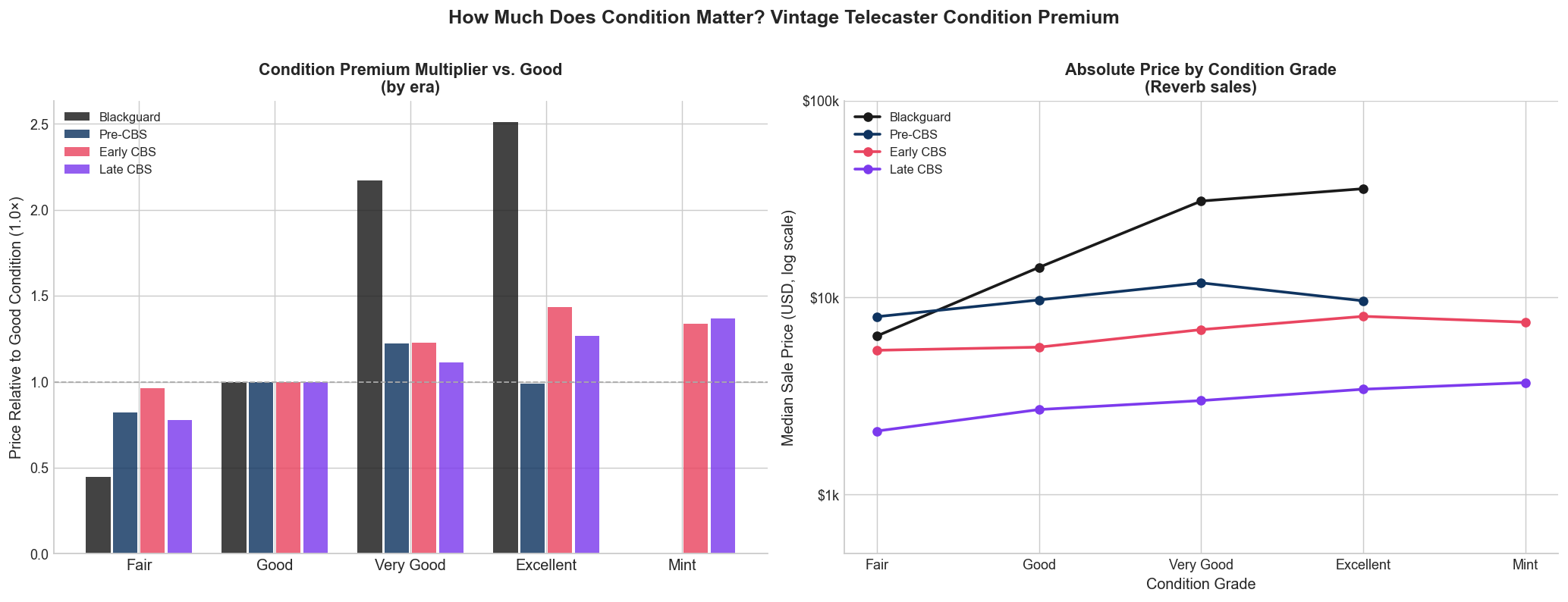
| Grade | Blackguard median | Multiplier vs. Good |
|---|---|---|
| Fair | $6,375 | 0.45× |
| Good | $14,225 | 1.0× (baseline) |
| Very Good | $30,899 | 2.17× |
| Excellent | $35,701 | 2.51× |
That's a $29,000+ spread between Fair and Excellent on the same era of guitar. The wide IQR visible in the Blackguard era box plot — where examples range from $8,800 to $46,200 (10th–90th percentile for 1952 alone) — is almost entirely explained by condition variation.
For Late CBS guitars (1970–1979), the condition spread narrows considerably. The absolute prices are lower and the relative premiums for better condition are less dramatic. This makes Late CBS guitars relatively forgiving purchases — you're less exposed to a single condition-grade misrepresentation.
The practical implication runs counter to how most buyers think about this market: condition grade should be your first question, before year, before variant, before finish. A Very Good 1955 Whiteguard ($16,500 median) outperforms a Good 1952 Blackguard ($14,225 median) despite the Blackguard era's premium reputation.
The Refinish Penalty
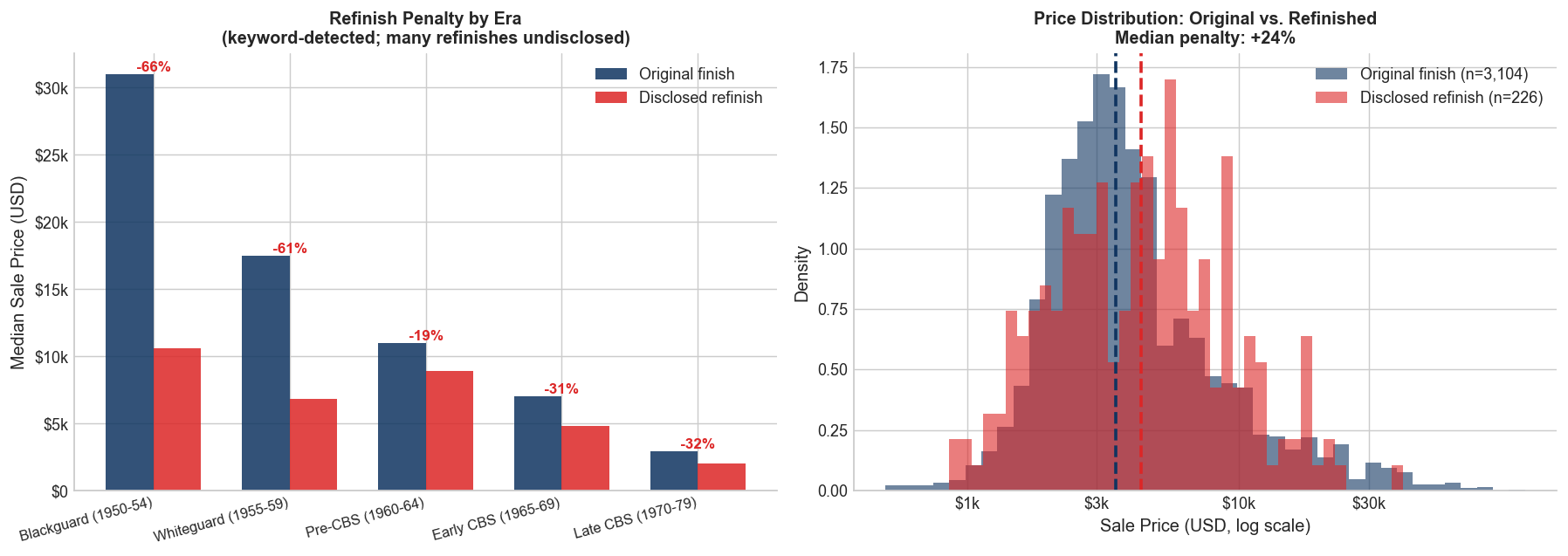
Original finish is one of the hardest things to replace and one of the first things serious collectors check. The data shows the market treats originality as essentially binary: either you have it or you don't.
A refinished Blackguard doesn't trade as a premium Blackguard with an asterisk. It trades closer to an original-finish Whiteguard, at best. The same guitar, different finish, half the price.
The detection problem is real. Some sellers genuinely don't know a guitar has been refinished. Others list it euphemistically — "professionally done," "aged to match," "vintage-correct." Physical inspection, UV light examination, and documentation review are essential before any purchase above the Late CBS tier.
For a much deeper dive into vintage Fender finishes, refinishes, and how they affect market value, check out this other AxeDB research post.
Custom Color Premiums
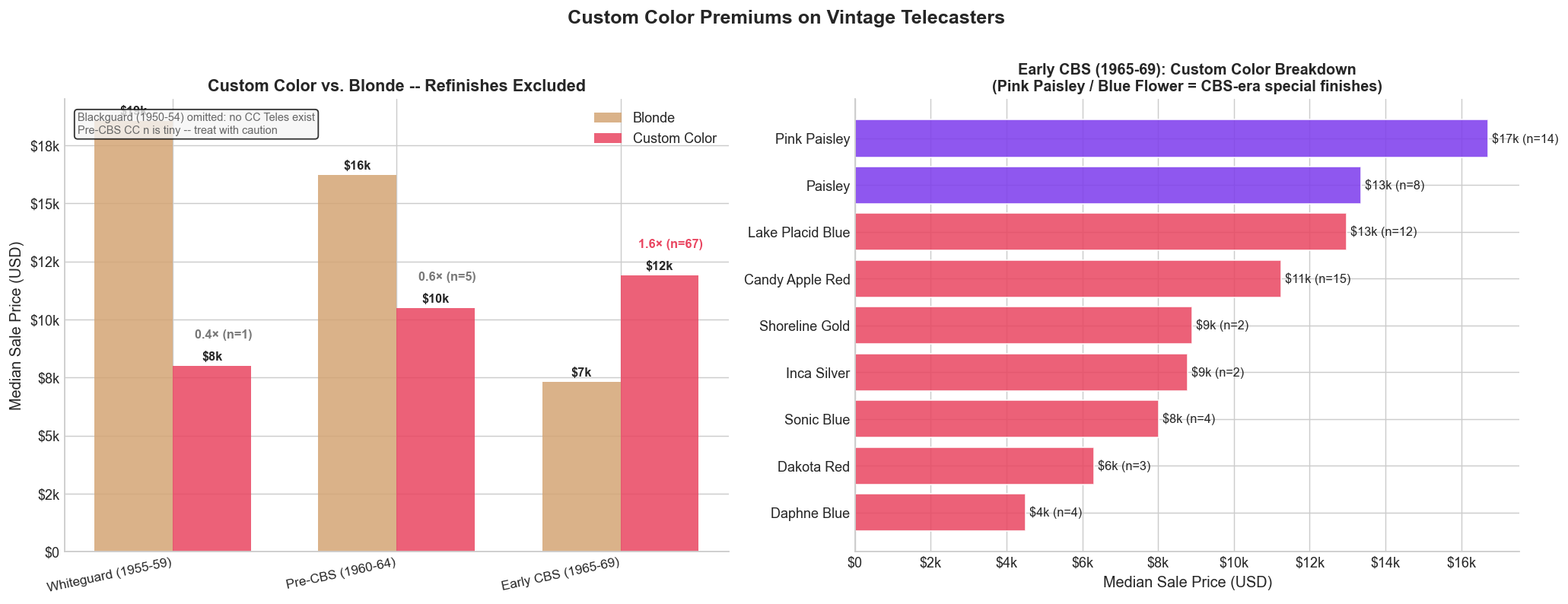
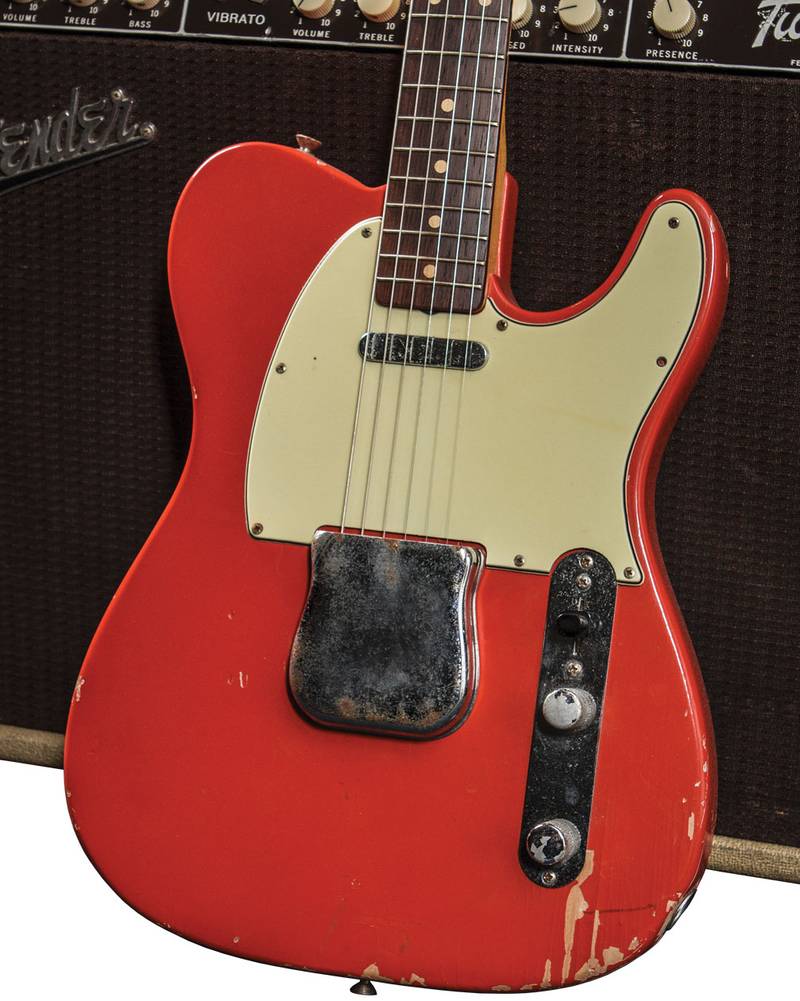
The Custom Color premium in the Telecaster market is real, but context matters. CBS-era Custom Colors are the clearest case. Factory colors like Fiesta Red, Lake Placid Blue, Sonic Blue, and Candy Apple Red command roughly 2–3× their blonde equivalents. These guitars are documented from factory records, visually distinctive, and genuinely scarce within production.
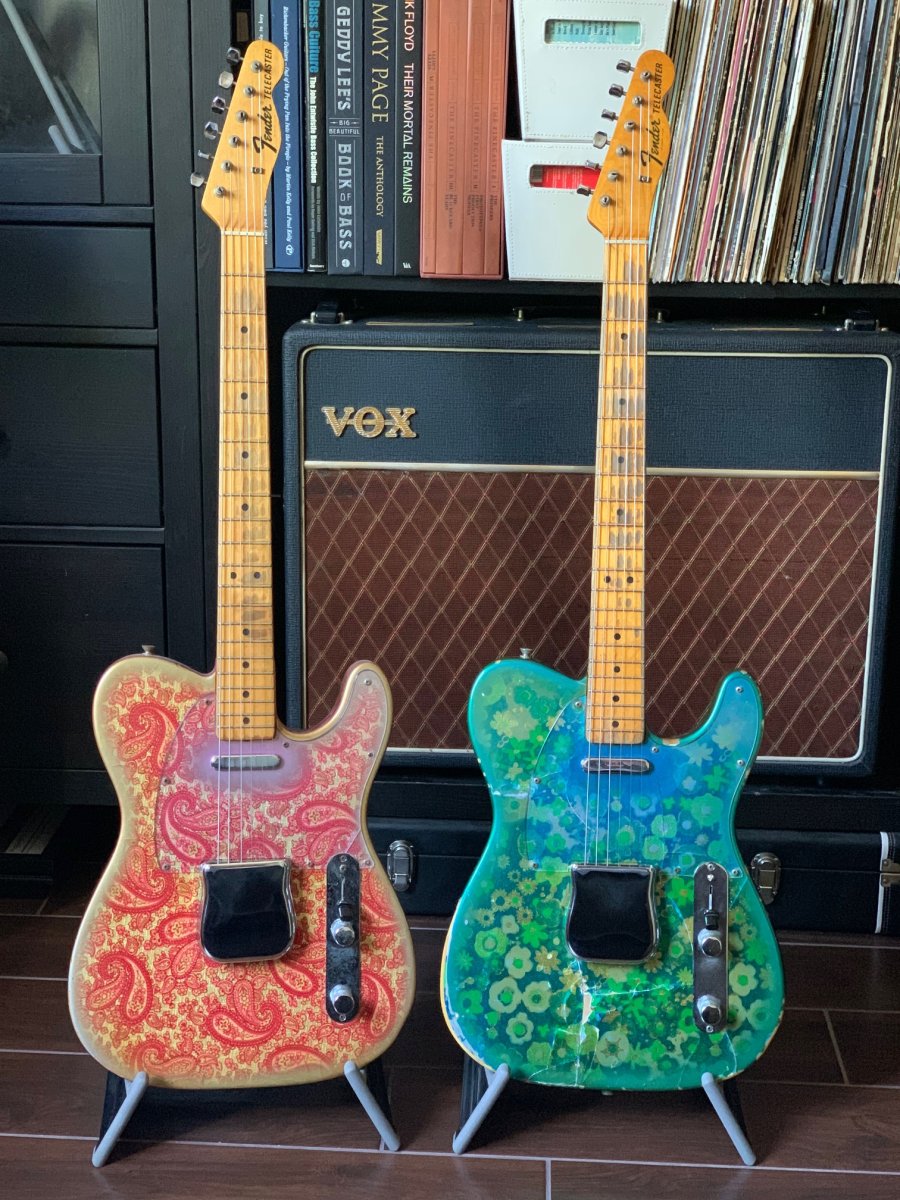
Paisley and Blue Flower occupy a category of their own. These are 1968–1969 factory finishes — wallpaper-print graphics applied over a base coat — and among the most visually extreme production decisions Fender ever made:
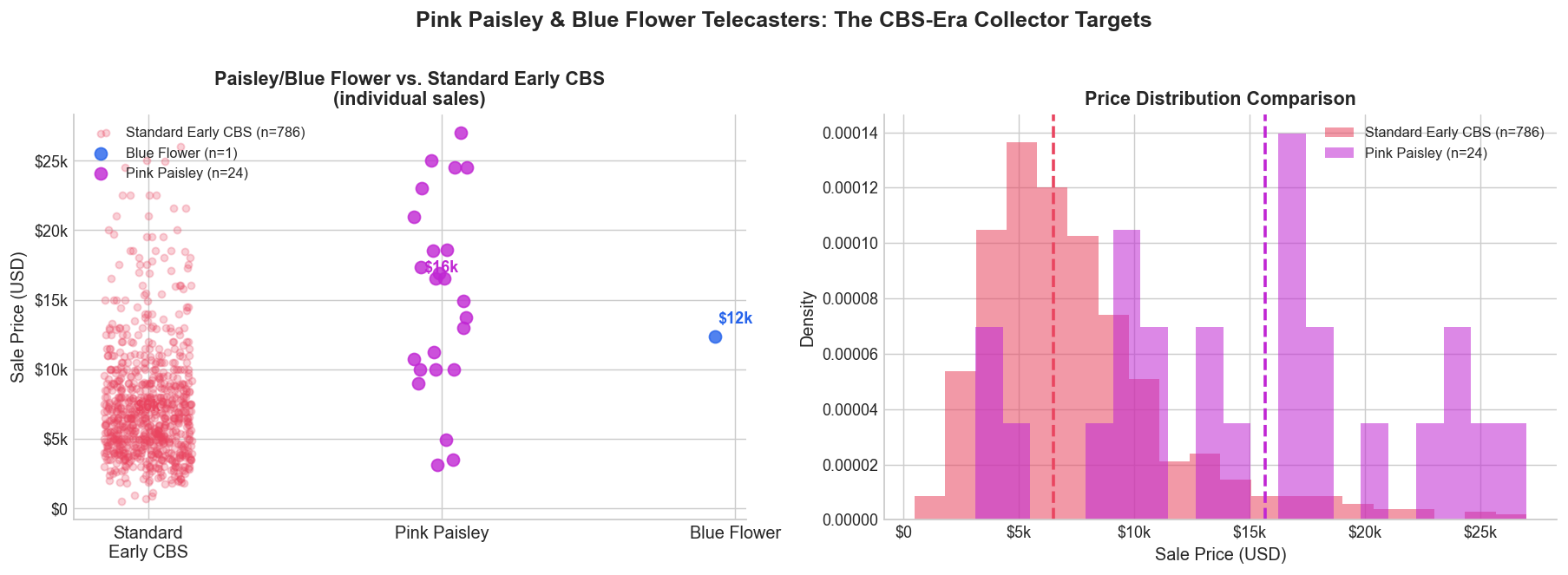
- Pink Paisley: median $15,700 (n=24)
- Standard Early CBS Telecaster: median $6,500
That's a 2.3× premium. These aren't obscure collector items — they're widely recognized as desirable and genuinely scarce.
Pre-CBS Custom Colors are more complicated. Our dataset contains fewer than 10 confirmed original-finish Custom Color Telecasters per pre-CBS era, making confident median estimates impossible. The apparent premiums in the raw data are also inflated by confusion between original Custom Color finishes and refinishes into desirable colors. A "Sonic Blue" Telecaster might be a factory original or a refinish — and the difference in value is roughly 2×.
Similar to the issue we had with Broadcaster and Nocaster data, genuine, clean-condition, early custom colors just don't show up in visible sales sources often. They're rare to begin with and often trade via private sales.
Again, this is explored in depth in another research project if you'd like to go deeper on custom colors and special Telecaster finishes.
The Esquire: Rethinking the "Discount"
Conventional wisdom holds that the Esquire — Fender's single-pickup Telecaster variant — trades at a 25–30% discount. The data says this is mostly wrong, and the explanation reveals something interesting about how condition and finish interact across the market.
Raw comparison, all records:
| Era | Esquire | Telecaster | Difference |
|---|---|---|---|
| Blackguard (1950–54) | $25,000 | $26,635 | −6% |
| Whiteguard (1955–59) | $17,440 | $14,645 | +19% |
| Pre-CBS (1960–64) | $14,340 | $9,900 | +45% |
| Early CBS (1965–69) | $7,925 | $6,750 | +17% |
In the raw numbers, Esquires look more expensive in three of four eras. But the controlled analysis changes the picture significantly.
Controlled for original finish and Good+ condition:
| Era | Esquire | Telecaster | Difference |
|---|---|---|---|
| Blackguard (n=10 Esq) | $27,000 | $28,900 | −7% |
| Whiteguard (n=48 Esq) | $16,150 | $15,750 | +3% |
| Pre-CBS (n=15 Esq) | $12,999 | $11,375 | +14% |
| Early CBS (n=16 Esq) | $7,925 | $7,000 | +13% |
The Whiteguard "premium" collapses to +3% on a like-for-like basis. The explanation: Whiteguard Esquires reach market with original finishes at a meaningfully higher rate (10.5% refinish rate) than Telecasters (18.1%). Refinished guitars trade at steep discounts, so a Telecaster pool that's nearly one-fifth refinished will show a lower median — not because collectors value Telecasters less, but because the pool contains more discounted examples.
The controlled finding: The traditional Esquire discount exists only in the Blackguard era, where it's approximately −7% — far below the conventional 25–30% estimate. In every later era, Esquires trade at parity or a small premium to equivalent Telecasters. An Esquire is not a backdoor to the same guitar for less money. What you're buying when you pay Esquire prices is, in part, a guitar that has arrived in better shape.
The Pre-CBS and Early CBS premiums (+14%, +13%) persist after controls but are not statistically significant at these sample sizes (n=15 and n=16 Esquires respectively). Treat them as suggestive rather than definitive. In practice, an Esquire discount likely does exist when holding condition, finish, and year constant; this data likely just shows that people historically kept their Esquires in better shape for future sales.
Also note that this Esquire-vs-Telecaster designation does not take into account the nuance that many Esquires are actually double Esquires, or esquires that were either modded or custom-ordered to feature a neck pickup. It's likely that an Esquire discount would be more visible in the data if controlling for single- vs. double-pickup models.
Special Variants
The Rosewood Telecaster (1969–1972)
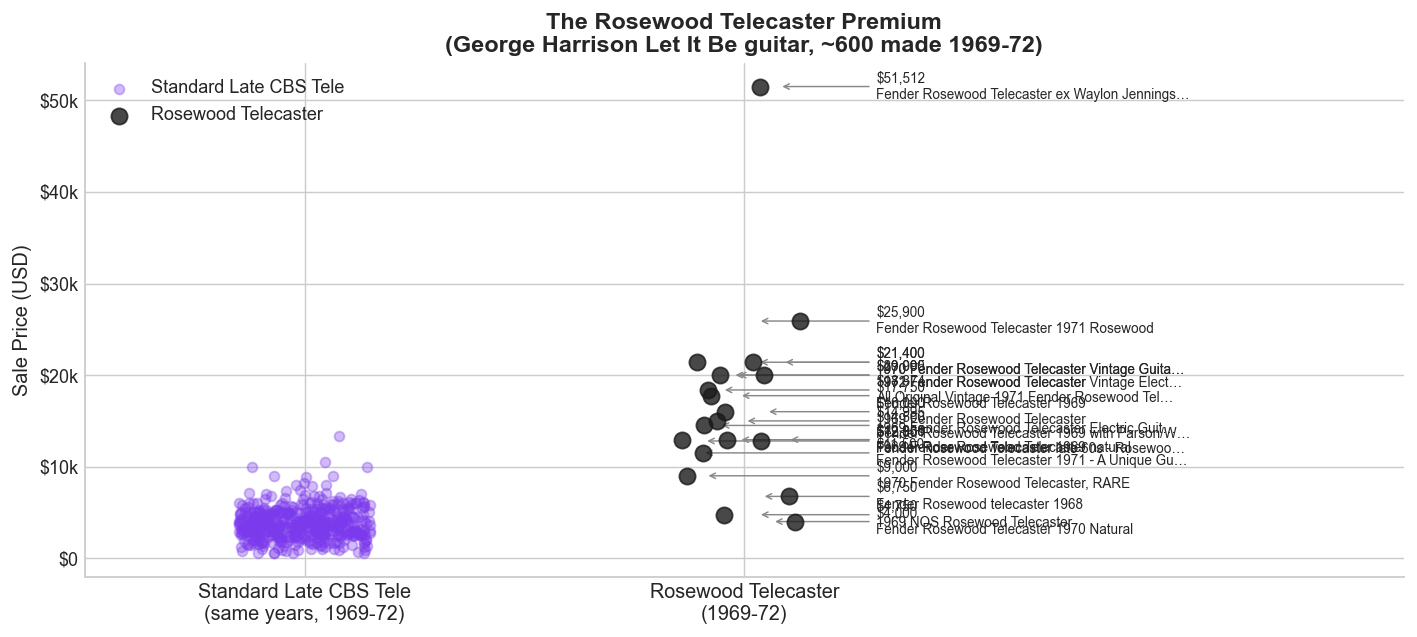
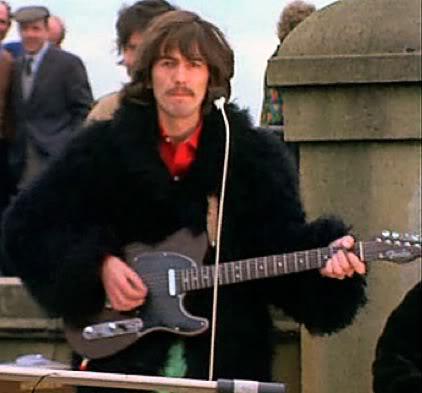
The Rosewood Telecaster is a separate collectible that happens to share the Telecaster shape. Fender made approximately 100 of these — all-rosewood body and neck, inspired by the guitar George Harrison played at the rooftop concert — between 1969 and 1972. Our 19 verified sales range from roughly $12,000 to $51,512, with the Waylon Jennings provenance example at the top end.
These are excluded from all other Telecaster pricing figures in this report. Mixing them in would distort era medians in both directions, since they're a different collectible market priced on different factors.
The 1958 Spike: It's Not the Toploader
1958 Telecasters trade at a persistent premium over adjacent years:
| Year | n | Median |
|---|---|---|
| 1956 | 25 | $12,950 |
| 1957 | 26 | $11,350 |
| 1958 | 15 | $20,000 |
| 1959 | 33 | $11,500 |
| 1960 | 22 | $10,075 |
The common attribution is the "toploader" bridge configuration — some 1958 guitars have strings loading through the body, some through the bridge plate. We tested this directly. Toploader examples (n=2, median $14,750) show lower prices than standard 1958 examples (median $21,500). The toploader does not drive the premium; if anything it's a mild drag.
A possible driver is that 1958 is the last full year of the all-maple fretboard. In 1959, Fender switched to a rosewood slab board glued to a maple neck. It's also possible that some of these are, in fact, toploaders and it's just difficult to tell from the data without inspecting individual listing images.
The volume of data is thin throughout this range (15 records for 1958), so a small number of high-condition examples can move the median meaningfully. Read the 1958 figure as directional rather than definitive; it's surprising enough that it could be a bit flukey.
The Late CBS Era
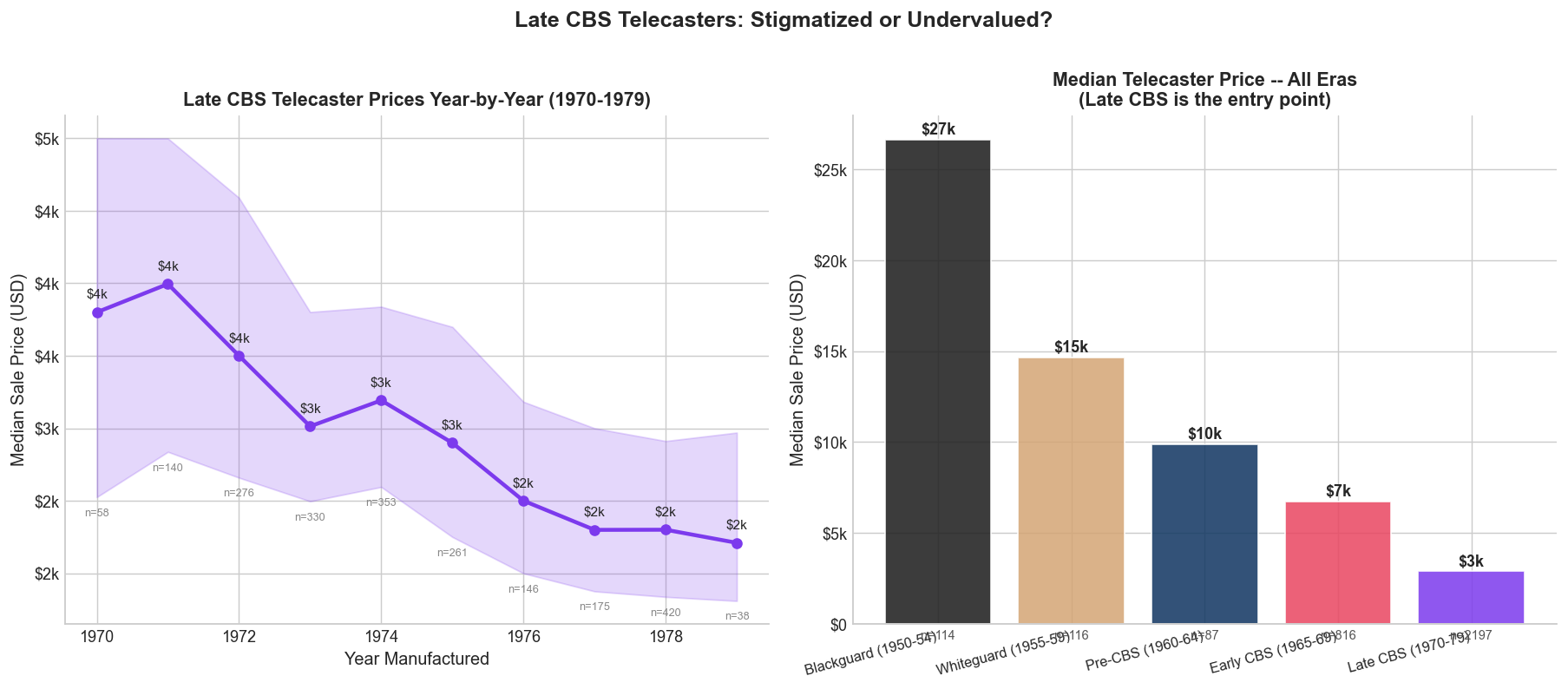
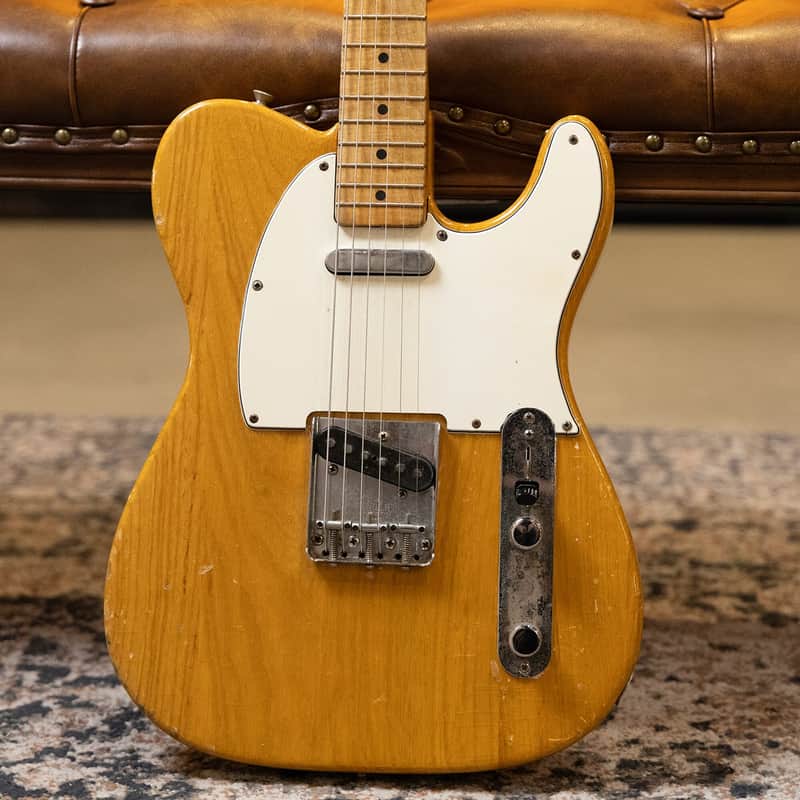
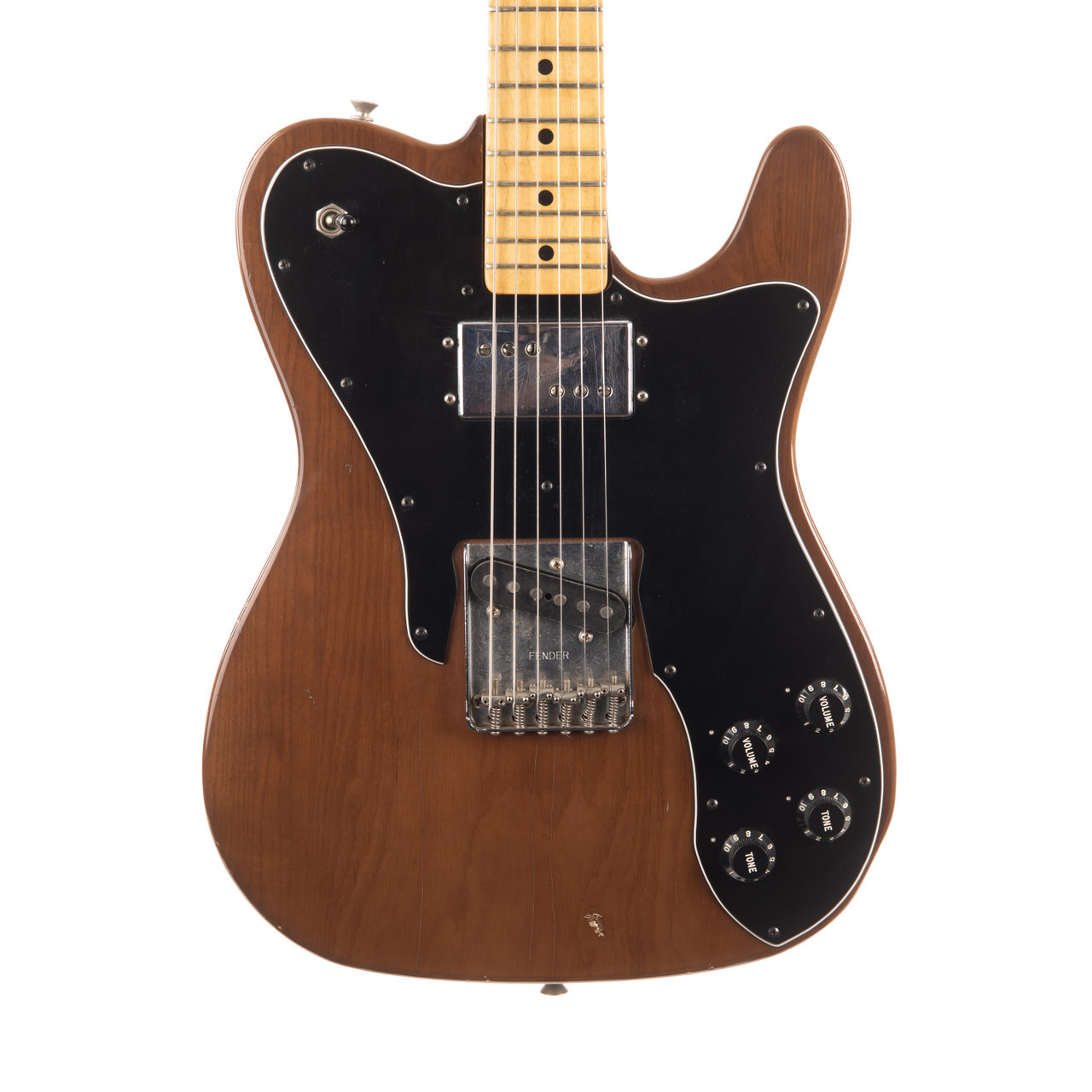
The Late CBS era (1970–1979) is where most of the market volume lives: 2,198 of 3,509 records, at a $2,900 overall median. Values decline progressively through the decade as CBS spec changes accumulate, sales volume grows, and collectibility declines.
The three-bolt neck, introduced in 1971, is the most widely criticized CBS change among players — it affects neck stability and is a clear marker of the cost-reduction era. 1970 and early-1971 examples that predate this change trade at a premium within the era (~$3,800–$4,000 median vs. mid-$2,000s for late-decade examples).
For players rather than collectors, Late CBS guitars offer the best dollar-per-guitar value in the vintage market: the core Telecaster design is intact, parts availability is excellent, and the aging has stabilized. The stigma is real but the instruments are playable.
Market Appreciation
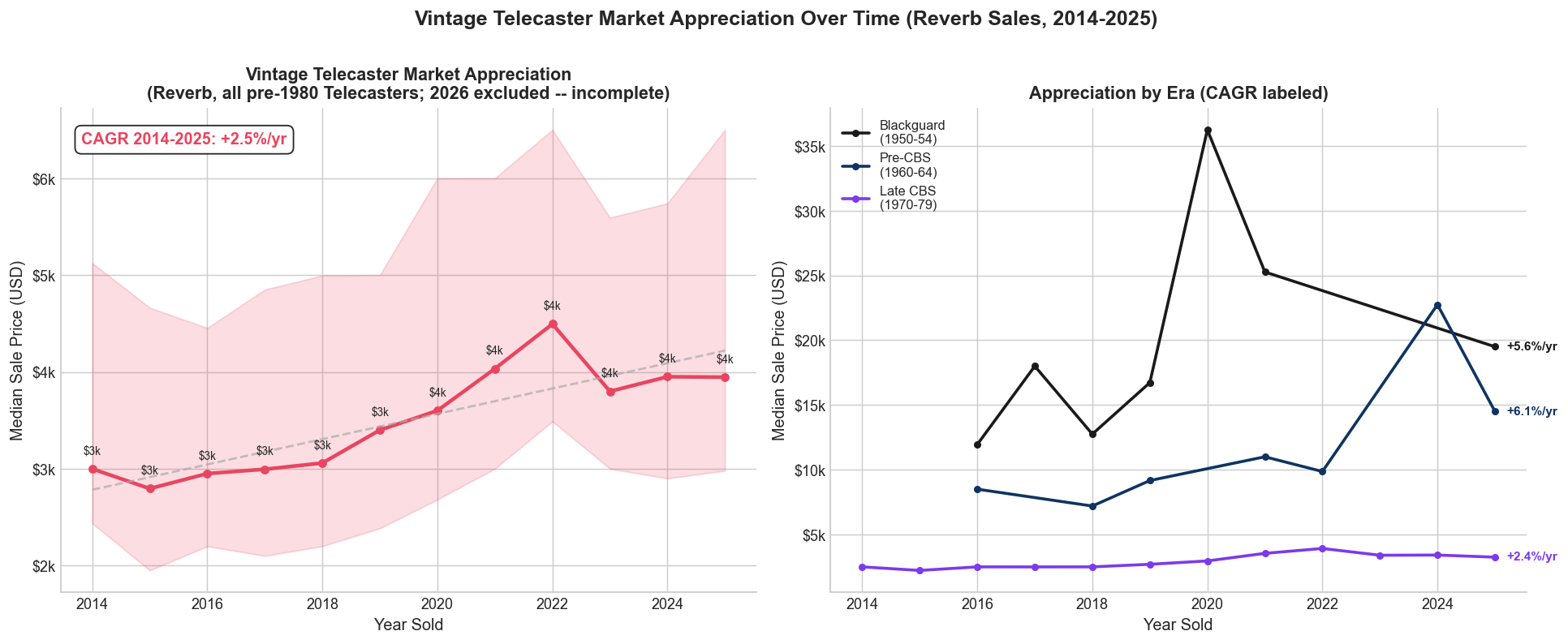
Looking at Reverb sale prices from 2014 to 2025, the overall vintage Telecaster market appreciated from a $2,999 median to ~$3,950. That's a compound annual growth rate of approximately 2.8% — modest relative to broader asset classes.
For reference, the S&P 500 returned roughly 13% annually over the same period. The overall vintage Telecaster market — heavily weighted by Late CBS guitars, which dominate transaction volume — materially underperformed a broad equity index over this timeframe.
The COVID bump unwound. The 2020–2022 period produced a sharp spike: median peaked at $4,495 in 2022, up roughly 50% from 2018 levels. By 2023–2025, prices settled back to $3,800–$3,950. Buyers who purchased at 2021–2022 peak prices may be sitting at nominal losses.
Important caveat: The 2.8% CAGR reflects the whole market, dominated numerically by Late CBS guitars. Blackguard and Broadcaster examples — which trade primarily at auction and through specialist dealers — may follow a different trajectory. Our Reverb dataset has too few annual Blackguard sales to compute a reliable era-specific appreciation rate. The limited auction data we have shows Blackguard prices holding significantly above pre-2020 levels, but this cannot be quantified with confidence from the current dataset.
A Blackguard in good condition may well perform like a decent investment if you're willing to hold for a long time. These things are rare. There aren't many buyers and historic sales data is thin, but they do seem to appreciate with time. This blog's opinion is that, if you want to grow your net worth, or if you think you may ever need quick access to funds, you should probably invest in index funds. Maybe real estate. However, if you have the money sitting around and will play, or at least enjoy looking at a vintage Tele hanging on the wall, you should go for it and just enjoy the price appreciation as a nice side effect. You'll probably at least get your money back in the end if you treat it well - you can't say that about a lot of other expensive purchases.
Source Comparison
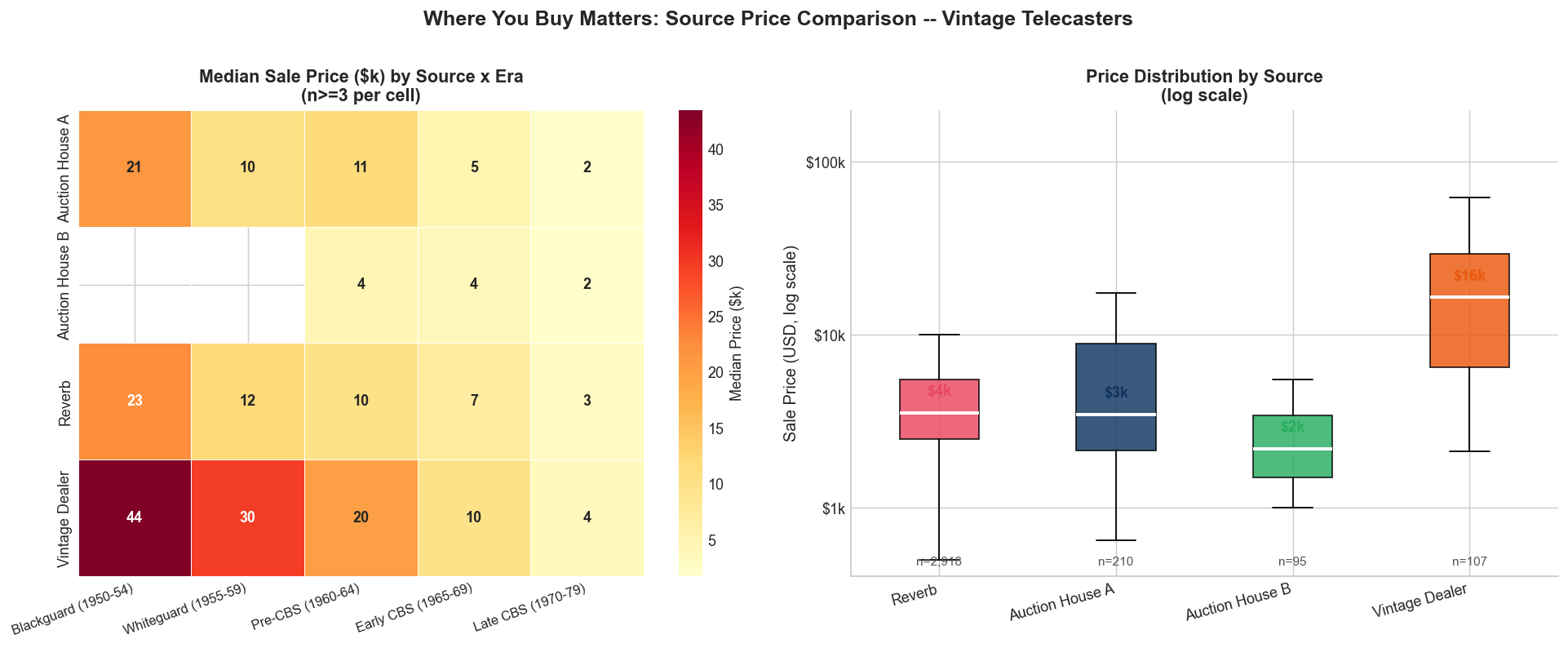
The four sources in this dataset tell a consistent story about relative values, with some expected differences in absolute levels:
- Reverb dominates the dataset by volume and skews toward the mid-market. It captures the broadest range of conditions and seller sophistication.
- Auction House A (a major US auction house) attracts well-documented, high-condition examples with motivated buyers. Expect slightly higher median prices at the premium end.
- Auction House B (a UK specialist auction house) has lots that appear to skew toward lower condition, particularly in the Pre-CBS era — likely reflecting the UK vintage market having different condition standards than US examples.
- The dealer (a specialist New York vintage dealer with published sale prices) offers curated, typically well-documented inventory.
Auction buyer's premium note: Auction house prices throughout this report are hammer prices — the final bid. Buyers pay an additional buyer's premium of approximately 20–25% on top of the hammer price. Factor this in when comparing auction prices to Reverb or dealer prices. An auction lot that hammers at $30,000 costs the buyer roughly $36,000–$37,500 all-in.
Buying Considerations
A few things the data consistently supports across budget levels:
Condition grade outweighs year label. In the Blackguard era, condition explains a 5.6× price range on the same era of guitar. Prioritize condition documentation — Reverb's standardized grades, auction house condition reports, independent appraisals — before focusing on the year.
The refinish question is binary. There's no such thing as a "lightly refinished" guitar that trades at 80% of an original. The market discounts refinishes by roughly half, consistently. Verify before purchasing.
Esquires are not cheaper Telecasters. On a like-for-like basis (original finish, equivalent condition), Esquires trade at parity or a small premium to Telecasters in every era except Blackguard. If you find an Esquire priced significantly below an equivalent Telecaster, understand why.
Auction prices are not sticker prices. Add 20–25% buyer's premium to any hammer price. A $25,000 auction hammer is a $30,000–$31,000 acquisition.
The Late CBS stigma is real, but so is the playability. The collectible market heavily discounts post-1965 guitars, but the instruments function fine and offer the best dollar-per-vintage-guitar value in the market. 1970–1972 examples are the sweet spot within the era.
Methodology
Dataset: 3,509 verified sales, manufacture years 1950–1979.
Filters applied:
- Sold status, sale price $500–$150,000, not a reissue or modern parts guitar according to series or an LLM analysis
is_custom_shopexcluded (1,418 records): modern Custom Shop reproductions tagged with the vintage year they replicate, not their actual production yearis_partscasterexcluded (199 records)has_celebrity_provenanceexcluded (21 records): guitars whose price is set by ownership history rather than instrument characteristics- Rosewood Telecasters isolated as a separate variant (n=19)
- Extreme outliers (>5× era median) removed after all above exclusions
Refinish detection: Combined regex keyword matching in listing titles with LLM-labeled is_refinished flags from auction lot descriptions. 88 additional refinished guitars were identified by a further LLM analysis.
Condition data: Available for Reverb records only (~83% of the Reverb subset). Auction lots are excluded from condition analysis because the auction houses use non-standardized condition descriptions.
Auction buyer's premium: All auction prices in this report are hammer prices. Buyers pay approximately 20–25% additionally. Prices are not adjusted for this in the data — apply the premium mentally when comparing to Reverb or dealer prices.
Appreciation analysis: Reverb only, 2014–2025. Sale year derived from listing date or sold date. Late CBS guitars dominate the volume, so the overall CAGR reflects that tier more than Blackguard or Whiteguard eras.
Data source: AxeDB.com — guitar market data aggregated from Reverb, multiple auction houses, and specialist dealers. The full underlying dataset is not publicly downloadable, but the per-model and per-era price data is available throughout the site.