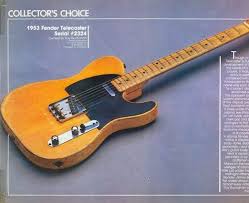
Roy Buchanan found Nancy while he was trying to leave music. Around 1969, during a rough patch that included a stint at barber school in Bladensburg, Maryland, he saw a man walking by with a battered Telecaster; Buchanan ran out mid-haircut and traded for it that same day. What made Nancy important was that Buchanan turned an early blackguard Tele into a control surface for volume swells, faux-wah tone sweeps, harmonics, and a kind of vocal phrasing most players still can’t convincingly replicate. That's why we remember Nancy by name while other blackguards just get a serial number.
Why This Guitar Matters
- It is the clearest single guitar associated with Buchanan’s core vocabulary. If you want to understand the bloom of the swells, the pinched “whistlers,” and the steel-guitar-like tone-knob moves people still associate with him, Nancy is the place to start.
- Its most interesting documented feature isn’t a rare factory spec but a functional one. Guitarist described Nancy as retaining a “pre-’52 wiring” blend-style circuit — a much more useful detail for players than any generic “blackguard Tele” label.
- It matters as a player’s instrument, not a preserved collectible. High action, a penny under the middle saddle, and improvised stringing are all part of the story; it's a classic, beat up, workhorse instrument.
- It is unusually knowable for a guitar tied to a relatively under-commercialized artist. The 1971 WNET documentary, the 1982 Noë Gold / John Peden documentation, and the Fullerton Museum Center exhibit give Nancy a stronger paper trail than many famous working guitars from the same era.
- "The Messiah Will Come Again" (1972). The track Guitarist magazine explicitly ties to "his Tele 'Nancy'" is one of the most referenced examples of what a Telecaster can do in expressive hands
The Instrument
Specs
| Feature | Detail | Source |
|---|---|---|
| Make / Model | Fender Telecaster | — |
| Year | 1953 | Noë Gold, exhibit plaque photo (Flickr) |
| Serial | #2324 | Noë Gold, exhibit plaque photo (Flickr) |
| Body | Ash (standard blackguard-era spec) | Standard period spec |
| Neck | Single-piece maple neck | Standard period spec |
| Wiring / control scheme | Reported by Guitarist (May 2019) as “pre-’52 wiring” — a blend-style circuit rather than modern Tele switching: position 1 = bridge with neck blend control; position 2 = neck only (lower control inactive); position 3 = neck with capacitor roll-off | Guitarist, May 2019 Telecaster feature |
| Action | “Pretty high” | Vintage Guitar, “Roy Buchanan” |
| Sustain modification | Penny placed under the middle saddle to affect D and G string height / sustain | Vintage Guitar, “Roy Buchanan” |
| Strings | Improvised lighter-gauge approach; included using a tenor banjo A string as a high E substitute | Vintage Guitar, “Roy Buchanan” |
| Pickups | Not documented in a public inspection record; bridge pickup often described in secondary sources as unusually lively, possibly somewhat microphonic | ToneQuest Report; secondary descriptions |
| Finish | Butterscotch blonde | Visible in photos |
| Current location | Last publicly documented on loan from collector Mac Yasuda to the Fullerton Museum Center’s “Solid Design: Leo Fender’s Telecaster” exhibit; current custody not known | Noë Gold, exhibit plaque photo (Flickr) |
What's interesting here is that the wiring and setup choices made Nancy behave less like a stock modern Tele and more like a built-in effects box. Buchanan had access to a bridge sound, a darker preset neck sound, and a continuously variable bridge-to-neck blend without touching a pedal. He used this extensively for swells.
The penny under the middle saddle is also interesting, changing the resonance and sustain on the D and G strings specifically. It's not equivalent to shimming the bridge; it's a saddle-contact modification affecting only those strings. The effect is audible on sustained bends in the middle register.
The high action works in combination with both: clean note clarity at aggressive deflections, and sustain long enough for the volume swell to bloom before the note starts dying.
Nancy's Tone and Rig Rundown
For Buchanan’s best-documented working period in the early and mid-1970s, the basic live formula was Nancy into a Fender Vibrolux Reverb, often with the amp turned toward the back wall rather than straight at the audience. The point was clean headroom, not distortion. The effects were mostly in his hands and in the guitar’s controls.
The best-documented later rig is the 1982 Telly Talk / John Peden–Noë Gold session: Nancy into a Fender Bassman (5F6-A, 4×10) with a 1961 brown Fender 6G-15 outboard spring reverb. That is a different context from the early live rig, and it should be treated that way: a documented 1982 snapshot, not necessarily the definitive Buchanan setup for every era.
- Attributable to the guitar: the Telecaster platform itself, the blend-style wiring, the directness of a blackguard-style bridge pickup, and the physical setup choices that favored clean bending, long note bloom, and sustained swells.
- Rig-dependent: clean Fender amps with headroom, especially Vibrolux/Bassman-type circuits; outboard spring reverb adds space, but it is not the source of the articulation.
- Player-dependent: the whole thing people actually hear as “Roy Buchanan” — pinky volume swells, tone-knob sweeps, pinch harmonics, vocal-width vibrato, and the timing to let notes bloom instead of filling every gap.
If you could only copy three things from this setup:
- Practice volume swells, any T-style guitar with this technique will do.
- Use a clean Fender-style amp with enough headroom that your right hand, not preamp gain, defines the note.
- Blend-circuit wiring (or at minimum a modified Tele wired for neck/bridge blend access from a single knob)
Provenance: Where It's Been
How the artist got it
Bladensburg, Maryland, around 1969. According to the Vintage Guitar biographical feature, Buchanan enrolled at the Bladensburg Barber School in January 1969 during a difficult period; he had decided to learn a trade. Someone walked past the school carrying a battered Telecaster. Buchanan abandoned his work mid-haircut, pursued the man, and felt compelled to acquire the guitar on the spot. The same day, he sourced a purple Telecaster and traded straight across.
The acquisition story tells us a few things: the guitar had seen hard use before Buchanan got it ("battered" is the consistent description), and he acquired it as an object of immediate personal connection rather than a vintage-market calculation.
Ownership timeline
| Period | Owner | How acquired | Notable changes |
|---|---|---|---|
| Early 1950s–~1969 | Unknown prior owners | Not documented | Guitar already described as battered by time Buchanan acquired it |
| ~1969–1988 | Roy Buchanan | Traded for in Bladensburg, Maryland, during barber-school period | High-action setup documented; penny-under-saddle tweak documented; any electronics or pickup changes beyond that are not fully traceable in public sources |
| Post-1988 | Estate / heirs / later private hands | Buchanan died August 14, 1988 | Public chain not fully documented |
| By ~2008 | Serial collector Mac Yasuda (has lent it out for display at times) | Not publicly documented | Loaned to Fullerton Museum Center exhibit |
Timeline: How It Changed
| Era | What changed | Why | Evidence |
|---|---|---|---|
| Pre-acquisition | Guitar already worn / battered | Prior working life before Buchanan | Vintage Guitar, “Roy Buchanan” |
| ~1969 or shortly after | High action and penny-under-middle-saddle setup documented | Clean bends, sustain, response on D and G strings | Vintage Guitar, “Roy Buchanan” |
| 1971 | Nancy appears in Buchanan’s WNET documentary era | Establishes the guitar in his public image | American Archive of Public Broadcasting |
| Late 1970s | Buchanan reportedly set the guitar aside for a period after theft attempts and a possible repair-related pickup issue | Security concerns and possible damage | Vintage Guitar, “Roy Buchanan” |
| June 1982 | Nancy documented in the Noë Gold / John Peden session and Telly Talk material | Creates the clearest late-period visual/documentary record | Noë Gold, “Nancy above the nut” |
| ~2008 | Public museum display | Confirms serial, year, and public exhibit status | Noë Gold, exhibit plaque photo (Flickr) |
There's some gaps, but overall the instrument has fairly consistent provenance and its changes over time are well documented.
Visual Record


Essential Listening
This is not a “best songs” list. It is a guided listening path for what Nancy lets you hear.
- “The Messiah Will Come Again” (Roy Buchanan, 1972) — The opening notes are the cleanest Buchanan primer there is. Listen to how the notes bloom after the pick attack instead of arriving fully formed. That is the volume-knob technique doing the heavy lifting.
- “Sweet Dreams” (Roy Buchanan, 1972) — Best entry point for his vibrato. The point is not just width; it is control. Sustained notes sound vocal because he lets them sit and then shapes them.
- “Five String Blues” (Second Album, 1973) — Important because it documents Buchanan’s practical, non-purist relationship to strings and setup. The top end has a slightly different feel because of the banjo-string workaround.
- “Tribute to Elmore James” (Second Album, 1973) — One of the best places to hear the tone knob treated as an active filter rather than a parked setting. The sweep sounds like a restrained wah because, functionally, that is what he is doing with his hand.
- “Fly... Night Bird” (You’re Not Alone, 1978) — A good corrective if you think the swells were just ornament. Here they are part of the melodic architecture.
- “Green Onions” (Loading Zone, 1977) — Listen for the bridge attack at the start of single-note phrases. Even if you strip away every myth around Nancy, that directness is still what people are responding to.
Market Context
The comparable basket
1952–1954 Fender Telecaster, blackguard era, butterscotch blonde, maple neck, player grade acceptable, originality flexible if the goal is Buchanan as a playing reference rather than museum purity
That is the right basket because Nancy matters less as a collector-grade 1953 Telecaster than as a famously used one. Prioritize the basic blackguard Tele recipe, a setup that tolerates hard attack, and control access you will actually use. A pristine all-original example is nice if you can afford it, but this guitar's story is one of a workhorse.
Relevant AxeDB model pages:
American Vintage II Telecaster
What actually drives price in this segment
- Original finish vs. refin — a convincing butterscotch refin is still a real discount in blackguard territory, even when the guitar remains a strong player.
- Pickup originality — original early Tele pickups are a major value driver on their own; rewinds and replacements matter materially at this level.
- Neck integrity — shaved or reworked early-’50s necks are common and heavily affect value.
- Hardware correctness — saddles, control plate, switch tip, screws, and tuners matter more here than casual buyers expect.
Famous-guitar premium vs instrument premium
Nancy has no public auction result, which is useful to say plainly. Its value as a provenance object would sit above the market for a comparable 1953 Telecaster, but Buchanan was a musicians’ musician, not a mass-market celebrity, so the premium would not behave like a Clapton or Hendrix number.
As an instrument, the relevant comparison is the blackguard Tele market itself. Clean original examples can run well beyond player budgets; player-grade 1952–1954 Teles are the more realistic target.
Get Your Own
Off the shelf
The closest straightforward production answer is the Fender American Vintage II 1951 Telecaster. It gets you the ash/maple/flat-pole-Tele platform without pretending to be a Buchanan replica. What it does not get you is Nancy’s wiring control scheme or Buchanan’s setup habits; those will take some modification and time on the bench.
If the specific blend-style control approach is the attraction, the good news is that a competent tech can wire a Broadcaster-style blend circuit without setting you back too much.
Vintage sweet spot
A 1952–1954 Telecaster in player condition is the real target if you want something spiritually close. Refins, changed saddles, and even other reversible compromises can be acceptable if the guitar is structurally right and priced accordingly.
What to watch for: shaved necks, rewound or replaced pickups, and optimistic originality claims. At this level, “looks right” is not good enough.
Build your own
- Body: Ash Tele body, butterscotch blonde finish
- Neck: Chunky maple Tele neck, 7.25" radius if you want period-correct feel
- Pickups: Vintage-output Tele set with a bright flat-pole bridge pickup; Fender Pure Vintage ’52 or equivalent
- Wiring: Broadcaster / blend-style circuit (optional - you will have to mod this post-purchase)
- Bridge: Vintage Tele bridge with brass saddles
- Hardware: Nickel vintage-style tuners and standard blackguard hardware
- Setup targets: Action a little higher than modern default, clean Fender-style amp, and the habit of using the guitar’s controls consistently
Myths and Disputes
-
Myth: Nancy’s sound is mostly about the guitar.
Reality: The guitar matters, but the documented constants in Buchanan’s sound are his hands: pinky volume swells, tone-knob manipulation, harmonics, and phrasing. Nancy was the platform, not the whole sentence. -
Myth: “Pre-’52 wiring” just means “old Tele wiring.”
Reality: The reported significance is functional, not merely chronological. A blend-style circuit changes how the guitar can be played in real time from the controls. -
Disputed: Whether the late-documented Nancy was identical in all parts to the guitar heard on the early-’70s records.
Best read: The 1953 identification and serial #2324 are well documented. The uninterrupted originality of every pickup and electronic component across the full career is not.
FAQ
What year is Nancy?
1953. The strongest publicly accessible documentation is the Fullerton Museum Center exhibit plaque photographed by Noë Gold, which identifies it as a 1953 Fender Telecaster, serial #2324.
How did Roy Buchanan get it?
Around 1969, during the Bladensburg barber-school period. The best-known account says Buchanan saw a man carrying the guitar, ran out mid-haircut, and traded for it that same day.
What does “pre-’52 wiring” mean here?
It refers to a blend-style Telecaster control scheme rather than the later modern neck/both/bridge setup with a standard master tone. In practice, that matters because it gives the player more tonal movement from the controls.
Did Nancy really have unusual setup tricks?
Yes, and they are part of the appeal. Vintage Guitar reports high action and a penny under the middle saddle; those are exactly the sort of practical, unromantic details that make the guitar feel real.
What strings did Buchanan use?
Not a neat branded “signature set” in the modern sense. Publicly cited accounts describe an improvised lighter-gauge approach, including using a tenor banjo A string as a substitute for the high E.
What amp is most associated with Nancy?
For the working live period, a Fender Vibrolux Reverb is the main reference. For the documented 1982 Telly Talk setup, it is a Fender Bassman with a 6G-15 outboard reverb.
Where is Nancy now?
The last clear public documentation places it on loan from collector Mac Yasuda to the Fullerton Museum Center’s Telecaster exhibit. I have not seen a stronger public source for its current location after that.
How much would Nancy itself be worth?
There is no public sale to anchor the number. As a provenance object it would sit above the normal 1953 Telecaster market, but the exact premium would depend on how buyers price Buchanan’s importance relative to bigger-name rock stars.
What’s the closest thing I can actually buy?
A good American Vintage II Telecaster, or a player-grade vintage Tele from the early-’50s if your budget allows it. The bigger lesson is to chase the platform and the control scheme, not the fantasy that buying a blackguard automatically gets you Buchanan’s hands.