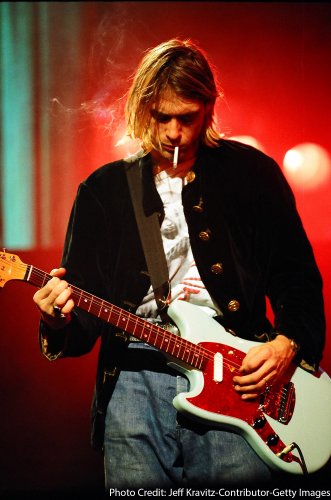
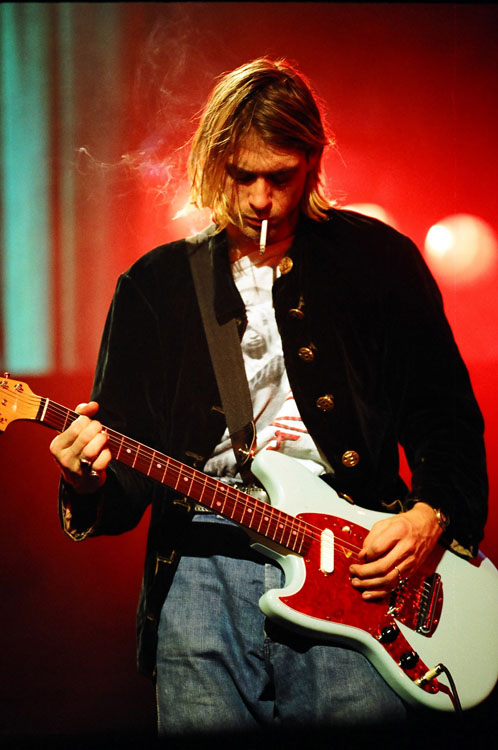
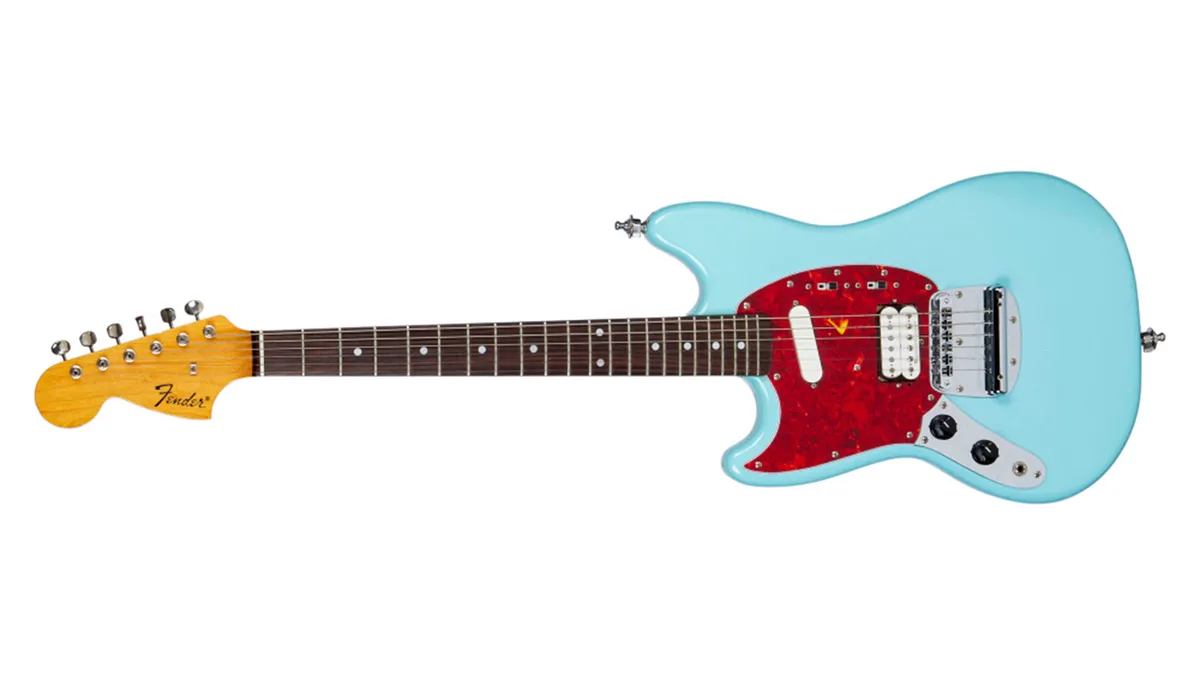
Kurt Cobain played three Fender Mustangs on the In Utero tour, and technician Earnie Bailey named them Sky-Stangs. Sky-Stang I is the Sonic Blue one, serial O 016988, built in 1993 by FujiGen in Japan — it's identifiable in photographs by its white-bobbin Seymour Duncan JB humbucker and a slight V-shaped anomaly in the pickguard. Cobain used it on 53 of the tour's 63 shows, from the October 18, 1993 stage debut at the Arizona State Fair through the final US show at Seattle Center Arena on January 8, 1994, and into the European leg that ended in Munich on March 1, 1994. It was sold at Julien's Auctions in November 2023 for $1,587,500 to Mitsuru Sato, a Japanese buyer who has stated plans to display it publicly.
Why This Guitar Matters
- It is probably the most traceable surviving Cobain stage Mustang: the white-bobbin bridge JB and the pickguard anomaly make it identifiable in a way most touring guitars are not.
- It shows Cobain's late-period working preference clearly. By the In Utero tour, the guitars doing the job on stage were modified Mustangs, not the Jag-Stang prototype he had helped design.
- Earnie Bailey's modification package is unusually well documented: humbucker route, Tune-O-Matic conversion, locked vibrato, shimmed neck, and setup for heavier strings.
- MTV Live and Loud is the best-filmed single document of the guitar in use, which makes Sky-Stang I one of the easiest Cobain guitars to study as an object rather than just admire as memorabilia.
- Its auction result was a provenance valuation, not an instrument valuation. That distinction matters if you are a player trying to get close without spending seven figures.
The Instrument
Specs
The Julien's Auctions catalog (November 2023) is the primary object record for this guitar. Bailey's interviews with Guitar World and similar publications provide modification details that the catalog corroborates.
| Feature | Detail | Source |
|---|---|---|
| Make / Model | Fender MG-69 Mustang (Japanese reissue) | Julien's Auctions catalog, November 2023 |
| Year | 1993, Made in Japan (FujiGen) | Julien's Auctions catalog, November 2023 |
| Serial number | O 016988 | Julien's Auctions catalog, November 2023 |
| Finish | Sonic Blue | Julien's Auctions catalog, November 2023 |
| Body | Likely basswood — standard for MG-69 production; not explicitly documented in auction record | Julien's Auctions catalog, November 2023 |
| Neck | Maple with rosewood fingerboard | Julien's Auctions catalog, November 2023 |
| Scale length | 24" (short scale) | Standard for Mustang model |
| Original pickups | Fender Mustang single-coils (replaced during build) | Earnie Bailey interviews |
| Modified pickup | Seymour Duncan JB (SH-4) humbucker, white bobbins — routed into the bridge position | Guitar World (Earnie Bailey interview) |
| Bridge | Gotoh Tune-O-Matic (replaced original Mustang bridge) | Guitar World (Earnie Bailey interview) |
| Vibrato | Fender Dynamic Vibrato, locked — tailpiece flipped and secured with washers | Guitar World (Earnie Bailey interview) |
| Neck modification | Shimmed at heel with hotel stationery | Guitar World (Earnie Bailey interview) |
| Nut | Cut for heavier strings (.010–.052) | Guitar World (Earnie Bailey interview) |
| Switch modification | Switch tops trimmed by Jim Vincent during 1994 European leg | Auction catalog notes |
| Strings | .010–.052 | Earnie Bailey interviews |
| Tuning | E♭ (down a half step) | Standard Cobain setup, In Utero era |
| Current location | Sold to Mitsuru Sato in November 2023; public display was stated as the intention at the time of sale | Julien's Auctions results, November 18, 2023 |
The Sky-Stang designation was Bailey's naming system, not Fender's. All three Sky-Stangs started as 1993 MG-69 Mustangs from the same custom order. The order itself — ten left-handed Mustangs — came about because the US Custom Shop couldn't build left-handed Mustang necks; Bailey sourced them from FujiGen through luthier Scott Zimmerman instead. The guitars shipped in batches: one Sonic Blue and one Fiesta Red on June 28, 1993; two more Sonic Blues on October 2, 1993; two Fiesta Reds on February 4, 1994; four were never shipped. Sky-Stang I was in the first shipment.
Each Sky-Stang received Bailey's modification package before hitting the stage: body routed for a humbucker, Tune-O-Matic replacing the Mustang's sliding bridge, Dynamic Vibrato locked with the tailpiece reversed and washer-clamped, neck heel shimmed, nut recut. The visual tell that separates Sky-Stang I from II and III is the pickup: white bobbins on the JB (II has black bobbins, III has an orange/red body blotch and a black JB). In well-lit concert photographs, the bobbin color is the fastest way to confirm which guitar Cobain is holding.
Sky-Stang I's Tone and Rig Rundown
Cobain's In Utero live sound was never just "Mustang into distortion." It was a layered, fairly deliberate rig, and Sky-Stang I makes the most sense when you separate the guitar's contribution from the rest of the chain.
- Attributable to the guitar: the 24" scale, the heavier string feel, and the JB humbucker in the bridge. The short scale changes the way the guitar fights back under the hand; the JB gives the bridge position more push, more mids, and less of the thinness a stock Mustang can have when hit hard.
- Rig-dependent: the Boss DS-2, Tech 21 SansAmp Classic, modulation pedals, Mesa/Boogie Studio Preamp, and the live power-amp / Marshall-cab setup. That is where most of the density and abrasion come from.
- Player-dependent: Cobain's hard pick attack, downstroke-heavy rhythm playing, and the way he used proximity and angle to control feedback.
The useful conclusion is simple: what Sky-Stang I changes first is feel, then EQ. The short scale and setup make the guitar easier to muscle around. The JB makes the bridge position less wiry and more blunt-force. The rest of the violence comes from the rig and the player.
If you could only copy three things from this setup:
- A short-scale guitar with a hot bridge humbucker
- E♭ tuning with a heavier-than-stock set
- A two-stage dirt sound rather than one generic distortion pedal
Provenance: Where It's Been
How Cobain got it
Sky-Stang I came out of Cobain's late-period search for better left-handed Mustangs. The guitars were sourced through Scott Zimmerman and FujiGen, with Bailey coordinating the practical side after Fender's U.S. operation could not provide the left-handed Mustang neck configuration needed. Sky-Stang I arrived in the first shipment on June 28, 1993, then entered service after Bailey finished the modifications and setup work.
That gap between delivery and stage debut is useful. It tells you the guitar did not arrive as a finished concept. It became Sky-Stang I in Bailey's hands.
Ownership timeline
| Period | Owner | How acquired | Notable changes |
|---|---|---|---|
| June 1993 – April 1994 | Kurt Cobain / Nirvana touring inventory | Custom-ordered through Bailey, Zimmerman, and FujiGen | Bailey modification package; active tour use |
| April 1994 – 2023 | Cobain family | Retained after Cobain's death; later publicly associated with Chad Cobain | No further changes publicly documented |
| 2007–2023 | On loan to MoPOP at various points | Family loan / exhibition use | Public display, including Taking Punk to the Masses |
| November 18, 2023 – present | Mitsuru Sato | Purchased at Julien's for $1,587,500 | No post-sale physical changes publicly documented |
The key thing about the provenance is that it is strong where many Cobain guitars are messy. There is a plausible, visible chain from working tour instrument to family-held object to museum-loaned artifact to auctioned collectible. That does not make every detail perfectly documented, but it is far cleaner than the average Cobain gear story.
Timeline: How It Changed
| Era | What changed | Why | Evidence |
|---|---|---|---|
| Mid-1993, before stage use | Bridge position routed for a humbucker; Seymour Duncan JB installed | Cobain wanted a more forceful, simpler live bridge sound than the stock Mustang setup | Bailey interviews; Julien's catalog |
| Mid-1993, before stage use | Stock bridge replaced with Gotoh Tune-O-Matic | Better tuning stability and less movement under hard playing | Bailey interviews |
| Mid-1993, before stage use | Dynamic Vibrato locked by reversing tailpiece and securing it with washers | Cobain did not meaningfully use the vibrato; Bailey prioritized stability | Bailey interviews |
| Mid-1993, before stage use | Neck heel shimmed; nut recut for heavier strings | Setup correction and string accommodation | Bailey interviews |
| Early 1994, European leg | Slider switch tops trimmed | Practical stage-use modification; likely to reduce accidental contact | Julien's catalog notes |
The important thing here is not just what changed but what did not. Once Bailey had the guitar where he wanted it, Sky-Stang I stayed essentially stable through the tour. This was not a constantly evolving experiment. It was a solved live-guitar problem.
Visual Record

Essential Listening
These are not "best Nirvana songs." They are the best places to hear what this guitar, this setup, and this version of Cobain's playing were doing on stage.
- "Rape Me" (MTV Live and Loud, December 13, 1993) — The opening riff is the cleanest single demonstration of why the JB swap mattered. Listen to the first entrance: the bridge sound is denser and more mid-forward than a stock Mustang usually is, but it still keeps the loose, slightly unstable short-scale feel.
- "Heart-Shaped Box" (MTV Live and Loud, December 13, 1993) — Listen to the jump from the quiet intro into the full band. This is where the guitar's role makes sense: not super articulate, not pretty, but very good at turning a part into a slab.
- "Aneurysm" (MTV Live and Loud, December 13, 1993) — Around the verse-to-chorus surges, the combination of short scale, heavy attack, and saturated rig gives the guitar that semi-chaotic edge Cobain seemed to prefer live.
- "Territorial Pissings" (MTV Live and Loud, December 13, 1993) — Good for hearing what the guitar does under pure abuse. The value here is not nuance; it is how well Bailey's setup keeps a Mustang functional under downstroke-heavy punishment.
- "Pennyroyal Tea" (MTV Live and Loud, December 13, 1993) — One of the better chances to hear the guitar outside full-speed bashing. The cleaner moments show how compressed and broad the bridge sound is compared with what a stock Mustang bridge pickup would likely have given him.
Market Context
The comparable basket
1990s Made-in-Japan Mustang reissue, 24" scale, Sonic Blue or Fiesta Red, player grade, routs and mods acceptable
That is the right basket because Sky-Stang I is not valuable as a pristine vintage Mustang. It is valuable as a documented working Cobain guitar. If you are chasing the instrument rather than the story, the relevant comparison is not "museum-clean left-handed Cobain piece." It is "Japanese Mustang reissue that can take Bailey-style modifications."
Relevant AxeDB model pages:
Kurt Cobain Mustang
Vintage Mustang (pre-2000)
Fender Mustang
What actually drives price in this segment
- Left-handed vs right-handed — left-handed Japanese Mustangs from this period are harder to find and matter if you want a collector-correct starting point.
- Finish originality — Sonic Blue examples can age oddly and are easy to misdescribe. A clean original finish matters more than sellers sometimes admit.
- Modification quality — in this niche, mods are not automatically bad. A clean humbucker route and sensible hardware swap can make a player-grade example more useful, even if it reduces originality.
- Factory and era — FujiGen-built MIJ Mustangs have their own following. They are not interchangeable in the market with later Cobain-inspired reissues just because the silhouette is similar.
Famous-guitar premium vs instrument premium
Sky-Stang I sold for $1,587,500 because it was Kurt Cobain's heavily documented tour guitar, not because a 1993 MIJ Mustang is inherently a million-dollar instrument. Strip away the provenance and you are back in the world of player-grade Japanese Mustangs and modern production equivalents.
That distinction is the whole point of this section. The story is priceless in collector terms. The underlying recipe is not.
Get Your Own
Off the shelf
Fender's Kurt Cobain Mustang is the straightforward production answer. It gets the short scale, the offset format, the bridge humbucker idea, and the general late-Cobain live logic right. What it does not reproduce exactly is Bailey's original hardware solution on Sky-Stang I, especially the locked Dynamic Vibrato approach and the details of the 1993 MIJ platform.
Vintage sweet spot
A 1990s MIJ Mustang reissue — ideally an MG-69 or close equivalent — is the right starting point if you want the feel of the underlying instrument rather than the signature-model interpretation. Prioritize short scale, good neck condition, and a body you do not mind modifying. Collector-clean originality matters less here than a clean working platform.
Watch out for sloppy humbucker routes, unstable neck pockets, and sellers treating any Sonic Blue Mustang as "Cobain spec." It is easy to get the color right and the rest wrong.
Build your own
- Body: Mustang-style 24" short-scale body, ideally in Sonic Blue
- Neck: Maple neck with rosewood board, medium C feel, 24" scale
- Pickups: Seymour Duncan JB (SH-4) in the bridge; neck pickup optional depending on how close you want to get to the stage-use concept
- Bridge: Tune-O-Matic style bridge
- Vibrato: Mustang Dynamic Vibrato locked or blocked for stability
- Hardware: White pickguard, chrome hardware
- Setup targets: Heavier strings than a stock Mustang would usually wear, E♭ tuning, medium-low action that still tolerates aggressive attack
Myths and Disputes
- Myth: Sky-Stang I is an In Utero studio guitar → Reality: In Utero was recorded in February 1993; Sky-Stang I arrived later, in June 1993, and entered use as a tour guitar.
- Myth: All the Sky-Stangs are interchangeable in photos → Reality: They began from the same basic template, but Sky-Stang I is distinguishable by the white-bobbin bridge JB and the slight V-shaped pickguard anomaly.
- Myth: The Jag-Stang replaced Cobain's Mustangs by the end → Reality: The In Utero tour evidence points the other way. The working guitars most visibly doing the job were the modified Mustangs.
- Disputed: The exact origin of the "Sky-Stang" name → Best read: Published coverage agrees that Bailey and Cobain used the name, but the precise naming story is thinner than some retellings make it sound. Treat elaborate explanations of the nickname with caution unless a primary source surfaces.
FAQ
What is Sky-Stang I, exactly?
A 1993 Made-in-Japan Fender Mustang, serial O 016988, finished in Sonic Blue and modified for Kurt Cobain by Earnie Bailey. It became Cobain's most-used Mustang on the In Utero tour.
Why is this one more important than the other Sky-Stangs?
Because it is the one you can track most clearly. The white-bobbin JB and pickguard anomaly make it identifiable across filmed and photographed performances in a way the others are not.
Was Sky-Stang I used on In Utero the album?
No. It is an In Utero tour guitar, not an In Utero recording guitar.
What pickup was in it?
A Seymour Duncan JB (SH-4) in the bridge, with white bobbins. That is one of the guitar's defining visual and sonic identifiers.
Why did Bailey lock the vibrato?
Because Cobain did not really need a floating Mustang vibrato and Bailey wanted stability. The mod is pure touring pragmatism.
What strings and tuning did Cobain use on it?
Bailey has cited .010–.052, and Cobain's live setup in this period was typically E♭. The important takeaway is that this was not a light-string, jangly Mustang setup.
Where is Sky-Stang I now?
It sold at Julien's in November 2023 to Mitsuru Sato. Public display was stated as the plan at the time of purchase.
How much is it worth?
As memorabilia, Sky-Stang I proved it was worth $1,587,500 at auction. As a guitar recipe, it is worth a tiny fraction of that. Those are two entirely different markets.
How do you tell Sky-Stang I from Sky-Stang II and III?
Start with the bridge humbucker bobbins: white usually means Sky-Stang I. Then look for the slight V-shaped anomaly in the pickguard.
What's the closest guitar I can actually buy?
Fender's Kurt Cobain Mustang is the production answer. A 1990s MIJ Mustang reissue is the better starting point if you want to recreate the actual Bailey-built logic of Sky-Stang I.