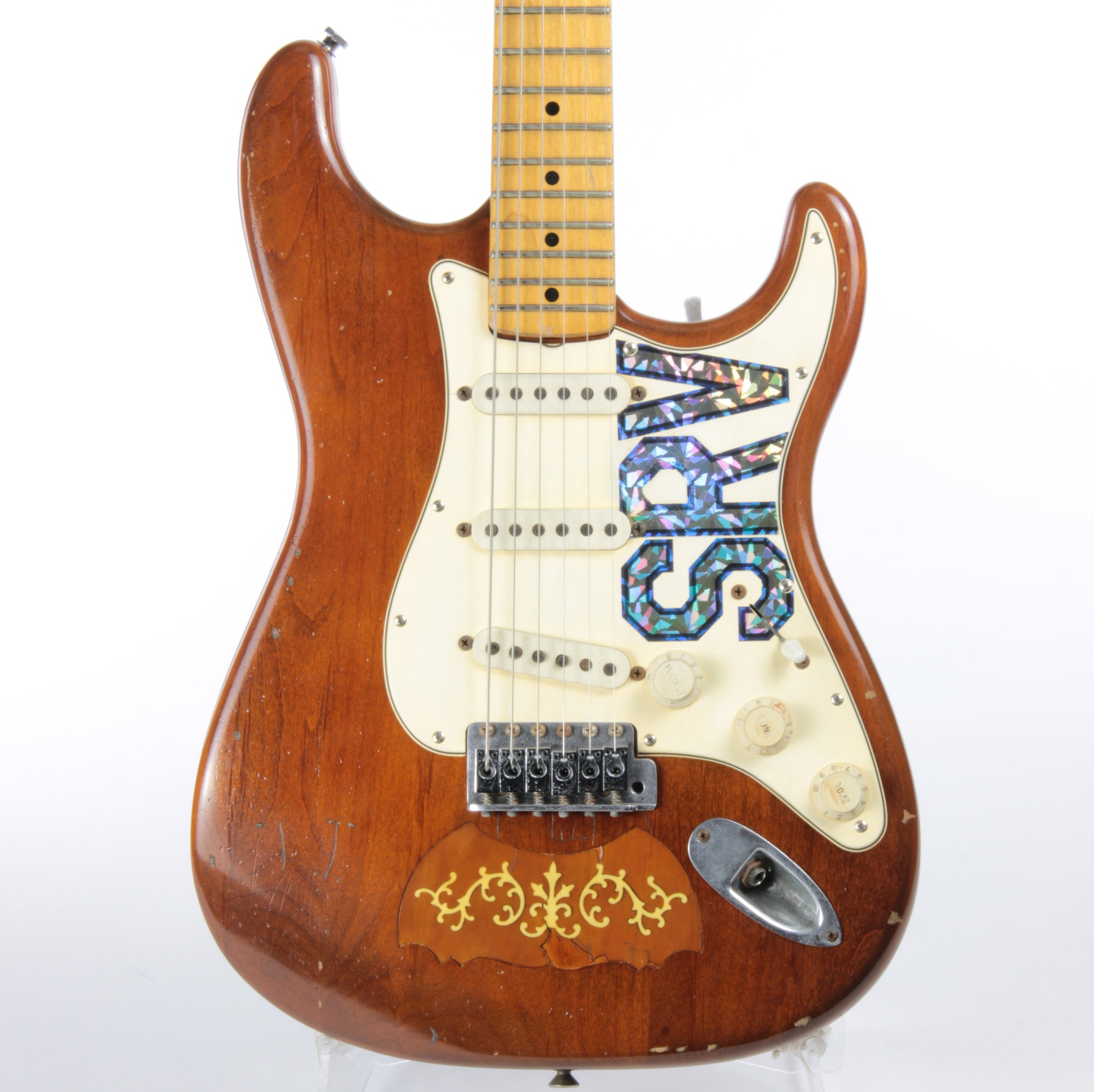
Lenny is the opposite of Number One. Number One is Stevie Ray Vaughan as force: loud, aggressive, finish worn from years of force. Lenny is Stevie Ray Vaughan leaving space.
That contrast is what makes this guitar so good, and so misunderstood. People call it “the 1965 Lenny,” but the interesting part is that it was already far from factory-original before Vaughan made it famous. The body had been stripped and refinished dark. A circa-1910 mandolin-style inlay had been set into the top behind the bridge. The neck that most people associate with the guitar was a replacement — described by Christie's as a later vintage neck, probably not made by Fender. In collector terms, this is a composite guitar. In musical terms, it is one of the clearest examples of how little factory-original purity has to do with whether a player falls in love with an instrument.
What makes Lenny Lenny is not originality. It is the neck plate engraved L81409 and inscribed Stevie Ray Vaughan '80, its origins as a birthday gift from his wife, and the fact that this is the Strat most closely tied to the tenderest side of his recorded voice.
Why This Guitar Matters
- It is the SRV guitar most associated with restraint rather than attack: the title track "Lenny" and, later, "Riviera Paradise."
- Its defining visual traits — the dark refinish, the mandolin inlay, the odd neck — all appear to predate Vaughan's ownership, which is unusual for a guitar this iconic.
- The above visual traits are highly unique; you'll never find a production-line guitar with that finish or inlay.
- It had sentimental value to Vaughan, originating as a birthday gift from his wife
- Christie's documented the guitar unusually well when it sold at the Crossroads Guitar Auction in 2004, which gives Lenny firmer object-level footing than many famous artist instruments.
- Its $623,500 auction result is a clean lesson in the difference between provenance value and instrument value: on parts alone, this would be a heavily discounted vintage Strat; as SRV's Lenny, it became one of the most valuable guitars ever sold at auction.
The Instrument
Specs
| Feature | Detail | Source |
|---|---|---|
| Make / Model | Fender Stratocaster | Christie's lot |
| Year / parts era | Circa 1965 and later — Christie's explicitly describes it as a composite instrument | Christie's lot |
| Body wood | Alder | FuzzFaced mentions this as the Custom Shop's reproduction-series' choice of body wood, based on inspection of the original guitar. |
| Body finish | Dark natural / mahogany refinish over the original finish | Christie's lot |
| Neck | Replacement neck, later vintage, "probably not of Fender manufacture" | Christie's lot |
| Fretboard | Maple (replacement neck, swapped sometime in 1981 — original neck was rosewood, visible in photos through early 1981) | Visual record; GroundGuitar |
| Pickups | Stock | SRV Archive |
| Inlay | Circa-1910 mandolin-style piece inlaid into the top behind the bridge | Christie's lot |
| Strings / tuning | Eb tuning, but played with lighter string gauge than the famously heavy-gauge strings used on Number One | Premier Guitar |
| Neck plate | Engraved L81409; inscribed Stevie Ray Vaughan '80 | Christie's lot |
| Notable markings | Mickey Mantle autograph on body; SRV stickers; back inscription To Larry / Best Wishes / Dickie B____ | Christie's lot; Guitar World |
| Case | Wood / metal case with tour stickers; HURRICANE on one side, STEVIE RAY VAUGHAN on the other; signed internally | Christie's lot |
| Current location | Guitar Center | Christie's results PDF |
The important thing to understand about that table is that Lenny is not a great guitar because it is a pristine vintage Fender. It is a great guitar because Vaughan heard something in a sentimental, visibly altered Strat and kept reaching for it when he wanted to sound open, lyrical, and vulnerable.
Lenny's Tone and Rig Rundown
René Martinez, Vaughan's longtime tech, specifically identified Lenny as the guitar on "Riviera Paradise." The guitar has a firmer recording attribution than a lot of famous artist instruments ever get. This helps frame the tone correctly.
What you can safely attribute to the guitar is fairly modest: it is still a Stratocaster, with Strat scale length, Strat trem feel, stock early/mid '60s pickups, and the clean top-end articulation that lets Vaughan play chord melody without the notes collapsing into each other. Whatever original mid-'60s core remained in the body and pickups likely contributed to that character. But this is not the guitar to use for speculative claims about exact body wood, magical refin resonance, or pickup voicing you cannot verify from an object record.
What is clear is the role the instrument played. On Lenny, Vaughan tends to back off the attack, leave more air between phrases, and let the tremolo bar act like punctuation instead of violence. A clean or barely breaking-up Fender-style amp with reverb is part of that sound. So is his touch. The guitar itself matters, but way he approached it matters far more for the sweet and gentle tone it's associated with.
If you only copy three things from the Lenny setup:
- Eb tuning with lighter strings — Vaughan played Lenny with a lighter gauge than Number One. Premier Guitar documented Lenny going as light as 11s on nights when Number One wore 13s. Lighter strings produce a softer attack, which fits how he played Lenny: less aggression, more air.
- Clean headroom with reverb — the sound needs space, not gain.
- Controlled tremolo use — on Lenny, the bar is not decoration; it is part of the phrasing.
Provenance: Where It's Been
How the artist got it
There are two versions of the Lenny acquisition story, and both need to be kept on the table.
The familiar version is the one most fans know: Lenora "Lenny" Bailey and a group of Austin friends found the guitar in a pawnshop and bought it for Vaughan as a 1980 birthday present. That story is neat, memorable, and emotionally satisfying. It also lines up nicely with the neck plate inscription Stevie Ray Vaughan '80, which is the strongest physical anchor the story has.
The messier version comes from Christie's, which places Vaughan's acquisition in the 1970s. That may reflect earlier contact with the guitar, a fuzzier recollection of when it entered his orbit, or simply a broader framing than the birthday-surprise version. What the object itself can tell you is narrower: the neck plate inscription is real; the guitar was definitely identified with Vaughan by 1980; the exact sequence that got it into his hands before that is not fully settled.
It's possible that the two stories can be squared by SRV having been aware of it in a shop, but not owning it prior to the 1980 purchase by Lenora, who would have known that Vaughan had had his eye on it.
Ownership timeline
| Period | Owner | How acquired | Notable changes |
|---|---|---|---|
| Pre-SRV | Unknown prior owners | Unknown | Dark refinish applied; mandolin-style inlay added; back inscription added |
| 1980 (or earlier) – 1990 | Stevie Ray Vaughan | Commonly described as a birthday gift from Lenora Bailey and friends | Neck plate inscribed; replacement neck fitted by this period; Mickey Mantle autograph added in 1985 |
| 1990–2004 | Jimmie Vaughan / SRV estate | Retained by family / estate | Preserved; later donated to the Crossroads sale |
| 2004–present | Guitar Center | Purchased at Christie's Crossroads Guitar Auction on June 24, 2004 for $623,500 | Displayed publicly; documented by Fender Custom Shop for the Tribute model |
Timeline: How It Changed
| Era | What changed | Why | Evidence |
|---|---|---|---|
| Pre-SRV (date unknown) | Original finish removed; dark natural / mahogany refinish applied | Unknown prior ownership | Christie's lot |
| Pre-SRV (date unknown) | Circa-1910 mandolin-style inlay added behind the bridge | Unknown prior ownership | Christie's lot |
| Pre-SRV (date unknown) | Back inscription To Larry / Best Wishes / Dickie B____ added | Prior personal dedication | Christie's lot |
| By 1980 | Neck plate engraved L81409 and inscribed Stevie Ray Vaughan '80 | Ownership marking / identity anchor | Christie's lot |
| Sometime in 1981 | Original rosewood-board neck replaced with later vintage maple-board neck, probably non-Fender | Exact reason unknown; likely breakage, preference, or simple necessity — guitar is documented with rosewood neck at Manor Downs TX in 1981, and with the maple replacement by later that same year | Christie's lot; Guitar World; GroundGuitar |
| Apr. 10, 1985 | Mickey Mantle autograph added to body | Vaughan performed the National Anthem at the Houston Astros home opener; secondary sources tie the autograph to that appearance | Premier Guitar; Guitar World |
| 1989 | Confirmed in use on "Riviera Paradise" | Vaughan's ballad voice in studio form | Christie's lot; René Martinez via MusicRadar |
| Jun. 24, 2004 | Sold at Christie's Crossroads Guitar Auction for $623,500 | Charity auction / public transfer | Christie's results PDF |
| Dec. 12, 2007 | Fender Custom Shop Lenny Tribute released | Guitar Center ownership enabled direct documentation and measurement | Guitar World; Premier Guitar |
The lesson from that timeline is simple: nearly everything visually distinctive about Lenny was already there before Vaughan. He did not turn a clean vintage Strat into an icon through rare parts or careful preservation. He turned a complicated, already-altered guitar into an icon by playing it in a way no one else could.
Visual Record


Essential Listening
-
"Riviera Paradise" (In Step, 1989) — This is the most important confirmed Lenny recording. Listen to the opening chord melody and the way the notes stay separated even when the voicings get dense. The tremolo bar dips at the ends of sustained notes are tiny, almost vocal; the whole point is control, not drama.
-
"Lenny" (Texas Flood, 1983) — Start with the intro, before the performance gets mythologized into "SRV ballad mode." What matters is the attack: soft but still articulate, with enough snap on the front of the note that the line never turns syrupy. This is Vaughan proving he could be delicate without becoming vague.
-
"Lenny" (Live at the El Mocambo, 1983) — The value of this version is that there is less studio polish between your ear and the instrument. Listen for how much of the emotion is coming from spacing, dynamics, and subtle bar movement rather than sheer sustain.
-
"Riviera Paradise" (live, In Step era) — A useful companion to the studio cut because it strips away some of the record's atmosphere. Listen for the way he leans on the tremolo arm after the melody has already landed; the bar acts like a sigh after the sentence, not the sentence itself.
Market Context
The comparable basket
If you are buying toward the sound rather than the story, the basket is narrower than the mythology suggests:
1965 Fender Stratocaster, player grade, maple fretboard, originality flexible, good single-coils, clean setup, reverb-friendly rig
Skip the refinish color and the mandolin inlay. Chase the basic mid-'60s Strat platform used clean, with enough headroom and touch sensitivity to let the notes breathe. On an ordinary vintage purchase, originality still matters a lot. For a Lenny-inspired build, it matters less than the internet might pretend. One of the guitar's distinctive features, the maple fretboard, basically only exists in player-grade, composite guitars anyway, as nearly all production guitars from Fender in this era had a rosewood board.
Relevant AxeDB model pages:
Vintage Stratocaster (pre-2000)
What actually drives price in this segment
- Neck originality — On a normal mid-'60s Strat, a replacement neck is a major deduction. For a Lenny build, though, it's basically required.
- Pickup originality — Original mid-'60s pickups carry real collector weight on their own. If the pickups are gone, the instrument may still be a great player, but it is no longer competing in the same part of the market.
- Finish originality — A refinish is usually one of the biggest hits a vintage Strat can take. Like the maple neck, though, it's basically a requirement for a decent Lenny homage.
- Structural health — Headstock repairs, body routes, replaced hardware, and neck-pocket issues all matter more than romance does once real money is involved. A Lenny-style strat can have a ton of replacement parts like the original did, but any decent tribute has to be a good player.
Famous-guitar premium vs. instrument premium
This is where Lenny becomes especially instructive. On paper, it has several traits the vintage market normally discounts: composite identity, replacement neck, refinish, and visible alterations. If you stripped away the Stevie Ray Vaughan association, those would all work against it. A non-famous version of this same guitar likely fetches near the bottom of the price range for a '65 Strat, maybe around $9,000.
But the public auction result — $623,500 at Christie's in 2004 — makes the real point. That number is not a comp for altered mid-'60s Strats. It is a comp for Stevie Ray Vaughan's Lenny. In other words: a provenance valuation, not an instrument valuation. Readers making an actual buying decision should keep those as separate categories.
Get Your Own
Off the shelf
The closest official replica is the Fender Custom Shop Lenny Tribute, released in 2007 after Guitar Center made the original available for direct documentation. It gets the visual identity right — dark refinish, inlay, neck plate engraving, Mantle autograph — and that is exactly why it exists. It is a collector's reproduction first, not the cheapest route to the sound.
If what you want is the musical lane rather than the object biography, a mid-'60s-style Strat is the better answer than a cosmetic replica. A modern 1965-style reissue gets you much closer to the important part of the experience: clean articulation, Strat trem feel, and the right platform for Vaughan's ballad setup.
Vintage sweet spot
A player-grade 1965–66 Stratocaster is the sensible target. Lenny itself is a useful reminder not to be doctrinaire here: refinishes, changed parts, and hard use do not disqualify a guitar from being great. They do, however, change what you should pay.
Watch for:
- swapped pickups presented as original
- replacement necks or repaired headstocks
- body routes hidden under the guard
- oversold "SRV style" descriptions that are really just ordinary mid-'60s Strats with heavy strings
Use the current AxeDB market pages for live pricing rather than fixed numbers in an article; this segment moves too much for static figures to age well.
Build your own
- Body: Strat-style body in a dark natural or mahogany-toned finish if you want the look, though the finish itself is not the musical point
- Neck: Comfortable vintage-style Strat neck with a maple fretboard
- Pickups: Mid-'60s-style single-coils with strong clean articulation rather than high output
- Setup: Eb tuning, clean amp with spring reverb, action low enough for expressive vibrato but high enough to let the notes ring
- Bridge: Standard right-handed Strat bridge and trem setup
- Mindset: Build for feel and phrasing, not for relic-theater
Myths and Disputes
-
Myth: "Lenny is just a cleanly specifiable 1965 Stratocaster."
Reality: The most authoritative public description is Christie's: circa 1965 and later, composite. That is the right way to think about it. -
Myth: "What makes Lenny special is its rare vintage correctness."
Reality: Almost the opposite. The guitar is special because Vaughan made a visibly altered instrument feel personal and irreplaceable. -
Disputed: 1980 birthday gift vs. earlier 1970s acquisition.
Best read: TheStevie Ray Vaughan '80neck plate strongly anchors the 1980 story, but Christie's broader 1970s framing means the acquisition timeline should be stated with some humility. -
Disputed: The Billy Gibbons connection to the replacement neck.
Best read: Secondary sources repeat it; Christie's only firmly confirms that the neck is a later replacement and probably not Fender-made. -
Unresolved: The back inscription
To Larry / Best Wishes / Dickie B____.
Reality: Christie's documents it; the identity behind it is still unclear in the publicly accessible record.
FAQ
What year is Lenny, really?
The cleanest answer is the Christie's one: circa 1965 and later, composite. Calling it simply a "1965 Strat" is convenient shorthand, but there's some nuance around the swapped parts.
What is the inlay behind the bridge?
A circa-1910 mandolin-style inlay set into the body. It is one of the guitar's defining visual traits and appears to predate Vaughan's ownership.
Who gave SRV the guitar?
Most retellings say Lenora "Lenny" Bailey and a group of Austin friends bought it as a 1980 birthday gift. Christie's suggests a broader 1970s acquisition story. The neck plate inscription is the best physical evidence tying the guitar to 1980.
Did SRV write "Lenny" the night he got the guitar?
That is the standard story, and it may be true. What is safer to say is that the guitar and the song became permanently linked, and the recorded version appeared on Texas Flood in 1983.
What is the Mickey Mantle autograph doing on the body?
Secondary sources connect it to Vaughan's appearance at the Houston Astros home opener on April 10, 1985. The autograph itself is documented by Christie's; the surrounding story comes from later reporting.
Who bought Lenny at auction?
Guitar Center bought it at Christie's Crossroads Guitar Auction on June 24, 2004 for $623,500.
Was that a record?
It was a major result for an SRV guitar, but not the top number at that sale. Eric Clapton's Blackie brought more at the same event.
Where is it now?
With Guitar Center. It has been displayed publicly and was made available to Fender for the Custom Shop Tribute project.
What is the closest version I can actually buy?
For the look, the Fender Custom Shop Lenny Tribute. For the sound and playing lane, a good mid-'60s-style Strat set up clean in Eb is the more practical answer.
How much is the original worth now?
No one knows until it trades again. The last public benchmark is $623,500 in 2004. Anything beyond that is guesswork until there is another real sale.