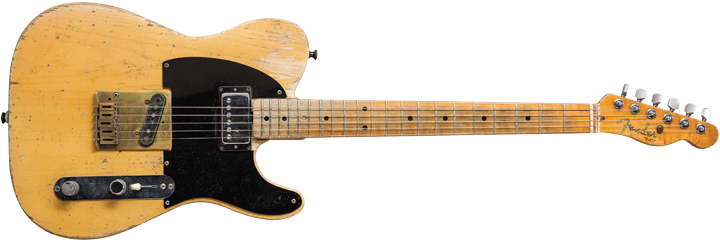
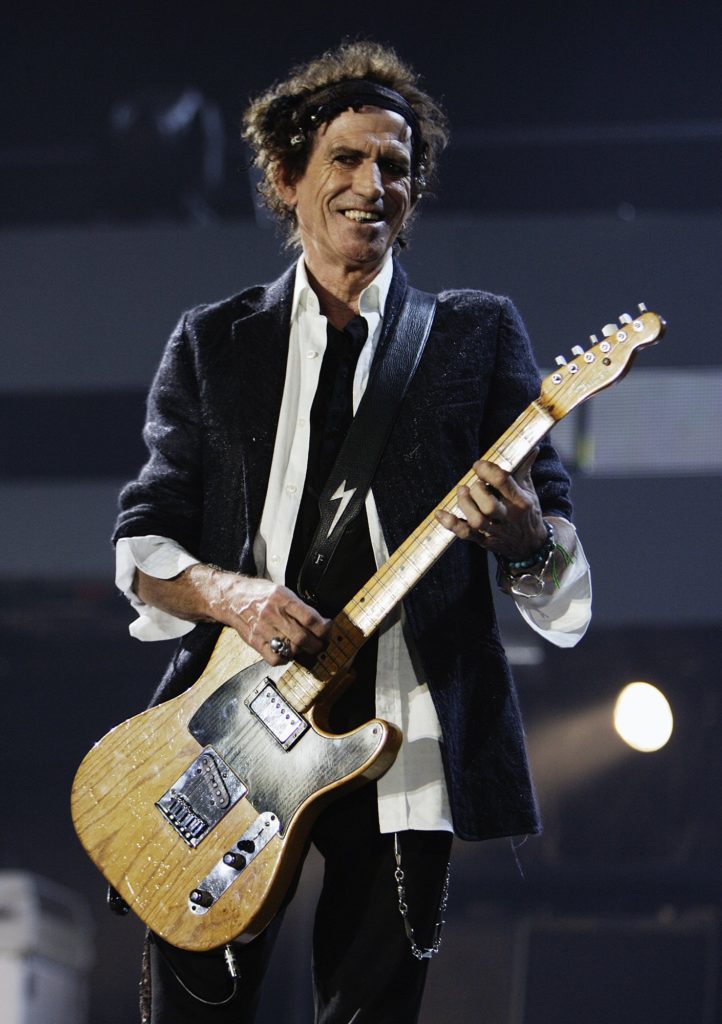
Keith Richards received an early-1950s butterscotch blonde Telecaster as a birthday gift from Eric Clapton in December 1970, and it soon became a primary tool during the Nellcôte sessions that would become Exile on Main St. He removed the low E string and tuned to open G (G–D–G–B–D) — a method he'd been orbiting since the late 1960s, but which this guitar made practical onstage and in the studio. He named it Micawber in the 1980s after the Dickens character, chosen because it was an unlikely word you could shout clearly across a crowded stage. It has been significantly modified over the decades and, as of 2023, Richards was still using a five-string Tele on Stones recording sessions.
Why This Guitar Matters
- Micawber became central to the rhythm guitar and riffs on Exile on Main St. — the five-string open-G method, applied with this guitar at Nellcôte, is the most studied single element of Richards' technique
- Richards has described the tuning as an "arrangement tool": removing the low E creates space for bass, piano, and horns that a six-string in standard tuning crowds out
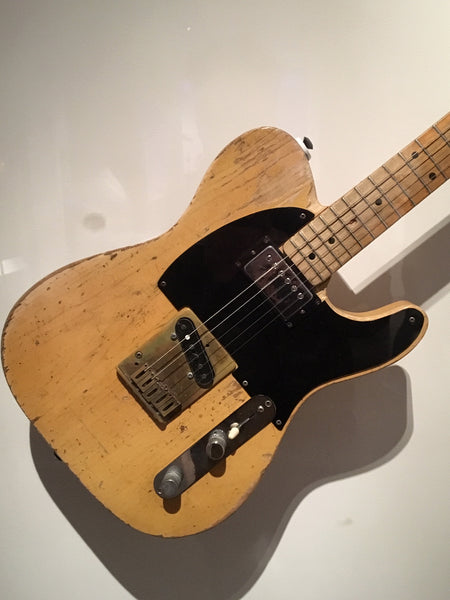
- The modification history — from stock Tele to PAF humbucker neck pickup, lap-steel-style bridge pickup, brass bridge, and Sperzel tuners — is unusually well documented for a working instrument
- In 2023, Richards stated a five-string Tele appears on "a good half" of Hackney Diamonds tracks, confirming that the approach established at Nellcôte is still active 50+ years later
- The missing 17th-fret inlay dot and the scalloped bass-side fret wear from Richards' strumming angle are documented physical identifiers
The Instrument
Specs
| Feature | Detail | Evidence | Source |
|---|---|---|---|
| Make / Model | Fender Telecaster, blackguard style | — | — |
| Year | 1953 per Richards; 1954 per museum label and published gear history — see Disputes | Primary interview; museum record | Guitar World, 2002; Play It Loud, The Met, 2019 |
| Body | Ash | Museum record | Play It Loud, The Met, 2019 |
| Neck | Maple | Museum record | Play It Loud, The Met, 2019 |
| Finish | Butterscotch blonde, black pickguard | Manufacturer profile; published inspection | Fender; Andy Babiuk, Reverb |
| Neck pickup | Gibson PAF humbucker, reverse-mounted | Manufacturer profile; published inspection | Fender; Andy Babiuk, Reverb |
| Bridge pickup | Fender lap-steel-style unit, two-screw mounting — identity disputed, see Disputes | Published inspection (primary account); disputed | Andy Babiuk, Reverb; Guitar World, 2016 |
| Bridge | Solid brass, aftermarket (Schecter-sourced) | Published inspection; gear history | Andy Babiuk, Reverb; Rolling Stones Gear via Premier Guitar |
| Bridge saddles | Five saddles; sixth-string saddle removed | Published inspection; gear history | Rolling Stones Gear via Premier Guitar |
| Tuners | Sperzel locking tuners | Published inspection; gear history | Andy Babiuk, Reverb; Rolling Stones Gear via Premier Guitar |
| Strings | Custom Ernie Ball five-string set: .011, .015, .018, .030, .042 nickel wound | Published inspection | Andy Babiuk, Reverb |
| Tuning | Open G: G–D–G–B–D | Primary interview | Guitar World, 2002; Guitar Player, 1992 and 2023 |
| Wiring | Possibly non-standard blend scheme — reported/speculated, not confirmed by teardown | Reported/speculated | Guitar World, 2016 |
| Visual identifiers | Missing 17th-fret inlay dot; severe pick wear on top bout; small dimple/gouge upper-left front bout | Published inspection | Andy Babiuk, Reverb; Guitar World, 2016 |
| Current location | Owned by Richards; publicly displayed at The Metropolitan Museum of Art during Play It Loud (2019) | Museum record | Play It Loud, The Met, 2019 |
Micawber's Tone and Rig Rundown
Micawber's tone is built around decisions that happen before the amp comes on:
- Attributable to the guitar: Five strings in open G means every chord voicing, every drone, every riff is filtered through the constraints of that tuning. The reverse-mounted PAF humbucker at the neck brightens what's normally a dark pickup. The brass bridge adds sustain and a slightly more present low-end character than standard bent-steel Tele saddles. The lap-steel-style bridge pickup delivers a different frequency response than a standard Telecaster bridge unit — more open in the upper-mids, and with the two-screw mounting that Babiuk's inspection identified.
- Rig-dependent: Richards primarily uses Fender Twin Reverbs — "Twins most of the time" in his own 2023 words, with the occasional Champ. The amp is relatively clean; the grit comes from how hard the guitar is played.
- Player-dependent: The scalloped wear on the bass-side upper frets tells you something specific about technique: Richards strums toward the end of the fingerboard, near where the neck meets the body, and hard. That placement and attack produce the percussive, slightly muted quality that's as important as the tuning itself.
If you could only copy three things from this setup:
- Five strings, open G (G–D–G–B–D) — without this, you're playing Micawber's appearance, not its vocabulary
- A reverse-mounted PAF-style humbucker at the neck — the single most unusual verified spec
- Fender Twin Reverb at medium volume, played hard with a heavy pick — the aggression is in the right hand, not the overdrive
Provenance: Where It's Been
How the artist got it
Eric Clapton gave Richards the guitar for his 27th birthday in December 1970. This origin story appears in Fender's official write-up, in Guitar World's coverage, and in the museum label text reproduced from the 2019 "Play It Loud" exhibit at The Met. The timing placed the guitar in Richards' hands just as the Stones were heading to France for the Nellcôte sessions.
Ownership timeline
| Period | Owner | How acquired | Notable changes |
|---|---|---|---|
| Early 1950s–December 1970 | Various (pre-history unspecified) | — | — |
| December 1970–present | Keith Richards | Gift from Eric Clapton | Multiple modifications over decades (see Timeline) |
| 2019 | Loaned to The Metropolitan Museum of Art | Loan for "Play It Loud" exhibition | Displayed alongside instruments from Chuck Berry, Prince, Kurt Cobain, and others |
Timeline: How It Changed
| Era | What changed | Why | Evidence |
|---|---|---|---|
| 1971 (Nellcôte Exile sessions) | Removed low E string; converted to five-string open G (G–D–G–B–D) | The five-string approach dovetailed with open-tuning experimentation Richards had been developing since the late '60s; the Nellcôte sessions were where it became the dedicated method | Andy Babiuk, Reverb; Play It Loud, The Met, 2019 |
| ~1972 (post-'72 tour era) | Neck pickup replaced with Gibson PAF humbucker, reverse-mounted | Quest for more bite; reverse orientation brightens the humbucker's natural response | Andy Babiuk, Reverb; Fender |
| ~1972 (post-'72 tour era) | Bridge pickup replaced with Fender lap-steel-style unit (two-screw mounting) | Part of the same modification package, handled by tech Ted Newman Jones III | Andy Babiuk, Reverb |
| ~1981 (Tattoo You tour era) | Solid brass Telecaster bridge (Schecter-sourced) fitted by tech Alan Rogan; Sperzel locking tuners added; sixth-string saddle removed | Road reliability and tuning stability for major touring | Andy Babiuk, Reverb; Rolling Stones Gear via Premier Guitar |
The Nellcôte conversion — pulling off a string and retuning — was the transformative decision. Everything else came in service of that. The pickup swaps, the brass bridge, the Sperzels all followed the approach rather than preceded it. The guitar evolved around a tuning method Richards had already committed to.
Visual Record

Essential Listening
Documented Nellcôte/Exile era
These tracks are from the sessions where Micawber's five-string open-G approach was established. Multiple sources place the guitar at Nellcôte in 1971; the guitar was in stock or near-stock condition at this stage.
- "Tumbling Dice" (Exile on Main St., 1972) — The five-string open-G voicing is audible in how the chord hangs: no bottom string anchoring it, just a drone and a shuffle. The most accessible Nellcôte riff.
- "Rip This Joint" (Exile on Main St., 1972) — The fastest track on the record. The scalloped fret wear makes sense when you hear this: hard strumming, near the end of the fingerboard, constantly.
- "Rocks Off" (Exile on Main St., 1972) — The Exile opener. The rhythm guitar sits back in the mix the way Richards has described it should: not the featured element, but the thing everything else hangs on.
- "Happy" (Exile on Main St., 1972) — Richards sings lead and plays simultaneously here, which is a different physical challenge from the rhythm tracks.
Signature open-G repertoire
Tracks from later eras where a five-string Tele — Micawber specifically, or the same method applied to similar instruments — is the documented approach.
- "Before They Make Me Run" (Some Girls, 1978) — Fender explicitly cites this as a Micawber track. The brass bridge is in place by this era; the tone is slightly different from the Nellcôte recordings.
- "Start Me Up" (Tattoo You, 1981) — One of the most recognizable open-G riffs in rock. The fully modified configuration (PAF, brass bridge, Sperzels) is in place by this point.
Manufacturer-associated (interpret with context)
Fender's official Micawber feature cites these tracks as examples where Richards "wielded" the guitar. This language may encompass live use rather than the original studio recording — at least one of these songs predates the December 1970 gift. Treat as strong associations, not confirmed studio provenance.
- "Brown Sugar" (Sticky Fingers, 1971) — Open-G in a more straightforward rock setting; Fender associates it with Micawber, though the recording predates or is contemporary with the gift.
- "Honky Tonk Women" (1969) — The foundational open-G Stones riff, and the song that demonstrates why Richards was exploring the tuning before Micawber arrived.
Current work
- Hackney Diamonds selections (2023) — Richards stated a five-string Tele appears on "a good half" of the tracks. He didn't name Micawber specifically; the five-string approach is continuous with the method regardless of which instrument.
Market Context
The comparable basket
"Early-1950s Fender Telecaster, blackguard era (1950–1954), ash body, maple neck, butterscotch blonde, original pickups or documented period-correct replacements"
The year dispute (1953 vs 1954) matters because production differences between early blackguard years are documented and collectors track them. Pickguard, control plate, and pickup specs changed through the early '50s. The ash body / maple neck combination is standard for the era.
Relevant AxeDB model pages: Fender Telecaster
What actually drives price in this segment
- Year precision — 1950 and 1951 "Broadcasters" and early Nocasters command the highest premiums; 1952–1954 production Telecasters are still exceptional but slightly more available
- Finish originality — butterscotch blonde is the standard blackguard finish; a refin drops value significantly in a segment where originality is paramount
- Pickup originality — blackguard-era Tele pickups are among the most studied single-coil designs ever produced; original matched sets drive premiums over any replacement
- Neck shape — early-'50s necks are very chunky by modern standards; shaved or reshaped necks reduce value significantly
- Hardware completeness — original screws, bridge plate, control plate, and strap buttons matter at this level
Famous-guitar premium vs instrument premium
Micawber is not available. A comparable stock instrument — an early-1950s blackguard Telecaster in butterscotch with original pickups — currently trades in the $50,000–$150,000+ range depending on condition. Richards' specific guitar, with the provenance, the documented modifications, and 50+ years of Rolling Stones history, would be a multi-million-dollar auction event.
Get Your Own
Off the shelf
Fender has issued a Keith Richards Micawber Telecaster as a limited Signature model. When available, it comes in butterscotch blonde with a PAF-style neck pickup, a bridge pickup approximating the lap-steel-style unit, and arrives set up for five-string open-G with brass saddle hardware. New prices when available run in the $2,500–$3,500 range; used examples appear occasionally and hold value well. Check the Fender Telecaster page for current used inventory.
For something available now, the Fender American Vintage II 1951 Telecaster (around $2,000 new) gives you an ash body, maple neck, and period-correct pickup voicing without the PAF swap. You'd add the humbucker separately.
Vintage sweet spot
A genuine early-'50s blackguard Telecaster is a serious purchase in the $50,000+ range. Most buyers chasing Micawber's tone don't need that — what they need is the tuning and the pickup configuration. The most cost-effective approach: a late-'50s or early-'60s Telecaster in solid condition ($5,000–$15,000), modified at the neck position for a PAF-style humbucker (Seymour Duncan Seth Lover or similar), fitted with a brass bridge plate (Glendale or similar), and strung as a five-string in open G.
Watch out for reshaped necks (hard to undo), replaced necks, and refins. UV light, paint-check on routes, ask for pot code photos.
Build your own
Parts list:
- Body: Ash, butterscotch blonde; period-style nitro lacquer; single-coil routing in neck position (route for humbucker or use a standard-sized PAF with adapter ring)
- Neck: Maple, period C-to-D profile; 7.25" radius; vintage fret spec
- Neck pickup: Gibson PAF-style humbucker, reverse-mounted — Seymour Duncan Seth Lover '59 or PAF Classic; orient backwards (screw poles facing the bridge) to approximate the brightness Fender describes
- Bridge pickup: Fender lap-steel-style — TV Jones Starwood or a Broadcaster-wound single-coil; treat this as "best available approximation" given the ongoing identity dispute
- Bridge: Solid brass Telecaster bridge — Glendale or similar; remove or omit the sixth saddle
- Tuners: Sperzel locking tuners, chrome, standard Tele headstock spacing
- Strings: Custom five-string set: .011, .015, .018, .030, .042 (Ernie Ball makes a dedicated Keith Richards set)
- Setup targets: Open G (G–D–G–B–D); action medium; no tremolo
Myths and Disputes
- Disputed: Model year (1953 or 1954) → Richards said "Micawber is a '53" in a 2002 Guitar World interview, explicitly contrasting it with a second Tele he called Malcolm ("that's the '54"). Museum exhibit labels and published gear-book documentation label it 1954. Both sources are credible; working vintage guitars accumulate mixed parts over decades, and the physical guitar may have construction details that complicate a clean year attribution. "Early-'50s, commonly cited as 1953 or 1954" is the defensible framing.
- Disputed: Bridge pickup identity → Babiuk's inspection account describes a Fender lap-steel-style unit with two-screw mounting. Guitar World's 2016 investigation documented competing theories: Broadcaster-era pickup, lap-steel pickup, and an unusually hot-wound early Tele bridge pickup (per unnamed former Fender employees). No definitive parts identification has been published.
- Uncertain: Wiring scheme → Guitar World reported that Richards is often observed with the selector in the bridge position, yet the sound implies some neck humbucker contribution — leading to long-running speculation about a non-standard blend wiring, possibly Broadcaster-style. No teardown has confirmed this. Treat wiring as unresolved.
- Myth: The five-string open-G approach originated at Nellcôte → Richards was experimenting with open tunings before Micawber arrived. The Nellcôte sessions are where the approach became a committed method tied to this specific guitar, not where he first discovered the tuning.
FAQ
When did Richards first use Micawber on a record? Multiple sources — the Play It Loud museum label and Babiuk's account — place Micawber's first recorded use at the Villa Nellcôte sessions in 1971 that became Exile on Main St. The guitar was in stock or near-stock condition at that stage; the open-G conversion happened during those sessions.
What tuning is Micawber set up for? Open G: G–D–G–B–D (low to high), five strings only. The low E string is removed entirely. This is the setup Richards has used on Micawber since 1971.
Why only five strings? Richards has given several answers, but the core argument is arranging space: removing the low E opens up frequency room for bass, piano, and other instruments. He noted in 2023 that the constraint also forces chord shapes and voicings he wouldn't reach on a six-string. The missing string isn't a limitation — it's the compositional tool.
What pickups does it have now? A Gibson PAF-style humbucker at the neck (reverse-mounted) and a Fender lap-steel-style unit at the bridge. The humbucker swap happened around the 1972 tour era. The exact identity of the bridge pickup remains disputed.
What strings does Richards use? A custom Ernie Ball five-string set: .011, .015, .018, .030, .042 — nickel wound, as documented by Babiuk's inspection of the guitar.
Has Micawber ever been at a museum? Yes — it was displayed at the Metropolitan Museum of Art as part of the "Play It Loud: Instruments of Rock and Roll" exhibition in 2019. The exhibit label identified it as a 1954 Telecaster.
What amps does Richards use with it? Primarily Fender Twin Reverbs, per his own statements in Guitar Player (1992 and 2023). The occasional Champ for something different. The amp is relatively clean — the grit comes from playing dynamics, not amp saturation.
What's the closest guitar I can actually buy? The Fender Keith Richards Micawber Signature Telecaster when available (check the Fender Telecaster page for used inventory), or build your own with a blackguard-style Tele platform, PAF neck humbucker, brass bridge, and five-string open-G setup.